
A closer look at the scenes and context surrounding Adele's music.
Adele’s voice can fill an arena, but its real power comes from preserving the dimensions of a private room: breath before a sentence, silence after a name, and time passing between two people who can no longer answer each other.
Her catalog is frequently reduced to heartbreak and vocal force. Both are present, but neither explains why these songs travel so widely. Adele writes distance with unusual precision—between home and adulthood, anger and grief, memory and the person remembering.
This five-movement route follows that distance from a London street to the exposed summit of 30. It is not a ranking. It is a study of how one singer makes time audible.
Movement I — Hometown Glory: the city is an emotional instrument
Written in Adele’s teens, “Hometown Glory” begins with piano figures that feel more like walking than accompaniment. The chords return with small changes, establishing a physical route before the lyric names streets, people and the complicated pride of belonging to London.
Adele does not idealize home. Her phrasing alternates between observation and defense, as if she is discovering the argument while singing it. The voice broadens when the song reaches communal feeling, but the piano keeps the perspective close to the pavement.
This is the foundation of her catalog: place is never background. A room, city, telephone line or old house becomes the distance through which emotion must travel. She makes scale by locating the speaker exactly.
Movement II — Rolling in the Deep: rhythm turns betrayal outward
“Rolling in the Deep” begins with acoustic guitar and a voice that sounds already in motion. The verse does not mourn; it gathers evidence. Handclaps, drums, piano and backing vocals enter in stages until private betrayal becomes collective accusation.
The production gives anger a physical grammar. Each added layer widens the circle, while Adele’s consonants strike the beat with percussive force. She belts the chorus, but volume alone is not the event. The crucial transformation is from singular hurt to plural witness.
Her control of timing keeps the song from becoming blunt. Phrases lean forward, then hold back before impact. “Rolling in the Deep” demonstrates that Adele’s power is rhythmic: she knows how long resentment must wait before it becomes release.
Movement III — Someone Like You: grief remains in real time
With only piano and voice, “Someone Like You” removes the machinery that made the previous movement confrontational. The arpeggio repeats without offering escape, while Adele reports another person’s new life in language that tries to sound composed.
The chorus contains blessing and refusal at once. She wishes the former lover well, then admits that memory will not obey. Adele’s voice catches, opens and retreats across repeated lines, so the performance records changing thought rather than a single settled emotion.
This is why the song can turn a large audience silent. It does not summarize grief after the fact. It lets listeners inhabit the seconds in which dignity and longing keep interrupting one another.
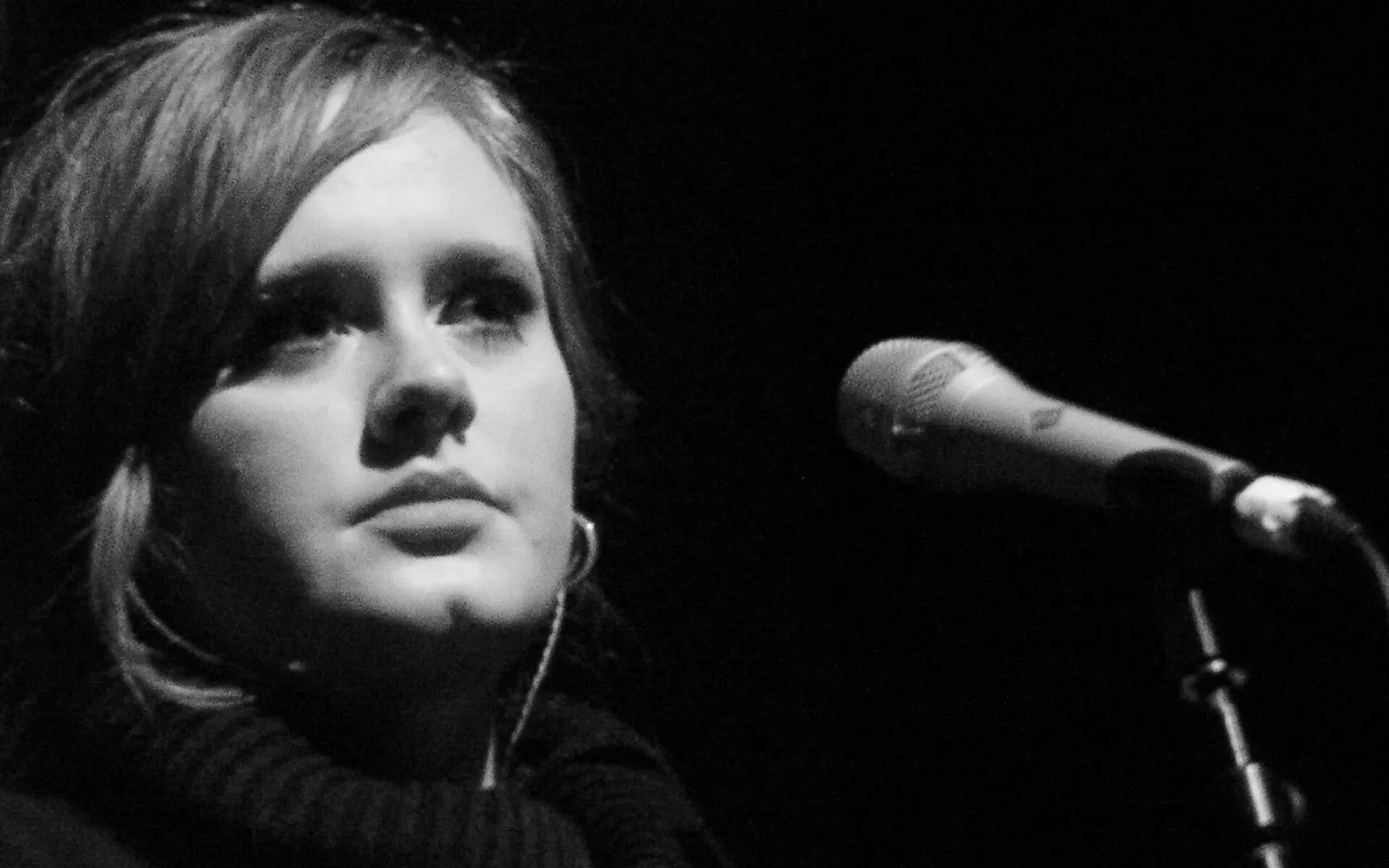
Adele performing in January 2009. Photo by Christopher Macsurak via Wikimedia Commons, licensed CC BY 2.0.
Movement IV — Hello: technology cannot shorten emotional distance
“Hello” begins as a telephone call, but its true subject is the failure of contact. Piano chords create enormous empty spaces around the first verse. Adele sings carefully into them, testing whether apology can cross years that have already hardened into identity.
When the drums and backing vocals arrive, the chorus becomes cinematic without resolving the conversation. The repeated greeting grows less like an opening and more like proof that no answer is coming. Scale measures the distance; it does not close it.
Adele’s lower register carries the verses with grain and caution. The higher notes are spectacular, but they matter because they break out of that guarded speech. “Hello” turns a familiar device—a call to the past—into architecture for absence.
Movement V — To Be Loved: the performance refuses protection
On “To Be Loved,” Adele returns to piano and voice, but the perspective has changed. The song is not about surviving someone else’s departure. It asks what a person must risk, admit and relinquish in order to live without self-betrayal.
The vocal grows progressively less polished. Notes fray under pressure; breath becomes audible; climactic phrases sound close to the edge of sustainable control. Those qualities are not defects to be corrected. They are the record of a singer deciding that emotional accuracy matters more than a sealed surface.
By the final section, the room seems unable to contain the voice, yet the performance remains intensely solitary. Adele reaches maximum volume without converting vulnerability into victory. The song ends with the cost still present.
The route between the five movements
“Hometown Glory” locates the self inside a city. “Rolling in the Deep” sends private anger into a chorus of witnesses. “Someone Like You” keeps grief in the present tense. “Hello” measures years through a failed call. “To Be Loved” removes the final layer of vocal protection.
Across these movements, the production changes radically while Adele’s central method remains stable. She makes emotion spatial. Listeners understand the feeling because they can sense the room around it and the distance it is trying to cross.
Why the ballad is not a conservative form
Piano ballads can appear traditional beside electronic pop’s constant reinvention. Adele uses that familiarity as a testing ground. With few textures available, phrasing, breath and harmonic delay carry structural responsibility that a denser arrangement might distribute across dozens of sounds.
Her best ballads are not timeless because they avoid their era. They are durable because they expose time itself: seconds held before a chorus, years compressed into a greeting, memories repeating after circumstances change.
The danger of monumental feeling
Adele’s scale can occasionally turn every conflict into a landmark. Large choruses, stately tempos and immaculate piano leave little room for triviality, humor or the unfinished mess of ordinary life. When the composition is weaker, grandeur arrives before specificity.
Her strongest work resists that tendency through conversational detail. A familiar street, a rumor, a phone call or a sentence addressed to a child gives the voice something concrete to push against. Monumentality must be earned by the room beneath it.
Final note
Listen in this order and the headline qualities—heartbreak, power, timelessness—become more precise. Adele is a dramatist of distance whose instrument happens to be enormous. She knows when to let that instrument fill the frame and when one careful word can make the frame feel larger.
The room inside her voice is why millions can enter without making the songs impersonal. Every chorus expands, but the original silence remains audible. Editor’s rating: 9.5/10.
Sources: Adele and XL Recordings official release materials; official Adele videos; official Spotify recordings. Cover photo from Adele’s 2016 Glasgow performance by Marc E. via Wikimedia Commons, licensed CC BY 2.0.