A closer look at the scenes and context surrounding Coldplay's music.
Coldplay’s defining trick is not making music enormous. It is keeping a small, uncertain feeling audible after the lights, strings and stadium voices arrive.
The band’s catalog is often divided between intimate early rock and technicolor global pop. That split misses the continuity. From the devotional plainness of “Yellow” to the ten-minute cosmic suite “Coloratura,” Coldplay repeatedly builds scale around emotional hesitation rather than replacing it.
This five-movement route follows how four musicians turn vulnerability into public architecture. It is not a ranking of hits; it is a map of expansion.
Movement I — Yellow: one image becomes a world
“Yellow” begins with guitar chords broad enough to feel inevitable, yet Chris Martin enters almost conversationally. The lyric does not explain why the stars, skin and devotion share one color. Its central image is imprecise, and that imprecision gives listeners somewhere to place their own memory.
Jonny Buckland’s guitar provides the song’s horizon. The riff is saturated but unhurried, allowing Guy Berryman’s bass and Will Champion’s drums to make forward motion feel patient rather than triumphant. The arrangement grows without changing its emotional posture.
Martin’s falsetto is crucial because it prevents the promise from sounding invulnerable. The voice reaches upward and thins at the edge, turning romantic certainty into an act of effort. “Yellow” establishes Coldplay’s first law: grandeur is most persuasive when the person inside it still sounds breakable.
Movement II — Clocks: anxiety learns to revolve
The piano figure in “Clocks” does not travel toward resolution. It circles, bright and urgent, making time feel like a room whose exits keep moving. Against that pattern, the band layers drums, guitar atmosphere and vocal phrases that arrive less as narrative than as fragments caught in motion.
Champion’s drumming gives the loop a body. Cymbals widen the frame while the kick keeps returning the song to earth. The performance builds pressure without the conventional relief of a sharply separated chorus, so momentum becomes the hook.
Coldplay discovered here that repetition could create scale more effectively than sheer volume. A stadium can sing a melody, but it can also inhabit a pattern. “Clocks” makes collective listening feel like thousands of people agreeing to remain inside the same unresolved thought.
Movement III — Viva La Vida: the crowd sings as a fallen king
“Viva La Vida” removes the band’s familiar guitar center and replaces it with strings, bells and a marching pulse. The lyric gives the audience a role: a ruler remembering vanished power. Millions of people sing in the first person, but the “I” belongs to a defeated character.
That displacement is the song’s great design. The chorus feels victorious while the narrative describes loss, judgment and historical reversal. Brian Eno’s production lets orchestral color accumulate in layers, yet the arrangement remains rhythmically clean enough for every entrance to feel communal.
Coldplay’s optimism is often treated as simple affirmation. “Viva La Vida” shows the darker mechanism underneath it. Uplift emerges from the distance between sound and story: the body rises while the character falls.

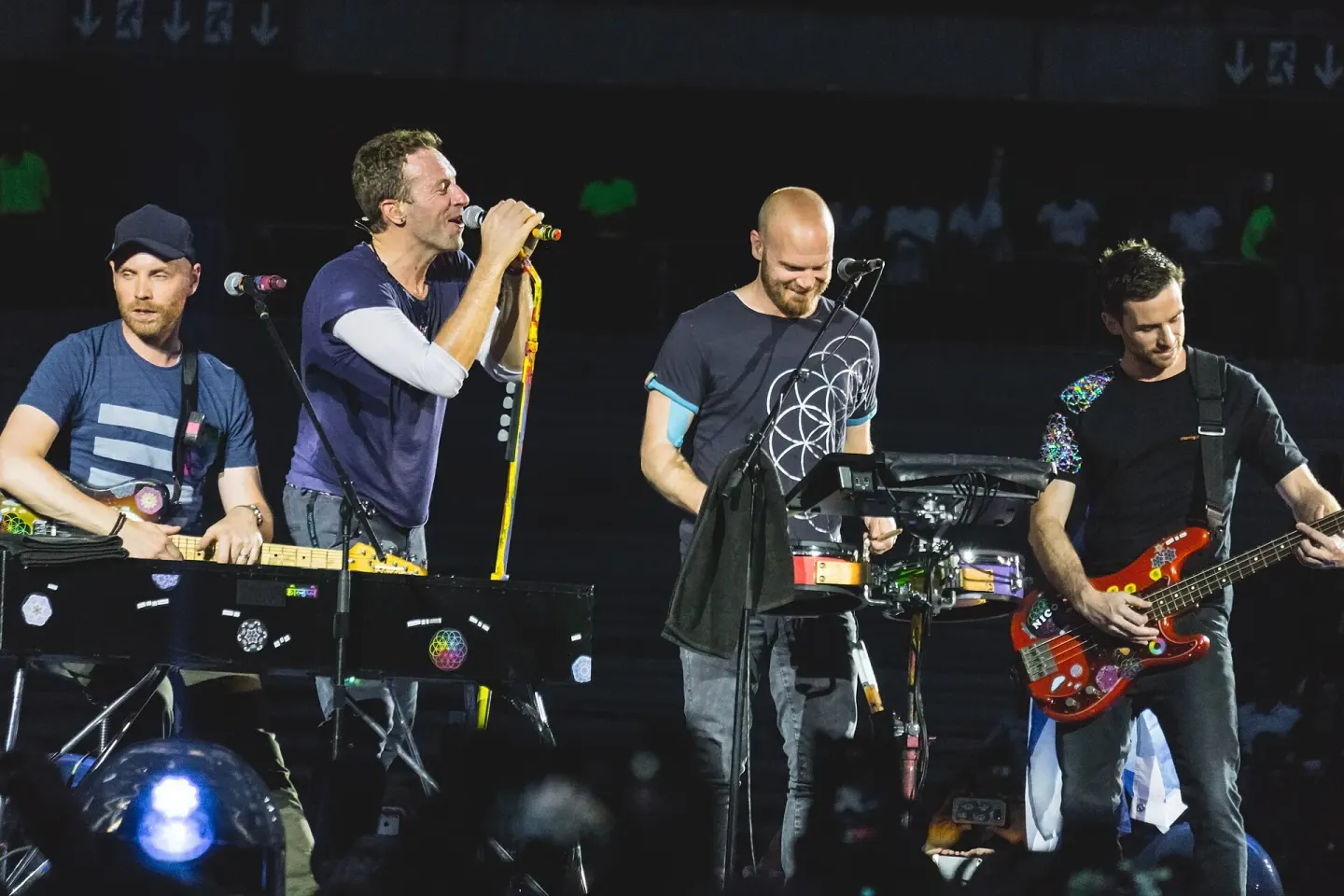
Coldplay performing at the Global Citizen Festival in Hamburg in 2017. Photo by Frank Schwichtenberg via Wikimedia Commons, licensed CC BY-SA 4.0.
Movement IV — Midnight: the band dissolves its own outline
After years of learning how to fill public space, “Midnight” turns inward until the musicians nearly disappear. Martin’s voice is processed into a translucent digital choir, surrounded by a low electronic pulse and textures that arrive like distant signals.
The song withholds the conventional Coldplay release. There is no immediate guitar lift, no chorus designed for instant mass recognition. Instead, harmony accumulates gradually while the altered vocal asks for light in darkness. Technology makes the plea less personal and more ghostly.
This experiment matters because it proves the band’s emotional grammar can survive without its usual surfaces. Fragility remains the center, but the fragile body is no longer clearly human. “Midnight” expands Coldplay by subtraction.
Movement V — Coloratura: wonder earns ten minutes
“Coloratura” gathers the band’s full vocabulary into a long-form cosmic journey: piano ballad, ambient drift, progressive-rock transition, guitar solo and communal refrain. Space imagery could have become decorative scale. Instead, the song treats the universe as a measure of how difficult and miraculous connection feels.
The arrangement is patient enough to let silence separate its sections. Buckland’s guitar moves from texture to articulate soloing; Champion shifts from restraint to propulsion; Berryman anchors changes that might otherwise float apart. The band, not the concept, holds the suite together.
When the central refrain returns, its simplicity has been changed by distance. Coldplay’s maximalism works because the journey preserves an ordinary desire inside extraordinary scenery. The stars do not make the feeling profound. The feeling makes the stars usable.
The route between the five movements
“Yellow” turns one ambiguous color into devotion. “Clocks” finds collective motion inside anxiety. “Viva La Vida” gives a crowd the voice of defeat. “Midnight” removes the visible band while keeping its plea intact. “Coloratura” rebuilds everything at cosmic scale.
Across the route, Coldplay keeps asking the same production question: how much can surround an emotion before the emotion disappears? Their strongest songs answer by protecting a vulnerable vocal gesture at the center of every expansion.
Why simplicity draws suspicion
Coldplay’s direct melodies and universal language can sound engineered for maximum agreement. At weaker moments, the band mistakes accessibility for inevitability, relying on repeated affirmations, wordless hooks or visual spectacle before a song has earned them.
But simplicity is not automatically emptiness. Writing a phrase that remains open to millions of listeners while retaining a specific emotional pressure is a difficult craft. The best Coldplay songs do not tell the audience exactly what to feel. They build a structure sturdy enough for many feelings to enter at once.
The band inside the spectacle
Stadium production can make Coldplay appear to be Chris Martin surrounded by light. The recordings tell a more collective story. Buckland’s patience, Berryman’s melodic restraint and Champion’s architectural drumming determine how the songs expand without losing balance.
Their musicianship is rarely about drawing attention to individual technique. It is about load-bearing decisions: when a guitar should remain a haze, when bass should move against the vocal, when drums should delay the expected impact. The spectacle rests on those invisible choices.
Final note
Listen in this order and the familiar division between “old” and “new” Coldplay begins to collapse. Acoustic intimacy, piano rock, orchestral pop, electronic minimalism and progressive scale become different solutions to one enduring problem.
Coldplay fills stadiums because it understands that collective emotion does not begin at stadium size. It begins with a voice reaching for a note, a piano phrase unable to stop circling, or one image whose meaning remains unresolved. The lights arrive later. Editor’s rating: 9.3/10.
Sources: Coldplay’s official albums, singles and song catalog; official Coldplay videos; official Spotify recordings. Cover photo from Coldplay’s 2017 Paris concert by Raph_PH via Wikimedia Commons, licensed CC BY 2.0.