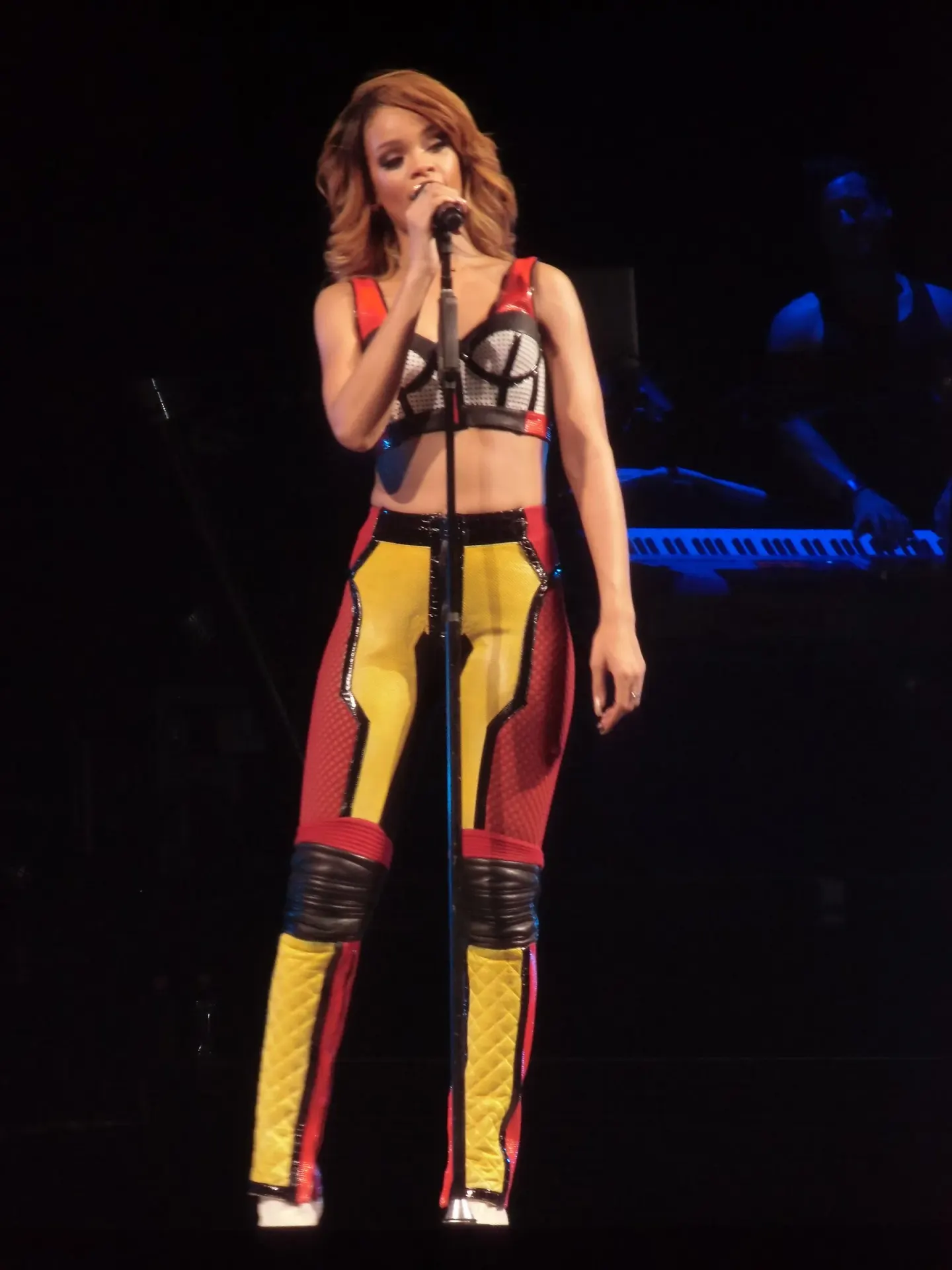
A closer look at the scenes and context surrounding Rihanna's music.
Rihanna’s greatest instrument is not range, volume or even tone. It is refusal: the ability to leave a feeling unexplained until attitude becomes its own form of evidence.
Across a catalog that moves from Caribbean club records to EDM, trap, rock and bruised soul, Rihanna rarely sounds eager to prove that she belongs inside a genre. She enters, identifies the smallest gesture that can carry the song, and makes everyone else adjust around it.
This five-movement listening guide is not a ranking of her biggest hits. It follows one creative principle through changing scale: the less Rihanna overstates, the more authority the performance gathers.
Movement I — Pon de Replay: rhythm before biography
Rihanna’s 2005 debut single begins with a request to the DJ, not an introduction to a star. The phrase “pon de replay” places Barbadian speech inside an international dance-pop frame while the production circles a lean, repetitive groove. The song offers no elaborate origin story. It teaches the room how to move.
Her vocal is youthful but already economical. Rather than overpowering the beat, she keeps phrases clipped and slightly cool, treating melody as another percussion layer. That restraint prevents the song from turning into an audition. She is not asking whether the club accepts her; she is issuing operating instructions.
The track’s minimalism also predicts a career-long instinct. Rihanna understands that pop identity can be established by placement: where a syllable lands, how long a vowel stays open, how little emotional explanation surrounds a command. Presence arrives before confession.
Movement II — Umbrella: allegiance without sentimentality
Two years later, “Umbrella” enlarges that authority into a universal promise. The opening drum pattern lands with industrial force, but Rihanna answers it calmly. She does not sing loyalty as desperation. The repeated “ella” hook turns reassurance into architecture—simple enough for a stadium, strange enough to remain unmistakable.
What makes the chorus durable is its emotional temperature. The lyric offers shelter through catastrophe, yet Rihanna’s delivery avoids pleading warmth. Her steadiness is the comfort. She sounds as if the agreement has already been made and weather cannot renegotiate it.
The bridge finally opens into fuller vocal pressure, but the release works because the verses withheld it. “Umbrella” demonstrates Rihanna’s talent for allowing production to carry spectacle while her voice supplies the fixed point inside it.
Movement III — We Found Love: euphoria with an empty center
Calvin Harris’s production gives “We Found Love” one of the era’s defining electronic crescendos. Rihanna’s contribution is to refuse the obvious emotional reading. She repeats a short sentence about finding love in a hopeless place with a flatness that can register as triumph, disbelief or memory.
When the synths explode, the vocal does not compete. It becomes a small human signal inside a huge engineered weather system. That scale difference creates the song’s melancholy. The drop promises transcendence, but the words keep returning to the conditions that made escape necessary.
The official video sharpens the contradiction through images of intoxication, tenderness and destructive repetition. Yet the recording already contains that story. Rihanna’s underplayed line lets the listener decide whether the lovers found salvation or simply discovered a brighter way to disappear.
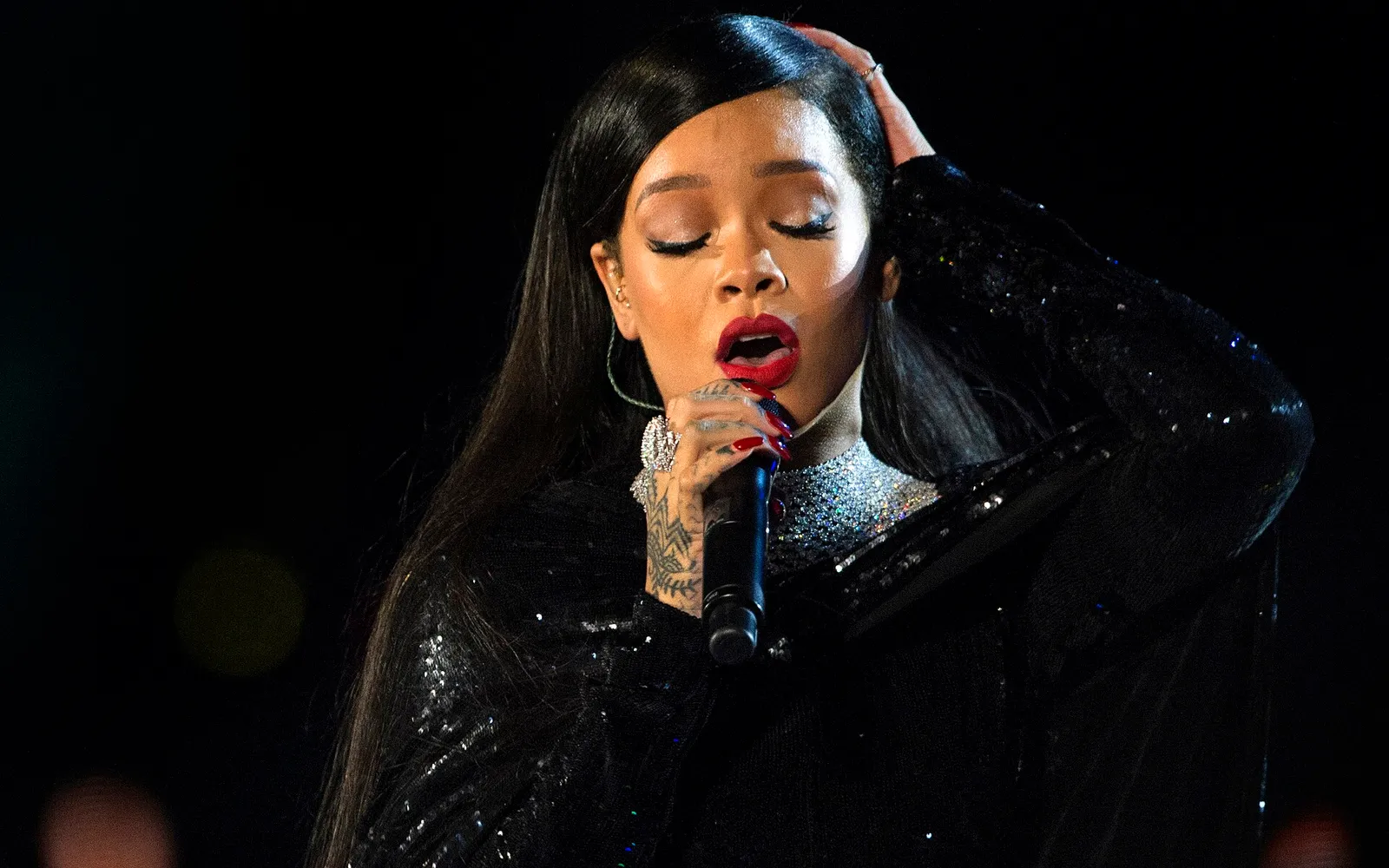
Rihanna performing at the Concert for Valor in Washington, D.C., in 2014. Photo by DoD News via Wikimedia Commons, licensed CC BY 2.0.
Movement IV — Work: language becomes the beat
On ANTI, Rihanna stopped treating global legibility as the highest goal. “Work” places Jamaican patois and Barbadian inflection at the center of an American number-one single, allowing pronunciation to carry rhythm that standardized pop English would flatten.
The hook is deliberately worn down. Repetition erodes the word until labor, desire and frustration blur together. Rihanna slides between consonants, compresses phrases and lets vowels drag behind the beat. Listeners who demanded a clean transcript missed the performance’s central fact: meaning is traveling through sound before it reaches syntax.
Drake’s verse is smoother and more explanatory, which makes Rihanna’s return feel even more decisive. She does not resolve the relationship. She restores its pulse. “Work” is a masterclass in how accent can function as authorship rather than decoration.
Movement V — Love on the Brain: control breaks open
After four movements built on cool economy, “Love on the Brain” reveals what Rihanna’s restraint has been protecting. The song draws on doo-wop and soul without presenting a museum-perfect vocal. Her tone scratches, bends and occasionally seems to push past its safe edge.
That roughness is expressive because it is specific. Rihanna can move from a narrowed, almost private line into a cry whose grain remains intact. She does not smooth pain into virtuosity. The voice sounds expensive and damaged at once, matching a lyric that understands love as both appetite and injury.
Live performances made the song a corrective to anyone who mistook economy for inability. Yet the lesson is not simply that Rihanna can belt. It is that she chooses when force will matter. Power arrives after a catalog has taught us to listen for the smallest change in pressure.
The route between the five movements
“Pon de Replay” makes the voice part of the rhythm. “Umbrella” turns steadiness into emotional shelter. “We Found Love” places a restrained human line inside electronic excess. “Work” lets language disrupt pop’s demand for instant translation. “Love on the Brain” finally exposes the abrasion underneath the control.
Taken together, these songs explain why Rihanna can move across producers and genres without disappearing inside them. Her signature is not a fixed sound. It is a decision-making style: identify the song’s pressure point, remove whatever explains too much, and occupy the remaining space completely.
What the hits can hide
Rihanna’s extraordinary run of singles sometimes encouraged the idea that she was primarily a perfect selector of other people’s material. Selection is indeed part of her artistry. But that description becomes inadequate when different writers, producers and eras repeatedly converge on the same vocal logic.
Interpretation is authorship. The distance in “We Found Love,” the phonetic compression of “Work” and the cracked force of “Love on the Brain” are not interchangeable surfaces. They are structural choices that determine what each composition means.
A catalog built around negative space
Many pop singers create intimacy by giving the audience more—more runs, more autobiography, more visible effort. Rihanna often creates it through negative space. Her pauses, flattened phrases and sudden flashes of grain allow listeners to project themselves without reducing the performance to neutrality.
This is why her coolness never feels empty. It is active withholding. The unsaid portion of the emotion creates tension around the words that remain, and the production becomes larger because the vocal refuses to fill every surface.
Final note
To hear Rihanna only as a sequence of eras is to miss the continuity inside them. Dancehall, stadium pop, EDM, trap and soul become different rooms for the same intelligence: a singer who knows that command does not require constant demonstration.
Start with the order above and listen for what she declines to explain. Rihanna’s voice gains power not by occupying every available inch, but by making absence feel designed. Editor’s rating: 9.6/10.
Sources: Rihanna’s official site and video catalog; Def Jam official release information; official Spotify recordings. Cover photo from the Diamonds World Tour in Cologne by Ilikeriri via Wikimedia Commons, dedicated CC0.