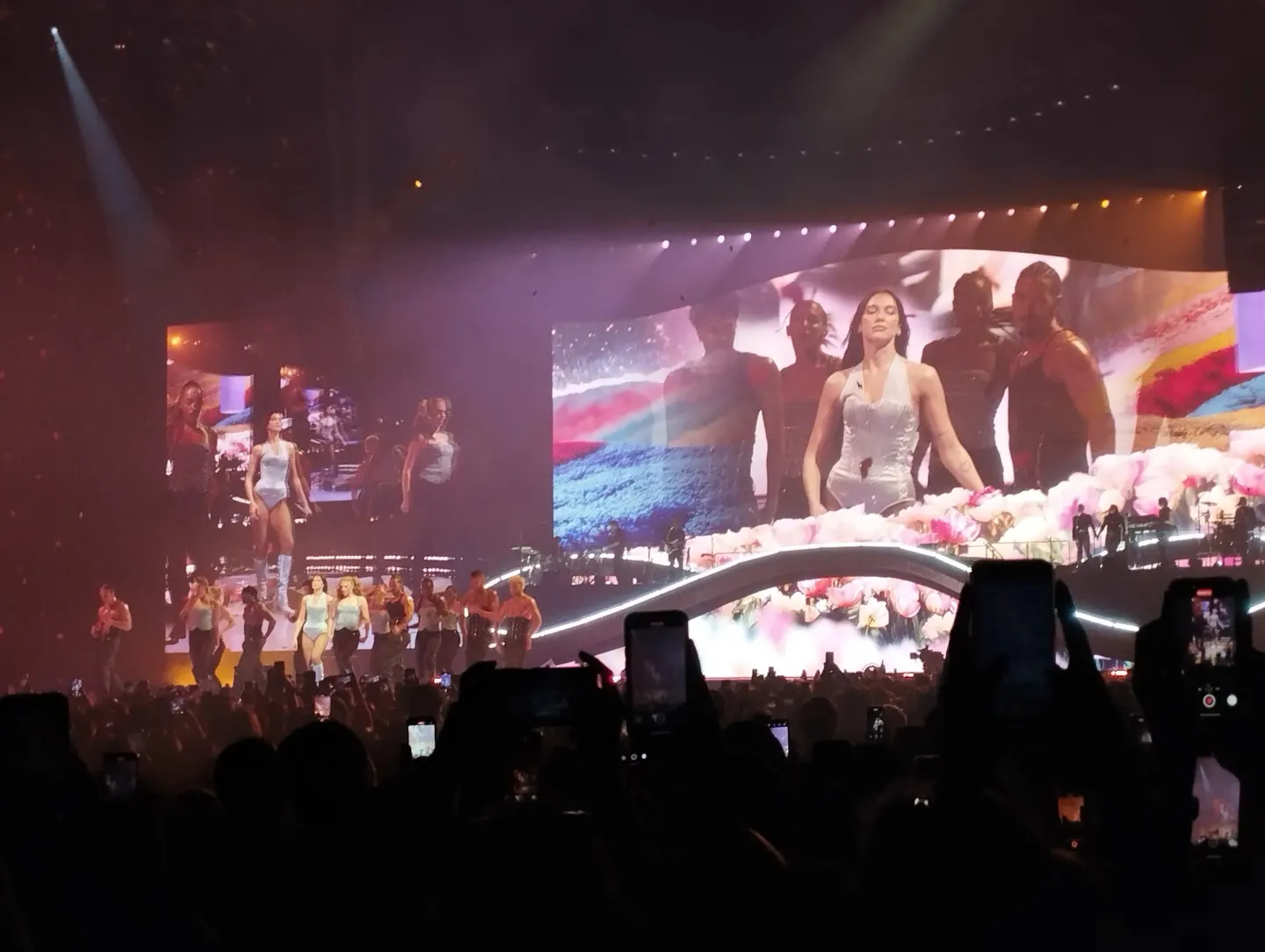
A closer look at the scenes and context surrounding Dua Lipa's music.
Dua Lipa has turned the completed Radical Optimism tour into a new live document. Dua Lipa: Live From Mexico, released in May 2026 alongside an official tour film, captures a show that treats pop precision as a flexible system: hits are extended, transitions are rewritten, and one local cover can change the identity of a city’s night.
The release arrives after the tour’s Latin American finale and contains the architecture of the full production rather than a short souvenir set. Streaming editions list performances from Radical Optimism, Future Nostalgia and her debut era, along with interludes, medleys and the Mexico-specific performance of Maná’s “Oye Mi Amor” with Fher Olvera.
Its news value is larger than the arrival of another live album. Dua Lipa’s catalog is often praised for studio control: bass lines are exact, hooks arrive on schedule, and disco references are polished until no seam shows. Live From Mexico demonstrates what happens when that control must breathe in front of an audience.
What Was Released
The live album appeared on May 22, 2026. Major streaming listings present a 42-track expanded edition, while other configurations contain 21 core performances. The official video campaign includes individual Mexico performances of “Training Season,” “Levitating,” “These Walls” and “Houdini,” making the staging available as both an album and a visual record.
The project documents the Radical Optimism tour after its global run rather than announcing a new tour. Dua Lipa’s official concert page currently shows no new public dates. That distinction matters: the release closes and analyzes an era instead of pretending it is still unfolding.
According to label material, the tour used a different locally selected cover in each city. The Mexico performance preserves one of the clearest examples. Fher Olvera joins Lipa for “Oye Mi Amor,” allowing the tour’s global pop machine to make room for a song the local crowd already owns.
“Training Season” Becomes an Entrance
The studio version of “Training Season” begins with rhythmic confidence and a lyric that refuses emotional incompetence. Live, it must do additional work: introduce the performer, the band, the scale and the audience’s role in one movement.
The Mexico performance expands the song’s physical authority. Drums and bass land with more air around them, backing voices thicken the demand, and the crowd turns the chorus from private standard into public contract. The production does not abandon polish. It exposes the labor that makes polish move.
Dua Lipa’s vocal approach is central. She rarely treats a live arrangement as an excuse for unstructured belting. Phrases remain rhythmic, consonants drive the groove, and larger notes are saved for structural turns. The discipline lets choreography, band and audience share the frame.
The Band Makes the Grid Elastic
Modern dance-pop can arrive onstage trapped by its own perfection. If every electronic layer is reproduced exactly, the show becomes a louder playback. If the arrangement discards the record entirely, the hook can lose the geometry that made it satisfying.
Live From Mexico works between those risks. Bass and drums preserve the grid while fills, outros and transitions stretch it. Guitar adds attack without converting the music into rock. Backing vocals widen choruses and free the lead vocal to interact with the room.
“Levitating” demonstrates the method. Its bass-led bounce remains instantly recognizable, but the live ending extends communal momentum past the point where the studio single would close. Repetition becomes a way of measuring audience energy rather than merely repeating a mastered file.
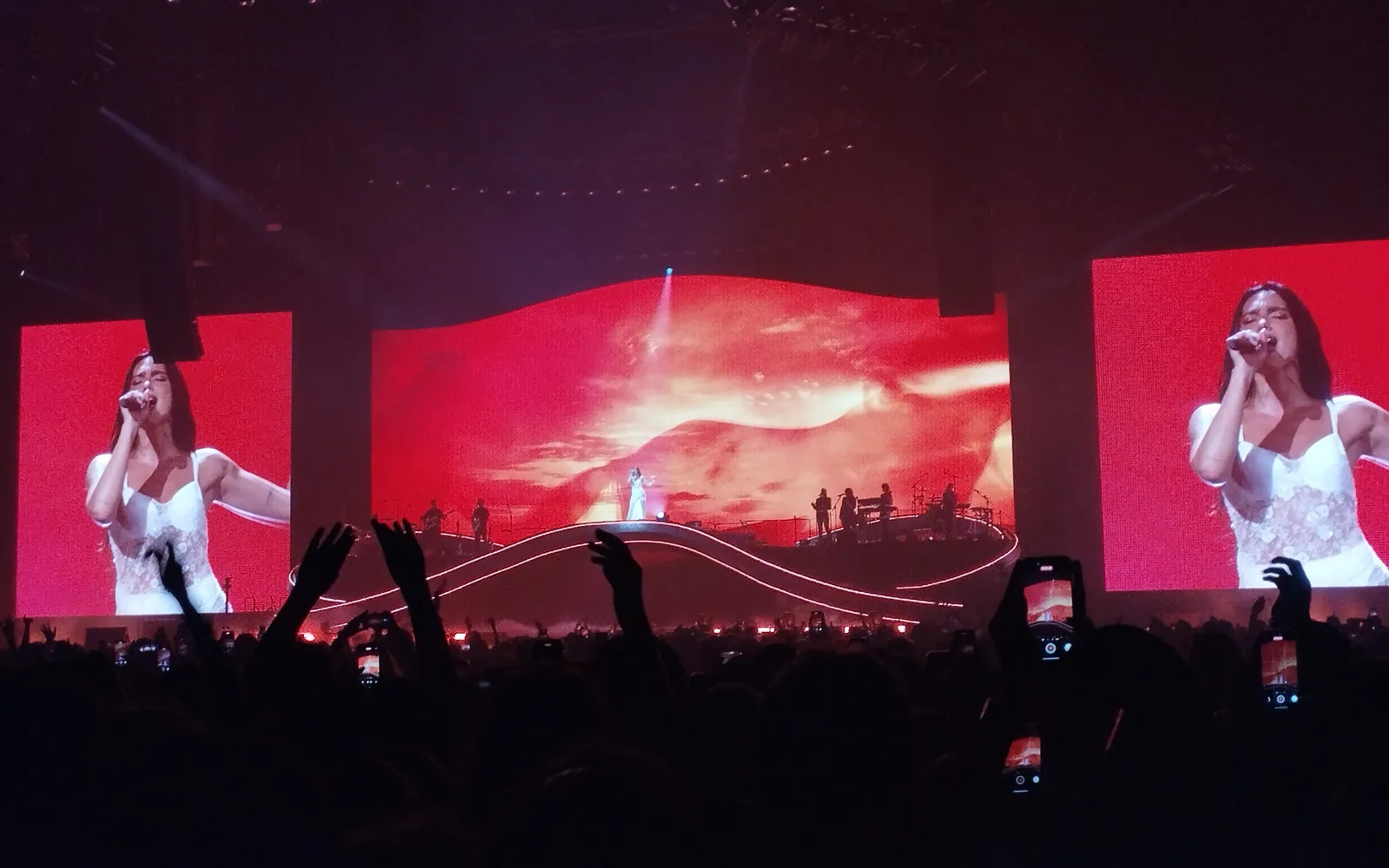
Photo: Dua Lipa performing the Radical Optimism tour at Paris La Défense Arena, May 24, 2025. ManoSolo13241324 / CC0, via Wikimedia Commons. Cropped for presentation.
“These Walls” Finds the Room Inside the Arena
“These Walls” is one of Radical Optimism’s more emotionally direct songs. Its central image turns a room into a witness to a relationship’s end. In an arena, that intimacy could disappear. The live arrangement instead uses scale to clarify it.
The performance begins by trusting the song’s conversational tension. Instrumental space leaves the vocal exposed before the chorus broadens. The audience supplies the paradox: thousands of people sing a lyric about a private room, making isolation communal without removing its specificity.
The Mexico sequence then moves toward “Oye Mi Amor.” The transition shows why the city-cover idea matters. A tour can personalize a night with a spoken greeting; learning and arranging a locally significant song requires deeper musical attention.
Local Covers as Tour Journalism
Across the tour, Dua Lipa selected a different cover for each city. The device could have become a novelty checklist. At its best, it functions like tour journalism: the show reports where it is by entering a song connected to that place.
In Mexico, “Oye Mi Amor” changes the balance of authority. Dua Lipa is the headliner, but Fher Olvera and the audience carry cultural memory the touring production cannot manufacture. Her task is not to dominate the song. It is to meet it with preparation and let recognition move through the stadium.
This practice also resists a common weakness of global touring, where the same production lands in every market with only the city name changed. The main set remains carefully standardized, but the cover creates one section that cannot be fully understood without location.
“Houdini” and the Art of the Final Release
“Houdini” is built around disappearance, attraction and the pleasure of refusing to be held. Its sleek studio groove made it the clearest bridge between Future Nostalgia and Radical Optimism. Live, it becomes a statement about exit.
The Mexico performance lets the rhythm accumulate before the final release. Lighting, choreography and band accents converge without competing for the climax. What looks effortless is coordination made visible: dancers hit the same rhythmic argument the bass has been making all night.
As a closing-era document, the song is appropriately unresolved. A live album preserves the tour, but preservation is not permanence. The performer exits; the audience noise remains captured around the song; the era becomes material that can be revisited without being restarted.
Why a Second Live Album Matters
Dua Lipa’s 2024 Royal Albert Hall project translated her catalog through orchestra, choir and formal concert staging. Live From Mexico answers with the opposite environment: a large pop tour built for movement, screens, dancers and mass participation.
Together, the releases make an argument about repertoire. These songs are not fixed to one production file. “Don’t Start Now” can live inside orchestral drama or a stadium groove. “Levitating” can remain exact while its ending expands. Radical Optimism songs gain strength when the band reveals their rhythmic skeletons.
The comparison also tracks Dua Lipa’s development as a live performer. Early criticism often treated choreography and voice as competing demands. The Mexico film shows an artist who organizes breath, movement and phrasing as one system. Improvement is not presented as a redemption story; it is audible craft.
Five Performances to Start With
“Training Season” — a studio demand enlarged into an opening-night contract
“Levitating” — the pop grid made elastic through a live ending
“These Walls” — private breakup detail surviving arena scale
“Oye Mi Amor” with Fher Olvera — local memory changing who owns the stage
“Houdini” — choreography, band and lighting converging on the exit
The Era After the Encore
Live From Mexico does not radically rewrite Dua Lipa’s catalog. Its achievement is more useful: it shows how carefully constructed pop can remain responsive. A city-specific song enters the machine; an outro grows; an audience takes over a chorus; the grid bends without breaking.
That makes the album a strong ending for Radical Optimism. The tour’s optimism was never the belief that uncertainty disappears. It was the discipline of moving through it. On the live record, movement is no longer a metaphor. It is the sound of musicians, dancers and a stadium making exact pop breathe together.
Cover image: Dua Lipa performing the Radical Optimism tour at Paris La Défense Arena, May 24, 2025. ManoSolo13241324 / CC0, via Wikimedia Commons. Cropped for presentation.