A closer look at the scenes and context surrounding Taylor Swift's music.
Taylor Swift’s new Toy Story 5 song is a country return disguised as a character assignment. “I Knew It, I Knew You” sends her back to acoustic detail, narrative compression and the kind of goodbye that becomes clearer only after the person—or toy—has gone.
Disney announced the original song on June 1, 2026, following a series of “TS” billboards that played on the shared initials of Taylor Swift and Toy Story. Written and produced by Swift and Jack Antonoff, the track arrived on June 5 before joining the film’s soundtrack on June 19. Disney describes it as inspired by Jessie’s continuing story and as a return to Swift’s country roots.
The release has moved like a major Swift single rather than a soundtrack footnote. It debuted at No. 1 on the Billboard Hot 100 and remains at No. 2 on the chart dated July 11, its fourth week. Billboard’s country update also shows it crossing formats, with a Pixar/Walt Disney/Republic/MCA Nashville credit and rapid country-radio growth.
What matters beyond the numbers is the fit. Swift has spent two decades writing about objects that absorb emotional history: a scarf, a cardigan, a getaway car, an old dress, a keychain on the ground. Toy Story is built on the same proposition. Things remember us, and separation gives those memories weight. Jessie is not simply a branded character for Swift to describe. She is a ready-made Swift narrator.
The News in Brief
Announced: June 1, 2026, by The Walt Disney Company
Released: June 5; added to the Toy Story 5 soundtrack June 19
Written and produced by: Taylor Swift and Jack Antonoff
Character focus: Jessie, whose story began in Toy Story 2
Versions: film/soundtrack recording, acoustic version and piano version
Chart movement: No. 1 debut on the Hot 100; No. 2 in its fourth chart week dated July 11
Why Jessie Fits Swift’s Songbook
Jessie’s defining scene in Toy Story 2 is already a country song in animated form. She remembers being loved, left behind and donated when a child grows older. The wound is not betrayal in the conventional sense. It is the discovery that a relationship can be sincere and still end because time has changed one participant.
Swift has returned to that emotional structure throughout her catalog. Her narrators often understand both sides of a departure and suffer because understanding does not reduce the loss. “I Knew It, I Knew You” places recognition in the title itself. Knowing someone becomes inseparable from knowing the ending they may choose.
The phrase also contains Swift’s favorite dramatic mechanism: repetition with a changed meaning. The first “I knew” can suggest certainty; the second turns certainty toward intimacy. Knowledge moves from fact to person. In a film about toys confronting technology and changing childhood, that distinction matters. A system can know a user. Jessie remembers a child.
Director and screenwriter Andrew Stanton said Swift immediately understood what Jessie was experiencing and that the song felt as if it had always belonged to the story. The compliment is revealing. The track works because Swift does not approach the character from outside. She writes in the emotional grammar that made Jessie resonate in the first place.
A Country Return Without Reenactment
Calling the single a return to country does not mean it reproduces 2006. Swift’s early records used Nashville storytelling, acoustic instruments and diaristic detail while aiming toward pop scale. Her later work absorbed electronic production, indie-folk restraint and stadium architecture. “I Knew It, I Knew You” returns with all of those lessons intact.
The arrangement foregrounds the lyric without pretending production is neutral. Guitar establishes memory, percussion keeps the song moving, and carefully placed lifts make the chorus feel cinematic without severing it from the verse. Swift’s voice is less interested in country accent than narrative proximity. She sounds close enough to the sentence for each repeated word to change pressure.
Antonoff’s involvement adds another layer. Their collaborations are often associated with synth-pop, but the pair’s strength is structural: they understand when a bridge should widen the frame and when an arrangement should step away from a line. Here, the film assignment disciplines that instinct. The song has to serve character and scene before it can advertise its own importance.
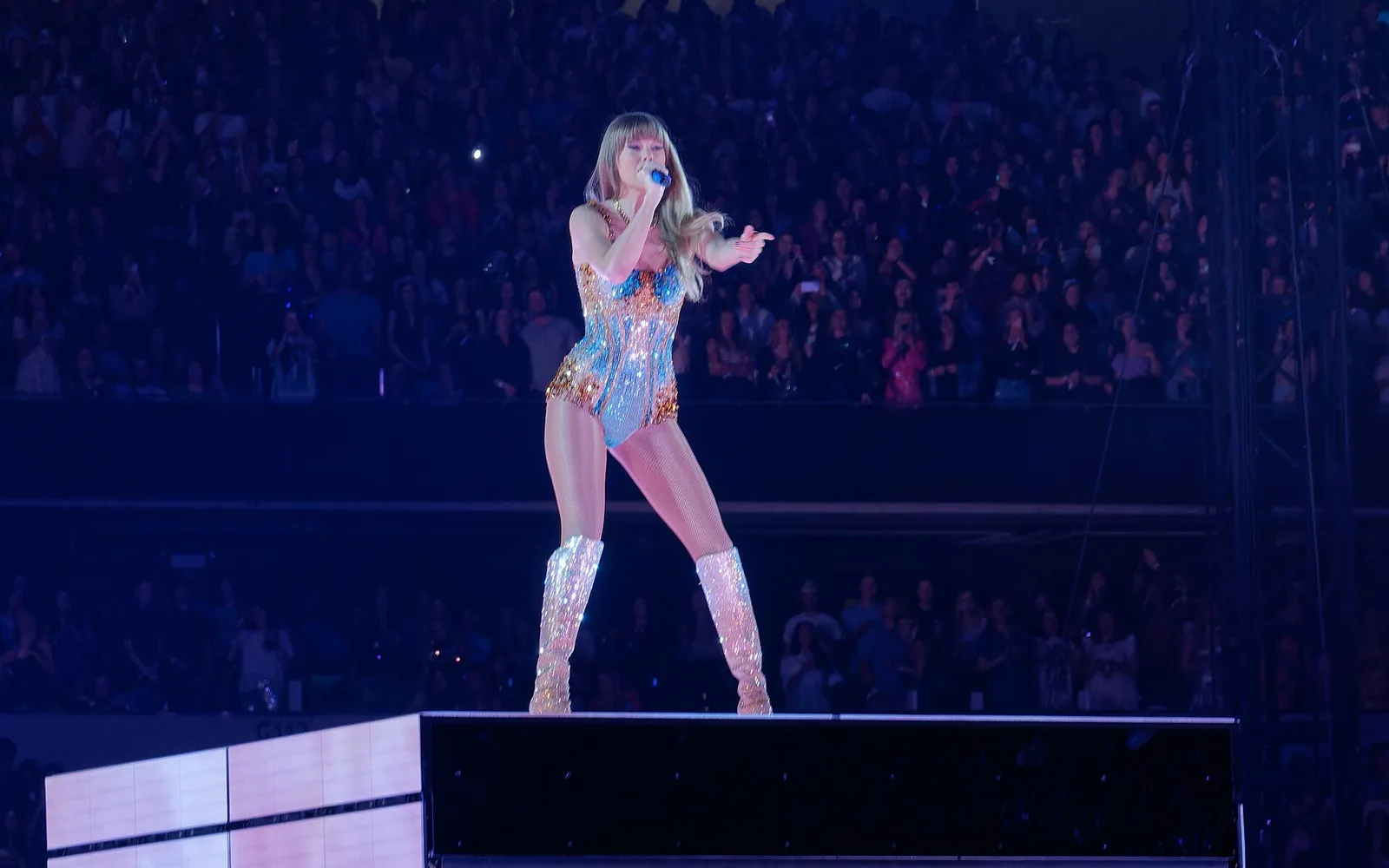
Photo: Taylor Swift performing on the Eras Tour in Arlington, Texas, April 2023. Ronald Woan / CC BY-SA 2.0, via Wikimedia Commons. Cropped for presentation.
The Soundtrack as a Test of Scale
A star of Swift’s scale can overwhelm a film simply by appearing on its soundtrack. The song risks becoming an event attached to Toy Story 5 rather than music inside it. Disney’s campaign openly used that scale: the “TS” billboards turned a corporate soundtrack announcement into a Swift-style clue hunt.
The recording itself takes the opposite approach. It narrows attention to Jessie and lets franchise history carry the spectacle. This tension between enormous rollout and intimate song is familiar in Swift’s career. Her most effective releases turn mass participation into close reading. Millions of listeners examine pronouns, objects and repeated phrases as if the stadium were a diary margin.
The three-version release extends that method. The primary recording belongs to the film’s movement. The acoustic version exposes the country skeleton. The piano version emphasizes farewell. These are not radically different compositions, but they invite listeners to hear arrangement as point of view.
From “Love Story” to a Story About Letting Go
“Love Story” remains the most useful early reference because it shows Swift writing through an existing character. Shakespeare provides the frame; she changes the ending. The song’s country-pop sweep makes adaptation feel like personal memory. Even then, the borrowed story was valuable because it gave her emotions a stage.
“I Knew It, I Knew You” reverses that relationship. This time Swift enters a franchise whose emotional ending is already sacred to its audience. The task is not to rewrite Jessie but to extend her without disturbing what listeners remember. Restraint becomes a form of authorship.
The difference also measures Swift’s development. The teenager behind “Love Story” made a canonical plot submit to romantic certainty. The adult soundtrack writer accepts that love may be genuine without preventing departure. One song opens a balcony door; the other understands why a bedroom was eventually emptied.
The Red Thread Through Red
The 2021 vault track “I Bet You Think About Me” offers another route into the new single. Both songs recover country color without using nostalgia as an excuse. Chris Stapleton’s presence, harmonica and sharp class detail make “I Bet You Think About Me” deliberately unruly. Its narrator survives rejection by making the memory inconvenient for the person who left.
Jessie’s song cannot use that defense. A toy cannot punish a child for growing up. The anger has to be filtered through recognition, which makes the emotional problem quieter and harder. Placing the two songs side by side shows the range inside Swift’s country writing: memory can be weapon, shelter or evidence.
What the Chart Result Means
The No. 1 debut confirms the obvious fact that Swift can turn a soundtrack release into a central pop event. More interesting is the song’s continued position and country-radio movement. It suggests that returning to a genre lineage can function as development rather than retreat.
Swift left Nashville exclusivity long ago, but she never stopped using the songwriterly habits built there: scene, object, turn, consequence. “I Knew It, I Knew You” makes those habits audible again at the surface. Its success is less a homecoming narrative than proof that the home was carried forward.
For Toy Story 5, the song supplies emotional continuity. For Swift’s catalog, it reconnects commercial present to narrative origin. For listeners, it offers a compact reminder that her largest cultural moments still depend on small sentences changing meaning.
Listen Next: The Country Thread
“Tim McGraw” — memory attached to a song before the catalog became one
“Love Story (Taylor’s Version)” — character adaptation turned into personal myth
“All Too Well (10 Minute Version)” — objects, scenes and consequence at maximal scale
“I Bet You Think About Me” — country texture used as comic revenge
“I Knew It, I Knew You” — country craft redirected toward Jessie’s acceptance
Cover image: Taylor Swift performing at SoFi Stadium during the Eras Tour, August 2023. Paolo V / CC BY 2.0, via Wikimedia Commons. Cropped for presentation.