A closer look at the scenes and context surrounding AKMU's music.
AKMU’s most important instrument is not acoustic guitar, piano or Lee Suhyun’s crystalline voice. It is the distance between two siblings: Lee Chanhyuk writes toward that distance, Suhyun sings across it, and the song becomes a conversation neither could make alone.
Pop duos are usually described through blend. AKMU are more interesting because they preserve difference. Chanhyuk’s voice can sound dry, narrow and conversational; Suhyun’s arrives with open resonance and startling clarity. He often begins a phrase as if thinking aloud. She answers by revealing the melody hidden inside it. Their harmonies work, but their contrasts do more.
That contrast has carried AKMU from the homemade wit of K-pop Star 2 to the folk-pop immediacy of Play, the emotional weather of Sailing, the collaboration-driven experiments of Next Episode, the bright economy of “Love Lee,” and the duo’s 2026 album Flowering. Genres change. The dramatic system remains: one voice proposes a world, the other makes us feel its consequence.
I. A Songwriter Who Leaves the Best Space Empty
Chanhyuk’s gift is often summarized as clever lyric writing, and the description is accurate but incomplete. His sharper skill is allocation. He knows which melodic peak should belong to Suhyun, which phrase becomes funnier in his own flattened delivery, and how long an arrangement can wait before the siblings sing together.
That patience separates AKMU from vocal showcases. Suhyun can carry a spectacular line, yet the songs rarely treat her range as an isolated event. Her voice is positioned as narrative light. When it enters above Chanhyuk’s earthier register, a room seems to gain windows. When it withdraws, the absence changes the temperature.
The arrangements protect this architecture. Acoustic instruments establish texture without crowding the middle; bass lines behave like punctuation; percussion often arrives to redirect a scene rather than certify its size. Even when synthesizers become central, as on “Dinosaur,” the production leaves a clear path between speaker and answer.
This is songwriting as negative space. Chanhyuk does not merely compose notes for two singers. He composes the moment before Suhyun enters, the silence after a harmony breaks apart, and the emotional information contained in who gets the final word.
II. “200%”: Character Before Virtuosity
AKMU’s 2014 debut single “200%” introduced that system with disarming lightness. Handclaps, acoustic guitar and a bouncing bass line create the surface of a crush song. Underneath, every vocal exchange establishes character. Chanhyuk’s opening sounds like a private calculation escaping into public. Suhyun answers with a melody too buoyant to contain embarrassment.
The hook works because the siblings do not oversell sweetness. Chanhyuk remains slightly awkward; Suhyun remains precise; the arrangement lets the feeling become larger than either performance. Their familiarity gives the teasing rhythm unusual credibility. They can interrupt each other without manufacturing chemistry.
The video’s youthful misdirection extends the song’s emotional intelligence. Fantasy and observation keep slipping into one another, allowing the final realization to be funny and painful at the same time. AKMU’s early work is full of this double vision: ordinary situations are rendered with cartoon clarity, then a small detail reveals how vulnerable the narrator has been.
Play made that approach feel like a complete language. “Give Love” turns a common phrase into rhythmic material. “Melted” takes a pun about ice and adults and develops it into social sorrow. The songs are accessible because their metaphors can be understood immediately; they endure because the metaphors keep opening after the hook is over.
III. The Sibling Voice as Dramatic Casting
AKMU’s division of labor could have hardened into a formula: brother writes, sister supplies the beautiful voice. Their catalog resists that hierarchy by making interpretation inseparable from composition. Suhyun does not simply decorate Chanhyuk’s songs. Her tone changes what the writing means.
Consider the difference between a line written on paper and the same line sung by Suhyun. Her clarity can make innocence feel almost severe. She does not need exaggerated breathiness to suggest fragility; a centered note against a sparse arrangement can feel more exposed than a whisper. Chanhyuk writes with that quality in mind, often giving her melodies that rise cleanly and then leave emotional ambiguity underneath.
His own voice performs another function. Its grain and speech-like phrasing keep the songs from floating away. He can sound like narrator, comic foil, witness or reluctant participant. When the two voices meet, the pleasure is not perfect similarity. It is the sense that two people have reached the same sentence by different routes.
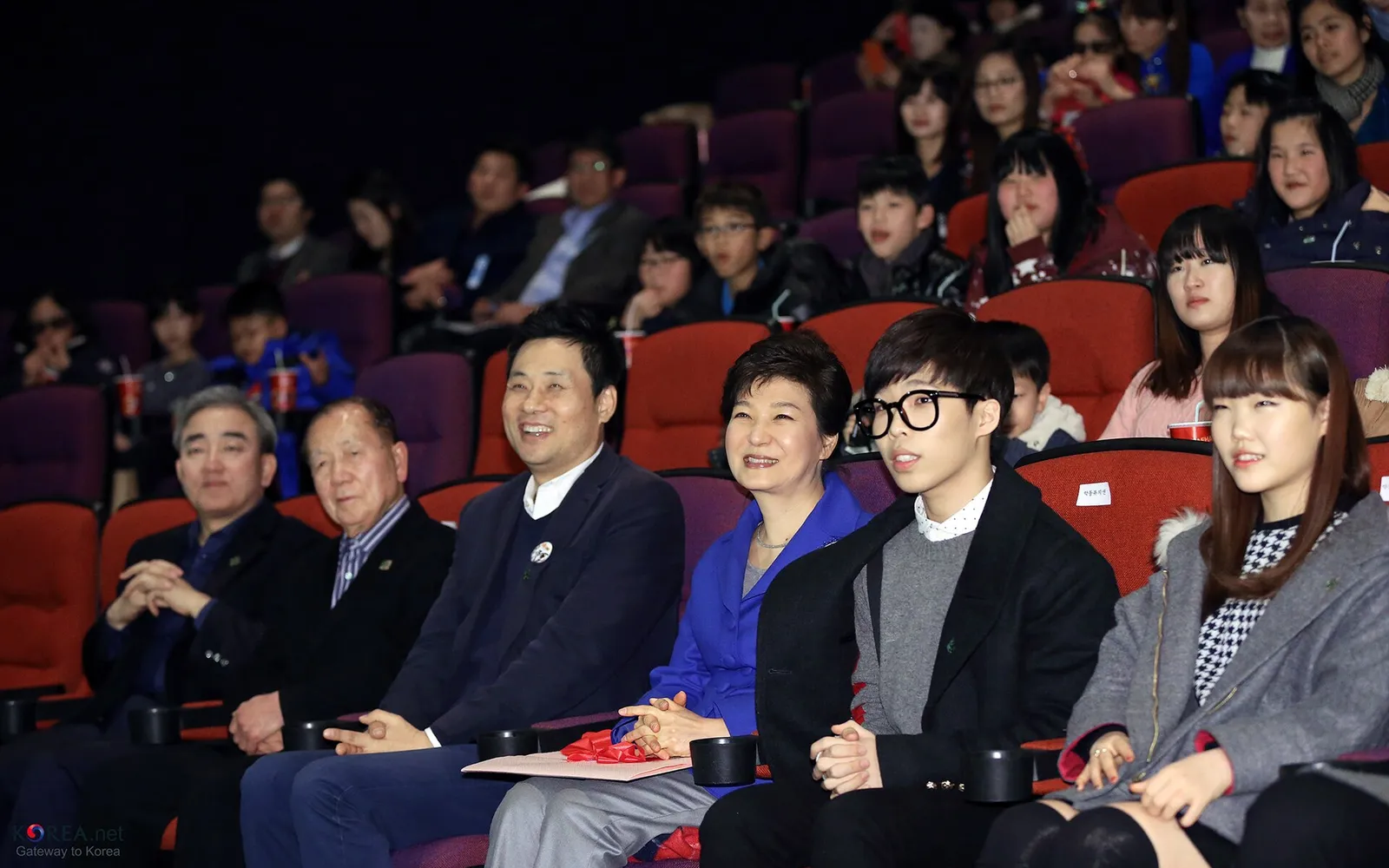
Photo: AKMU appearing at a Culture Day event in Seoul, January 2014. Jeon Han / Korea.net / CC BY-SA 2.0, via Wikimedia Commons. Cropped for presentation.
IV. “Dinosaur”: Fear Learns to Move
“Dinosaur” was an important expansion because it placed AKMU’s storytelling inside electronic scale. The track builds from muted guitar and memory into a synth-driven chorus large enough to resemble the childhood fear in its title. Yet the drop never erases the singers. Suhyun’s high line cuts through the electronic mass like someone naming a nightmare while still inside it.
The song draws on the siblings’ childhood memories of financial difficulty and fear, but it avoids explanatory realism. A dinosaur is more useful than a ledger. It gives anxiety a body, lets the chorus become a chase, and preserves the perspective of a child who understands danger before understanding its cause.
Chanhyuk’s verses keep the memory close to speech. Suhyun transforms it into atmosphere. This movement from detail to scale is the duo’s craft in miniature: the songwriter establishes the object, the singer reveals its emotional size, and production builds a world around the exchange.
The success of “Dinosaur” also demonstrated that AKMU’s identity did not depend on acoustic instrumentation. Remove the guitar, increase the low end, open the chorus into festival-sized electronics—the core remains audible because it lives in narrative casting rather than genre.
V. Sailing and the Courage to Slow Down
After Chanhyuk’s military service, 2019’s Sailing returned with a different sense of time. The youthful quickness of Play had not disappeared, but the album allowed images to drift and consequences to arrive slowly. Water became both setting and method: songs moved through separation, freedom and memory without forcing a single emotional destination.
“How can I love the heartbreak, you’re the one I love” is the album’s still center. Its title contains the entire argument. Heartbreak is not elevated into something worthy of love; the person remains beloved even when the separation cannot be. That grammatical distinction saves the song from romanticizing pain.
The arrangement proceeds with extraordinary restraint. Piano marks the emotional floor. Strings enter as pressure rather than decoration. Chanhyuk begins from the lower edge of the melody, his voice sounding almost resigned to the sentence. Suhyun does not arrive to overpower him. She extends the line until restraint itself becomes unbearable.
Their shared history matters here, but not because the song is literally about siblinghood. It matters because trust shapes the performance. Chanhyuk can write a climax that depends on Suhyun refusing melodrama. Suhyun can sing a devastating line without guarding it from the songwriter. The duo’s intimacy functions as an editing system: each knows when the other is doing too much.
VI. Collaboration Without Losing the Conversation
Next Episode tested whether that system could admit more voices. YG’s official discography describes the 2021 release as AKMU’s first collaboration album, pairing the duo with artists including Lee Sun Hee, IU, Zion.T, Beenzino, Choi Jung Hoon, Crush and Sam Kim. The guest list is imposing, but the project works when collaborators enter an existing dramatic structure rather than replacing it.
On “NAKKA,” IU’s cool tone becomes a third plane between Chanhyuk and Suhyun. The song imagines solidarity at the edge of a fall, while its retro pulse converts danger into motion. “Stupid Love Song” uses Crush’s softness to blur who is consoling whom. The feature credits are not ornaments; they recast the conversation.
This is another consequence of AKMU’s strong internal grammar. Because the roles are clear, a guest can disturb them productively. A new timbre changes the geometry. The duo remain recognizable not by defending a fixed sound but by arranging relationships between voices.
VII. The Bright Song Is Not the Simple Song
“Love Lee” returned AKMU to compact, cheerful pop in 2023. Its title is a pun on “lovely” and the siblings’ surname, a small device typical of Chanhyuk’s writing. The track’s relaxed beat, clipped guitar and instantly repeatable chorus can seem deliberately lightweight after Sailing and Next Episode.
Lightweight is not the same as careless. The melody is designed around the exact contrast that has always powered the duo. Chanhyuk provides eccentric texture; Suhyun makes the hook glide; repeated syllables turn family identity into pop rhythm. The song understands that delight is also a craft problem.
The 2026 album Flowering gives that long arc a useful new frame. Its title suggests growth without pretending growth is linear. Across AKMU’s career, maturity has not meant abandoning humor, and experimentation has not required rejecting melody. The duo can return to brightness because brightness was never their cage. It was one color in a system built to carry many.
VIII. What AKMU Teach About Pop Partnership
Many idol groups achieve character through multiplication: several voices, roles and visual identities combine into a larger whole. AKMU work in the opposite direction. With only two people, every difference is exposed. There is nowhere for a weak transition, false emotion or unnecessary note to hide.
The sibling relationship supplies familiarity, but familiarity alone does not create good music. AKMU’s achievement is turning it into method. Chanhyuk writes with an unusually precise understanding of Suhyun’s instrument. Suhyun interprets with enough independence to keep the songs from becoming demonstrations of his intent. Each performance is both collaboration and critique.
That is why their music can move between folk, jazz, balladry, electronic pop and retro collaboration without losing its center. The center is not a genre. It is the act of listening from one sibling to the other.
In AKMU’s best songs, the first voice never completes the thought. It leaves a door open. The second voice walks through, and the space between them becomes the part we remember.
A Five-Song Route Through the Craft
“200%” — character, comedy and crush-song momentum in perfect allocation
“Melted” — wordplay widened into social observation
“Dinosaur” — childhood fear translated into electronic scale
“How can I love the heartbreak, you’re the one I love” — restraint as emotional climax
“NAKKA” featuring IU — a third voice productively changing the duo’s geometry
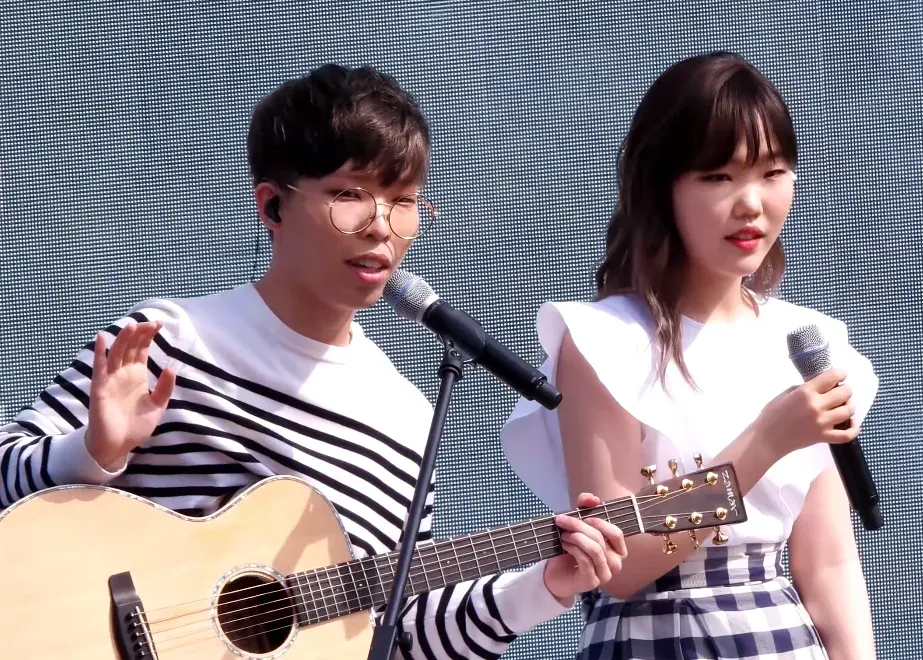
Cover image: AKMU at a listening event in Seoul Forest, May 5, 2016. Mang2goon / CC BY 3.0, via Wikimedia Commons. Cropped for presentation.