A closer look at the scenes and context surrounding Halsey's music.
Halsey writes identity as a temporary room: vivid enough to live inside, unstable enough to leave. The voice may change genre, decade or character, but one signature remains—the moment a carefully built persona develops a crack and the person behind it starts speaking through.
That crack is why Halsey’s catalog survives its surfaces. Badlands arrived in dystopian blue; hopeless fountain kingdom turned doomed love into a theatrical city; Manic dismantled the stage into a diary; If I Can’t Have Love, I Want Power used industrial rock and medieval imagery to examine pregnancy and power; The Great Impersonator tried on decades and artistic ancestors while confronting illness, mortality and the fear that the pop star itself might be an impersonation.
The worlds are elaborate, but Halsey is not hiding behind concept. Concept is the instrument used to approach material that direct confession cannot hold all at once. Each album invents a character sturdy enough to carry the truth until the truth becomes heavier than the character.
I. The Voice Refuses to Become Neutral
Halsey’s singing is immediately recognizable because it preserves friction. Vowels can narrow, consonants arrive with a conversational edge, and a phrase may turn from melodic control toward something almost spoken. The tone has been imitated and caricatured, especially in conversations about mid-2010s pop pronunciation. What those caricatures miss is dramatic function.
On “Gasoline,” the voice sounds like someone narrating their own construction from inside the machine. On “You should be sad,” country phrasing is not a costume but a way to make disappointment feel plainspoken. On “Easier than Lying,” distortion surrounds a vocal that grows more bodily as the production becomes less human.
Halsey does not pursue a universally flattering tone. They use vocal texture to establish who is speaking and how close that speaker is to losing control. The beautiful note matters less than the pressure placed on it.
This makes the voice unusually adaptable without becoming anonymous. Synth-pop, acoustic country, pop-punk, trip-hop and industrial rock can all host Halsey because the continuity lies in narrative grain. Genre changes the room; the voice tells us who is trapped there.
II. Badlands: Building a Place for the Feeling
Badlands is often remembered through Tumblr-era aesthetics: desert colors, cinematic slogans, young-adult dystopia. Its deeper achievement is spatial. Halsey turns emotional isolation into geography. The narrator is not merely sad or angry; they are living in a territory governed by those feelings.
“Castle” presents ambition as entry into a corrupt court. “Colors” uses synesthesia to map attraction and decay. “Control” gives mental instability a creature under the bed. These metaphors are direct, sometimes deliberately oversized, but they provide architecture for an artist learning how much autobiography a pop song can expose.
The album’s limits are part of its importance. Every emotion arrives with scenery; every conflict wants to become mythology. Later records will learn to remove walls. But Badlands establishes Halsey’s central method: when the self feels impossible to explain, build a world where its rules become visible.
III. Romance as a Cast of Characters
hopeless fountain kingdom expands that world-building into role play. Inspired by tragic romance, it divides emotional conflict among houses, lovers and cinematic scenes. The album’s pop polish can make its concept feel less coherent than its ambition, yet its best songs understand that romance changes how a person performs identity.
“Bad at Love” moves through former partners as a sequence of self-diagnoses. The hook sounds definitive, but each verse complicates the verdict. “Sorry” removes most of the scenery and lets piano expose a different fear: not that others cannot love the narrator, but that the narrator cannot recognize love while receiving it.
This tension—between the person acting inside a relationship and the person analyzing that performance—will become crucial. Halsey’s narrators are rarely innocent observers. They notice their own manipulation, appetite, avoidance and need even when they cannot stop them.
IV. Manic: Ashley Enters the Frame
Manic opens with a track titled “Ashley,” using Halsey’s given name to announce that the distance between person and persona is collapsing. The album refuses one visual world or genre. Interludes, country-pop, electronic confession and alternative rock coexist like tabs left open in the same mind.
“Without Me” delivers the cleanest pop structure of Halsey’s career while making caretaking sound like self-erasure. Its success comes from compression: a complicated relationship pattern becomes a few precise images and a chorus whose accusation can be sung as grief.
“You should be sad” changes genre to change posture. Acoustic guitar and country rhythm allow Halsey to stand outside the relationship and speak without the narcotic pull of synth-pop. “929” goes further, turning biography into a stream of corrections, timestamps and doubts about whether any public version of a life is accurate.
The album is called Manic, but its fragmentation is not random. It sounds like identity after the concept album has stopped protecting it. Ashley does not replace Halsey; the two names begin negotiating in public.

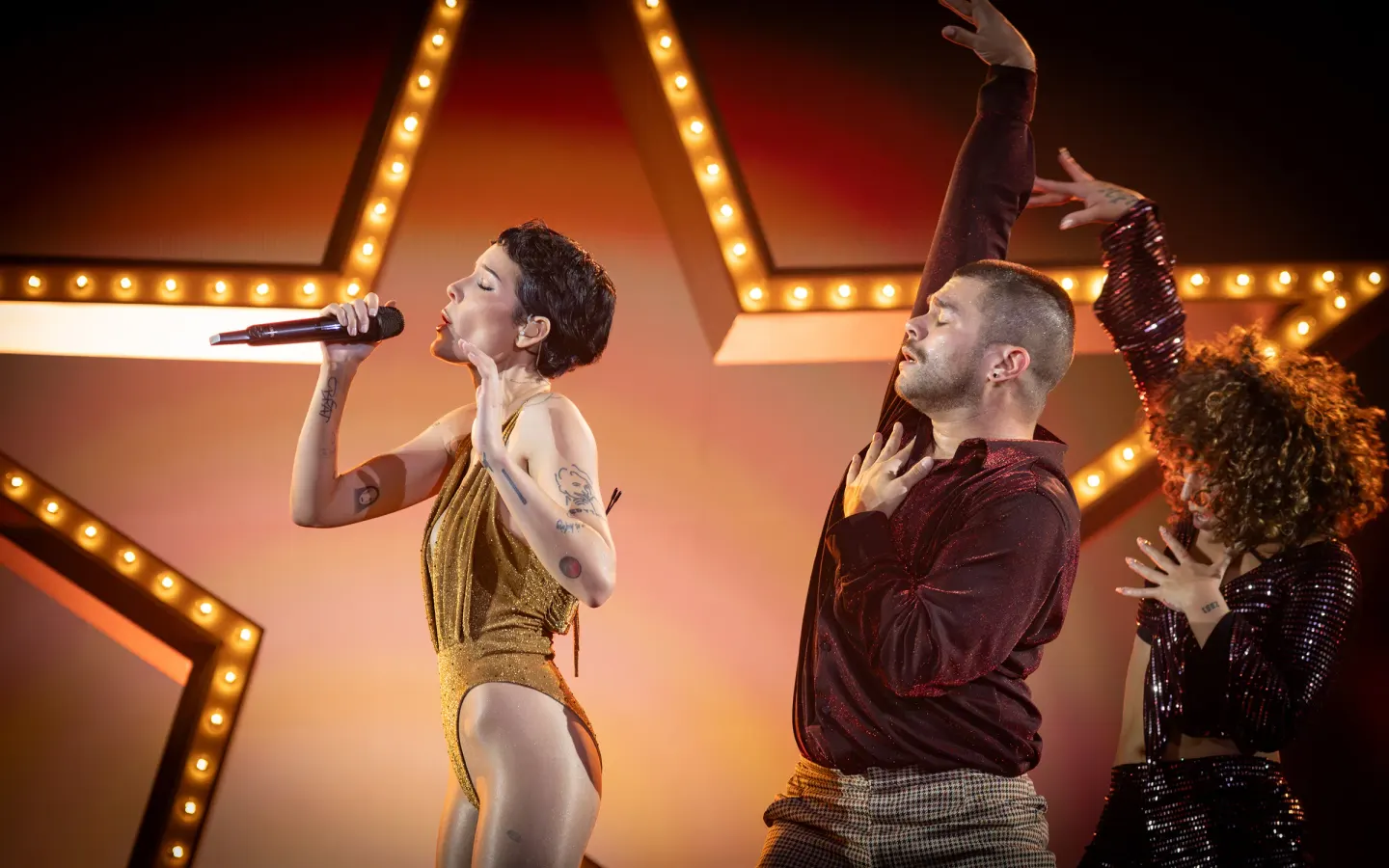
Photo: Halsey performing for Amazon Music Live, October 2024. Justin Higuchi / CC BY 2.0, via Wikimedia Commons. Cropped for presentation.
V. Power, Pregnancy and the Body as Genre
If I Can’t Have Love, I Want Power gives Halsey’s writing its most forceful production system. Trent Reznor and Atticus Ross build an industrial, electronic and rock framework in which pregnancy is neither softened into serenity nor reduced to provocation. The body becomes a political and sonic problem.
“The Tradition” begins like a warning passed through generations. “Bells in Santa Fe” makes departure feel programmed into the pulse. “Easier than Lying” erupts with guitars and drums violent enough to match the narrator’s internal accusation. “I am not a woman, I’m a god” turns category refusal into a cold, repeating hook.
The album’s signature is not simply its heavier sound. Production stops illustrating the lyric and begins arguing with it. Tender words meet hostile texture; control is asserted over arrangements that sound capable of swallowing the singer. Halsey’s voice responds by becoming more physical—less concerned with polish, more willing to tear against the track.
Here, genre is not a new outfit. It is the pressure the body requires.
VI. “Ego” and the Garage Behind the Pop Star
“Ego,” from The Great Impersonator, stages Halsey inside a 1990s alternative-rock frame: live-band energy, guitar abrasion and a chorus that sounds built for a crowded room. The video doubles the performer, turning self-conflict into a band practice, a fight and a chase.
The song asks what remains when public identity becomes an opponent. Its hook is catchy because the diagnosis is blunt; its performance is compelling because Halsey does not pretend to stand outside the ego being criticized. The singer wants recognition and escape at the same time.
This contradiction reaches backward through the catalog. The Badlands ruler, the doomed lover, Ashley, the pregnant queen and the great impersonator are all methods for surviving attention. “Ego” places them in the same garage and lets the noise reveal their shared body.
VII. Impersonation as Autobiography
The Great Impersonator imagines Halsey making music across different decades and through the influence of artists including Dolly Parton, Stevie Nicks, David Bowie, Fiona Apple, PJ Harvey and Björk. The promotional portraits make homage visible, but the album is not strongest as celebrity dress-up.
It is strongest when imitation exposes the limits of the Halsey persona. “Only Living Girl in LA” wonders whether fame would even fill the singer’s funeral. “The End” places illness inside an acoustic song so restrained that medical fear enters without spectacle. The three “Letter to God” tracks revisit desire, attention and sickness from different imagined eras.
“Lonely is the Muse” brings back guitar weight to examine the person who inspires art and is then discarded by it. Halsey sings as both muse and maker, object and author. The voice breaks open on the chorus because no stable role can resolve the conflict.
The album’s references therefore function like mirrors angled around a hospital room, a childhood memory and a career. Halsey becomes other artists to ask whether Ashley can still be found when the performance ends.
VIII. The Signature Is the Moment of Failure
Halsey’s personas are memorable, but persona alone is not the signature. The signature is failure: the castle stops protecting its ruler, the tragic romance cannot explain the lover, the pop star cannot contain Ashley, the queen cannot transcend the body, and the impersonator cannot imitate mortality away.
These failures are productive. They prevent concept from becoming branding. Each album begins with an organizing image and becomes more truthful as the image loses control. Halsey’s best songs occur at that threshold, where metaphor remains visible but confession has started leaking through it.
This also explains the catalog’s unevenness. Halsey takes large conceptual swings, and not every lyric or genre reference can carry the weight assigned to it. Yet the risk produces a body of work more alive than a perfectly consistent brand. The albums do not agree on who Halsey is.
They agree that identity is something made under pressure—and that the most honest sound may be the seam beginning to split.
Where to Start
“Gasoline” — the constructed pop self speaking from inside the machine
“929” — autobiography correcting itself in real time
“Easier than Lying” — voice and industrial production tearing against each other
“Ego” — the pop star confronted as an opponent
“The End” — illness narrated without hiding behind scale
“Lonely is the Muse” — object, author and persona collapsing into one chorus
Cover image: Halsey performing for Amazon Music Live, October 2024. Justin Higuchi / CC BY 2.0, via Wikimedia Commons. Cropped for presentation.