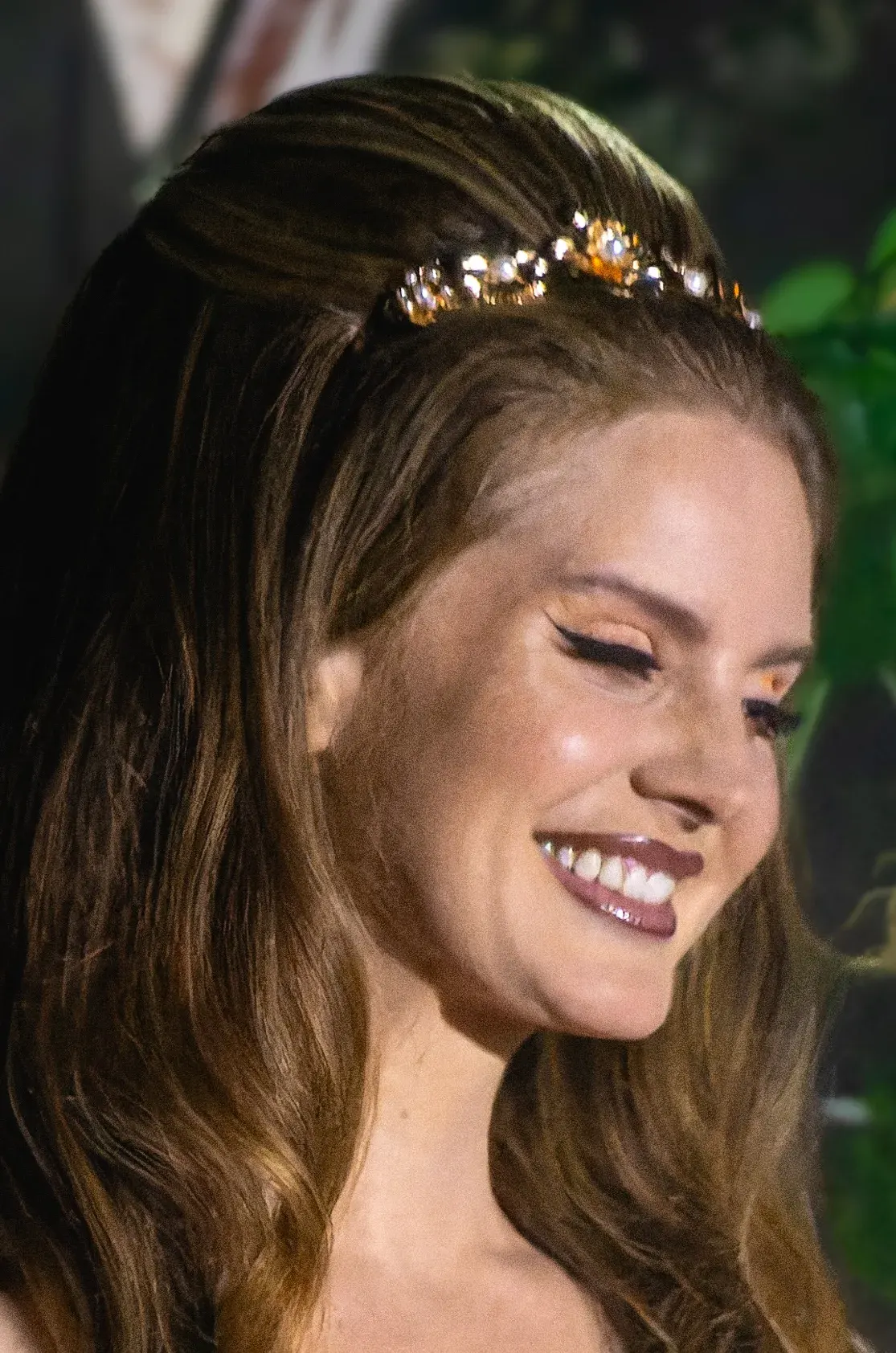
A closer look at the scenes and context surrounding Lana Del Rey's music.
Lana Del Rey's most radical instrument is not nostalgia but tense. Her records make the present feel as though it has already faded, placing contemporary desire inside an America assembled from cinema, roadside architecture, pop memory and private damage.
That distinction matters. Nostalgia simply points backward. Del Rey's best music does something stranger: it collapses decades until an old torch-song cadence, a trap hi-hat, a Laurel Canyon harmony and a phone-screen confession can occupy the same emotional weather. The listener is not transported to a recoverable past. We enter a present that arrives pre-haunted.
Across her catalogue, time is rarely a straight line. It loops, dilates and corrodes. Verses drift like recollection; choruses return like myths a country keeps telling itself. Her slow phrasing makes each word seem selected after the event, even when the lyric describes a feeling happening now.
Video Games invents the remembered present
"Video Games" sounded startling in 2011 because it refused the speed and brightness surrounding mainstream pop. Piano, strings and Del Rey's low vocal moved with the gravity of an older ballad, while the lyric placed that grandeur beside beer, backyard leisure and a lover absorbed by a screen.
The song's power comes from the mismatch. Its arrangement treats an ordinary, possibly unequal relationship as lost cinema before it has even ended. Del Rey sings from inside devotion and from a future that already understands its cost. Love becomes an image being archived in real time.
That double perspective established the grammar of her career. The vintage signifiers are not decorative filters. They create distance, allowing immediate feeling to be observed as cultural memory.
Born to Die turns Americana into a set
On Born to Die, American iconography appears with the suspicious perfection of a studio backlot: flags, convertibles, swimming pools, motel rooms and dangerous men. Hip-hop drums sit beneath orchestral melancholy. Del Rey's voice can sound imperious in one phrase and almost dissociated in the next.
This is why reducing the album to retro styling misses its tension. The surfaces are deliberately too beautiful. They expose how romance borrows its language from movies, advertising and songs, especially when reality offers less glamorous forms of dependence.
The title track makes fatalism feel ceremonial. "National Anthem" turns wealth and patriotic spectacle into feverish role-play. The characters understand that they are performing myths, yet performance remains the only language large enough for their appetite.
Ride opens the myth onto the highway
"Ride" expands Del Rey's world from private interiors to the American road. Its orchestral sweep promises freedom, but her delivery keeps that promise unstable. Long vowels seem to search for somewhere to land; the chorus moves forward while emotionally circling the same need.
The road in American music often guarantees reinvention. Here it is also avoidance. Motion can postpone a reckoning without resolving it. Del Rey makes that ambiguity audible by singing with both grandeur and fatigue, as though escape has already become another routine.
Her slowness is crucial. A faster performance might turn the song into uncomplicated release. Del Rey leaves enough time around each phrase for freedom and loneliness to occupy it together.
Ultraviolence lets the tape darken
Ultraviolence replaces some of the debut's digital collage with guitars, room sound and a narcotic band feel. The past becomes less like cinema and more like damaged recording medium. Songs seem yellowed at the edges.
Del Rey does not merely sing over this atmosphere. Her timing controls it. She often enters late, lets a syllable sag, or repeats a phrase until glamour tips into compulsion. The record's troubling romantic scenarios are not made safe by their beauty; the beauty is part of how the danger operates.
That is an essential critical tension in her work. Del Rey can render destructive dynamics with extraordinary formal precision, but listeners must still distinguish depiction, fantasy and endorsement. The music's seduction should sharpen that question, not erase it.
Lana Del Rey photographed in 2012. Photo by Tyler Merbler via Wikimedia Commons, licensed CC BY 2.0.
Honeymoon perfects suspended time
If Ultraviolence sounds worn, Honeymoon sounds almost outside ordinary chronology. Strings, reverberant guitars and unhurried percussion create long corridors of sound. Melodies appear less to advance a plot than to prolong a state.
Del Rey uses repetition as suspension. A phrase returns because the character cannot leave it, and the arrangement refuses to hurry her toward resolution. The album's old-Hollywood vocabulary is therefore not a museum. It is a mechanism for slowing contemporary anxiety until every contour becomes visible.
Love separates memory from scale
"Love" addresses youth without pretending to recover it. The song's verses observe ordinary preparation and movement; the chorus opens into cosmic scale. Del Rey sounds both participant and witness, close enough to share the feeling but distant enough to recognize how quickly it will become memory.
This is one of her gentlest uses of temporal doubleness. The future loss inside the present does not cancel joy. It makes attention more urgent. For once, melancholy protects the moment rather than consuming it.
Venice Bitch makes duration the subject
"Venice Bitch" stretches beyond nine minutes, but its length is not ornamental excess. The song begins with intimate acoustic clarity, then loosens into psychedelic guitar, synthesizer haze and recurring fragments. Structure slowly becomes weather.
Instead of illustrating memory through lyrics alone, the recording behaves like memory. Details surface, blur and return in altered perspective. Del Rey's voice sometimes leads and sometimes recedes into the mix, no longer the fixed center of her own recollection.
The track demonstrates how patience can become pop form. Time spent inside the arrangement changes the listener's relationship to its opening simplicity. By the end, the beginning already feels like somewhere we once lived.
Norman F***ing Rockwell! questions the dream
On Norman F***ing Rockwell!, Del Rey's American mythology becomes more conversational and more openly disillusioned. The arrangements retain classic singer-songwriter warmth, but the writing punctures male genius, romantic self-deception and national decline with dry specificity.
Her voice sounds less like a character entering a grand set and more like an author walking through its remains. California remains beautiful, yet beauty no longer guarantees belief. The album's achievement is not abandoning the myth but developing enough distance to argue with it.
That evolution also changed how her slowness reads. What once suggested doomed passivity can become critical patience: the refusal to let a seductive image pass before its contradictions have been examined.
White Dress hears the person before the persona
"White Dress" reaches backward to a pre-fame self, but Del Rey avoids the clean authority of autobiography. Her unusually high, fragile delivery makes recollection sound physically difficult. Details of work, music conferences and summer circulate like objects handled too often.
The song does not claim that the earlier life was pure. It asks what kinds of freedom disappear when a private identity becomes a public image. Memory is unstable evidence, and the strained vocal acknowledges that instability more honestly than a polished declaration would.
A&W breaks the timeline in half
"A&W" compresses several Lana Del Rey eras into one seven-minute rupture. Its first movement is sparse, confessional and harmonically unsettled. The lyric moves through girlhood, sexuality, judgment and erasure while refusing a neat testimony.
Then the track mutates. Bass and programmed rhythm pull the song into a grim, compulsive second half built around the "Jimmy" refrain. The transition feels like a hard edit between incompatible memories, yet both belong to the same narrator.
This is temporal collage at its most severe. Folk intimacy does not mature into resolution; it is interrupted by an old motif returning as contemporary menace. Del Rey shows that a catalogue can remember itself without becoming self-congratulatory.
The new country inflection is another clock
Recent songs including "Henry, come on" and "Bluebird" bring country and American vernacular textures closer to the foreground. That move is less a genre costume than another way of measuring time. Acoustic instruments, conversational address and open space let her writing approach the apparent directness of a letter.
Yet directness in Del Rey's music is always provisional. A plain image can carry decades of musical association; a familiar chord change can make a new sentence feel inherited. She remains interested in how individuals borrow old forms to understand feelings that have no old solution.
Why the slowness still matters
Streaming culture rewards immediate recognition, compressed hooks and constant availability. Del Rey's influence is not simply that many singers adopted a lower register or vintage palette. More consequentially, she proved that mainstream scale could accommodate ambiguity, long duration and unresolved atmosphere.
Her records invite close listening because their surfaces do not stay fixed. Grandeur can become irony; nostalgia can reveal fabrication; passivity can turn into authorship. The same vocal phrase may sound ancient and digitally immediate, sincerely romantic and critically alert.
Lana Del Rey's lasting achievement is to make pop history feel less like a sequence than a room full of simultaneous broadcasts. She stands among them, changing stations slowly enough that we hear the static between eras. The present does not disappear. It becomes newly strange because she lets us hear how quickly it is turning into memory. Focus rating: 9.4/10.
Sources: Lana Del Rey official releases and website; official Lana Del Rey videos; official Spotify recordings. Cover photo from Primavera Sound Barcelona 2024 by Raph_PH via Wikimedia Commons, licensed CC BY 2.0. Inline photo by Tyler Merbler via Wikimedia Commons, licensed CC BY 2.0.