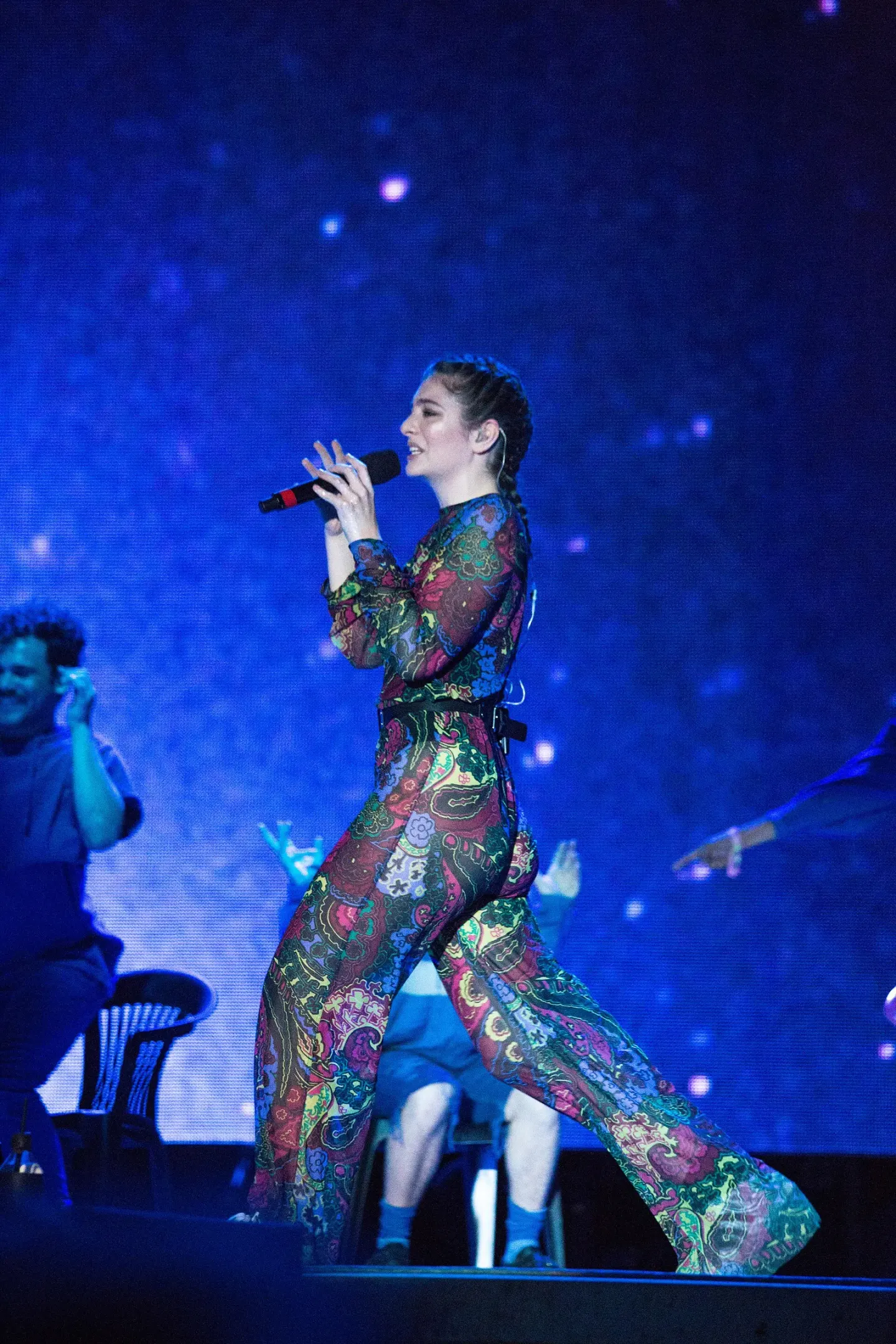
A closer look at the scenes and context surrounding Lorde's music.
Lorde has built a rare pop career by refusing to pretend that one age can speak for another. Each of her four albums changes the distance between the singer and her life: first observing the world from the edge, then entering the party, stepping outside it, and finally treating the body itself as evidence.
Pop rewards continuity. A successful voice, visual code or emotional posture is expected to repeat until the market loses interest. Lorde's catalogue works by a different principle. She keeps the precision of her writing while allowing the position of the writer to become unstable.
That is why her long intervals matter. They are not empty spaces between products; they preserve the difference between versions of a person. Pure Heroine, Melodrama, Solar Power and Virgin do not offer a smooth coming-of-age narrative. They record four incompatible ways of understanding closeness.
Royals turns exclusion into a viewpoint
"Royals" arrived with almost comical economy. Finger snaps, low frequencies, stacked voices and a lyric that catalogued luxury clichés were enough to redraw the scale of a global hit. The song did not merely reject expensive fantasy. It demonstrated that standing outside a fantasy could become its own source of power.
Lorde's performance is cool but not emotionally vacant. Her low register creates the impression of someone watching before speaking, testing the distance between media images and suburban experience. When the harmonies widen, private skepticism becomes communal language.
The record's enormous influence can obscure how unusual its perspective was. Teen pop often promises access to a larger world. "Royals" asks who designed that world, why its symbols repeat, and whether imagination must accept the available script.
Pure Heroine maps the edge of the city
Across Pure Heroine, streets, tennis courts, bedrooms and borrowed cars become observation posts. The production leaves large areas unoccupied, giving small sounds disproportionate force. Handclaps and vocal layers can feel architectural because there is so little clutter around them.
Lorde writes adolescence not as innocent preparation for real life but as a complete social system. Status, boredom, intimacy and dread already operate with adult intensity, even when the setting appears minor. "Tennis Court" hears performance anxiety inside casual conversation. "Ribs" turns the fear of aging into a pulse that seems to accelerate while the lyric tries to hold still.
"Team" completes the album's geography. Its city is unseen on screen, yet the song refuses both shame and tourism. Belonging comes from shared knowledge of overlooked places. The teenager at the edge is not asking the center for permission; she is naming another center.
Melodrama walks inside the room
Four years later, Melodrama abandons the safe distance of observation. The house party at its conceptual center is crowded, volatile and porous. Lorde no longer studies desire as a social pattern. She submits to its bad timing.
"Green Light" is the decisive entrance. Its verses are tense and rhythmically narrow, collecting humiliation and disbelief. Then the piano arrives, the drums open and the chorus runs toward a freedom the narrator does not yet possess. The song understands catharsis as action before conviction.
This is crucial to Lorde's writing. Emotion does not become true only after it is resolved. A body can dance toward a conclusion that the mind has not reached. Pop form supplies temporary momentum without falsifying the contradiction.
The Louvre makes private scale enormous
On "The Louvre," infatuation is described with both embarrassment and imperial confidence. Lorde hears herself exaggerating and does it anyway. The song's production expands around that unstable self-awareness, guitars and voices creating a horizon larger than the relationship deserves.
The famous image of broadcasting a rush from the Louvre's walls turns private obsession into public transmission. Yet the joke remains inside the grandeur. Lorde's gift is to let a feeling know that it is ridiculous without reducing its force.
Supercut admits that memory edits
"Supercut" is one of the clearest statements of her method. The narrator knows memory has assembled favorable fragments into a highlight reel, but knowledge does not stop the reel. Bright synths and forward motion make selection feel euphoric while the lyric acknowledges everything omitted.
Where Pure Heroine trusted observation, Melodrama discovers that the observer is also an unreliable editor. Intimacy changes the camera. The person telling the story has something to protect, and structure reveals the protection.
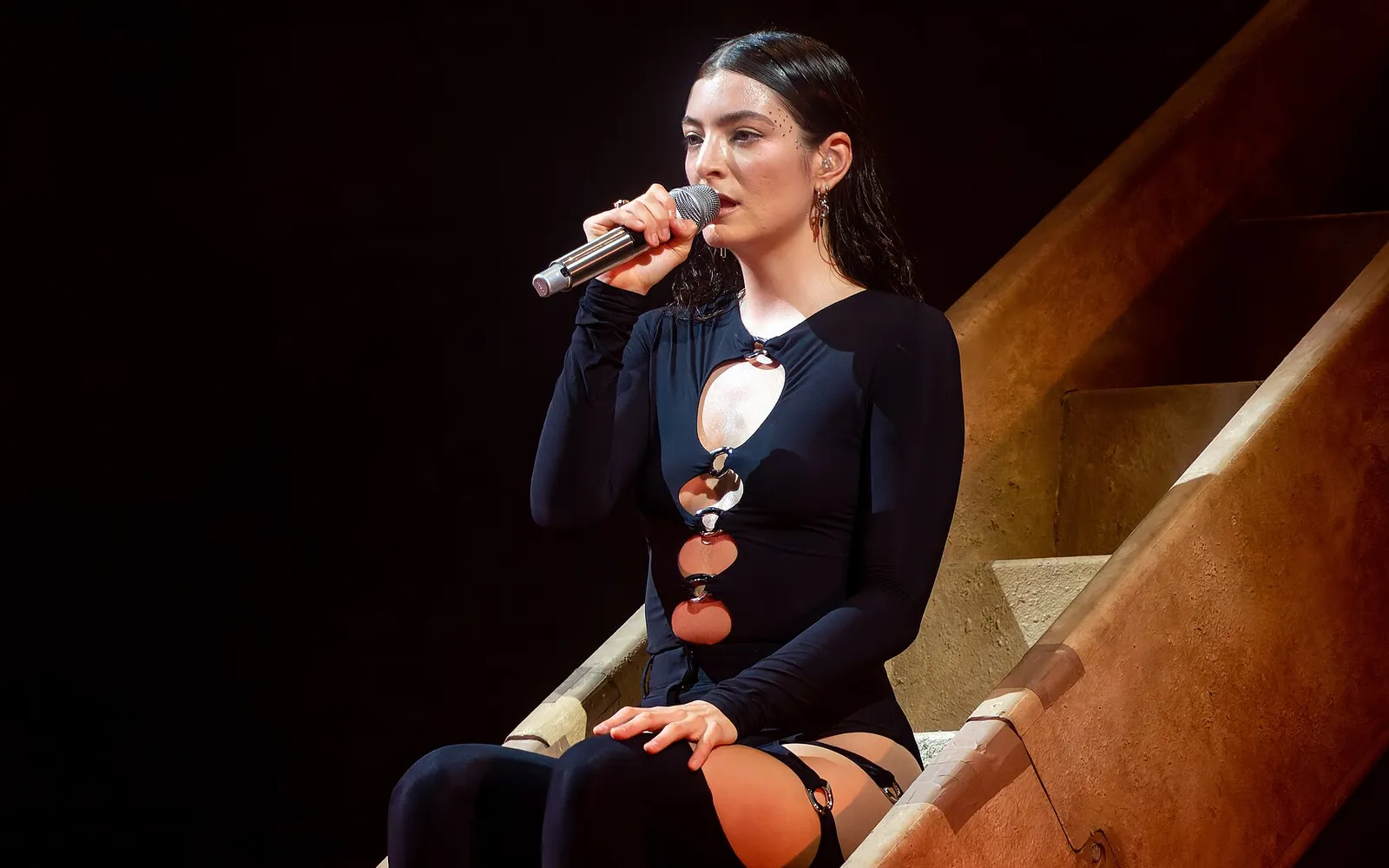
Lorde performing at Primavera Sound Barcelona in 2022. Photo by Raph_PH via Wikimedia Commons, licensed CC BY 2.0.
Solar Power chooses distance on purpose
Solar Power was often received as retreat: from electronic intensity, urban night and the dramatic density listeners associated with Lorde. That reading identifies the change but can mistake it for absence. The album asks what happens when a writer suspicious of spectacle becomes suspicious of her own spectacle.
The title track uses acoustic brightness, loose harmonies and a knowingly beatific persona. Its beach is both pleasure and performance. Lorde sings as a convert, a host and someone amused by conversion language. The track's lightness is therefore not simple serenity; it is a test of how sincerity survives self-consciousness.
The album's quieter pacing can frustrate because it denies the obvious peaks that made Melodrama so immediate. But that denial belongs to its subject. Stepping away from the party means giving up the party's reliable narrative machinery.
Stoned at the Nail Salon hears choices closing
"Stoned at the Nail Salon" gives the album's distance a more vulnerable shape. Over spare guitar, Lorde considers whether the life she chose is wisdom, accident or one temporary arrangement among many. Domestic images do not settle the question.
Her phrasing allows certainty to dissolve at the end of lines. The song refuses a common adult fantasy: that growing older converts confusion into a stable point of view. Maturity here means recognizing how many lives become unavailable each time one life takes form.
What Was That returns to the street
"What Was That," the first signal from Virgin, brings harder electronic movement back into Lorde's music without recreating Melodrama. The perspective has changed. Instead of a party becoming the whole world, the song moves through a city as memory repeatedly breaches the present.
The vocal sounds exposed against the rhythm. Details arrive with the abrupt clarity of images triggered in public: a substance, a room, a phrase, a former self. The question in the title is not only about a relationship. It asks how an experience can once organize a life and later become difficult to name.
Virgin moves the evidence into the body
Released in 2025, Virgin is Lorde's fourth album and her most physically direct. Its electronic surfaces can be translucent, abrasive or warm, often leaving enough space for breath and strain to remain audible. The body is not a metaphorical accessory to emotion. It is where identity, appetite, control, illness, sex and creative work leave marks.
"Hammer" begins in motion, with desire and self-recognition arriving as sensory pressure. "Man of the Year" destabilizes gendered self-image rather than presenting a fixed answer. "Favourite Daughter" places achievement and approval in the same nervous system. Across the record, clarity means exposure, not simplicity.
This distinguishes Virgin from a conventional return-to-form narrative. The electronic pulse reconnects Lorde with the kinetic power many listeners missed, but the album does not return her to the twenty-year-old inside Melodrama. Its movement is less about escape than inhabitation.
The machines become additional voices
Lorde's work has always treated production as a form of narration. On Pure Heroine, empty space made the outsider's attention feel exact. On Melodrama, sudden expansion allowed the body to outrun thought. Solar Power used acoustic looseness to question withdrawal, while Virgin lets synthesizers sound as unstable and bodily as the singer.
That continuity matters more than genre. Minimal electronics, maximal pop, soft rock and translucent club music are not competing identities. They are different distances from the subject.
A generation is not one voice
Lorde was quickly described as a generational spokesperson, a flattering title that can become a creative trap. A generation does not remain seventeen, and no individual should have to convert collective projection into permanent autobiography.
Her strongest response has been formal. Rather than announce universal lessons, she writes details precise enough to become shared: the room after everyone leaves, the fear inside a familiar street, the body resisting an assigned story. Identification happens through specificity, not representation by decree.
Why the gaps protect the songs
The spaces between Lorde albums keep each world intact. They prevent an era's vocabulary from becoming routine and allow the next record to disagree with the previous one. This makes the catalogue smaller than a standard pop discography but unusually legible as a sequence of changed consciousness.
Most importantly, the gaps let Lorde preserve the moral intelligence of growing up: the knowledge that an earlier self was neither foolish nor complete. Pure Heroine's observer, Melodrama's participant, Solar Power's retreating public figure and Virgin's embodied narrator can contradict one another without any being exposed as false.
Lorde writes pop at the speed of becoming, which is slower and less orderly than the release calendar prefers. Her achievement is not capturing a generation once. It is showing that a voice remains truthful only if it is allowed to change where it stands. Focus rating: 9.2/10.
Sources: Lorde and Universal Music official release materials; official Lorde videos; official Spotify recordings. Cover photo from Bonnaroo 2017 by ThorntonDrury via Wikimedia Commons, licensed CC BY-SA 4.0. Inline photo from Primavera Sound Barcelona 2022 by Raph_PH via Wikimedia Commons, licensed CC BY 2.0.