
A closer look at the scenes and context surrounding Sam Smith's music.
Sam Smith's voice is often described by its size, but its deeper signature is exposure. The high notes matter because listeners can hear the breath beneath them, the small instability that keeps technical control from becoming emotional armor.
From dance features and piano ballads to Bond orchestration, gospel arrangements and the theatrical pop of Gloria, Smith has repeatedly changed the scale of the room. What remains constant is a particular relationship between strength and fragility. The voice opens widely, yet rarely sounds sealed.
This is not the same as simply sounding sad. Smith's best performances treat vulnerability as musical structure: where a phrase begins, how long a vowel is allowed to thin, when harmony arrives, and whether the final word resolves or remains suspended.
Latch reveals the body inside precision
Disclosure's "Latch" introduced many listeners to Smith through movement rather than stillness. The production is clean and buoyant, built from syncopated chords and a beat that keeps affection in motion. Smith's vocal does not float passively above it. Short phrases push against the rhythm before the chorus releases into longer, higher lines.
That contrast established an important part of the instrument. Smith can sound intimate without becoming rhythmically vague. Breath is not only evidence of feeling; it marks time. The voice stretches the dance track's grid while remaining accountable to it.
Stay With Me makes repetition a confession
"Stay With Me" is harmonically direct and lyrically almost severe in its simplicity. The narrator knows that a temporary encounter is not love but asks for company anyway. Smith sings the opening verses with little protection, leaving room around each admission.
When the choir-like backing vocals enter, a private request becomes communal sound. The scale expands without changing the fact of loneliness. That is the song's central formal intelligence: massed voices do not solve isolation; they amplify how widely the need can be recognized.
Smith's final repetitions avoid a triumphant conversion. The melody rises, but the emotional condition remains unresolved. Power is used to expose the request, not dignify it into certainty.
I'm Not the Only One controls the break
On "I'm Not the Only One," Smith sings from knowledge rather than suspicion. The piano and restrained groove create a measured surface, while the vocal repeatedly threatens to exceed it. Small catches and upward turns make composure sound actively maintained.
The chorus works because Smith does not begin at maximum force. The phrase accumulates weight across its length, and the highest notes arrive as pressure finally becoming audible. Technique creates an emotional timeline inside a few seconds.
Writing's on the Wall chooses vertical drama
A Bond theme demands monumentality, and "Writing's on the Wall" gives Smith an orchestral frame of strings, piano and suspended harmonic tension. The vocal line climbs steeply, often reaching upward before the arrangement feels ready to catch it.
That vertical writing can sound exposed to the point of risk. Rather than adopting the invulnerable authority associated with many Bond themes, Smith places fear inside the spectacle. The question is whether intimacy can survive a life organized around danger.
The performance divides listeners partly because its falsetto refuses the conventional masculine center of the genre. That refusal is precisely what gives the song its identity. Grandeur is not presented as fearlessness; it is the size fear acquires when sung in public.
Too Good at Goodbyes turns defense into rhythm
"Too Good at Goodbyes" begins with a narrator claiming expertise in emotional exit. The vocal is controlled, almost procedural, while clipped accompaniment leaves the mechanism visible. As harmonies gather, the song reveals that repetition has not produced immunity.
Smith uses rhythmic restraint to portray self-protection. Lines stop cleanly, as if feeling can be managed through punctuation. The chorus then lengthens those lines and exposes the cost. A habit of leaving becomes a form of being left in advance.
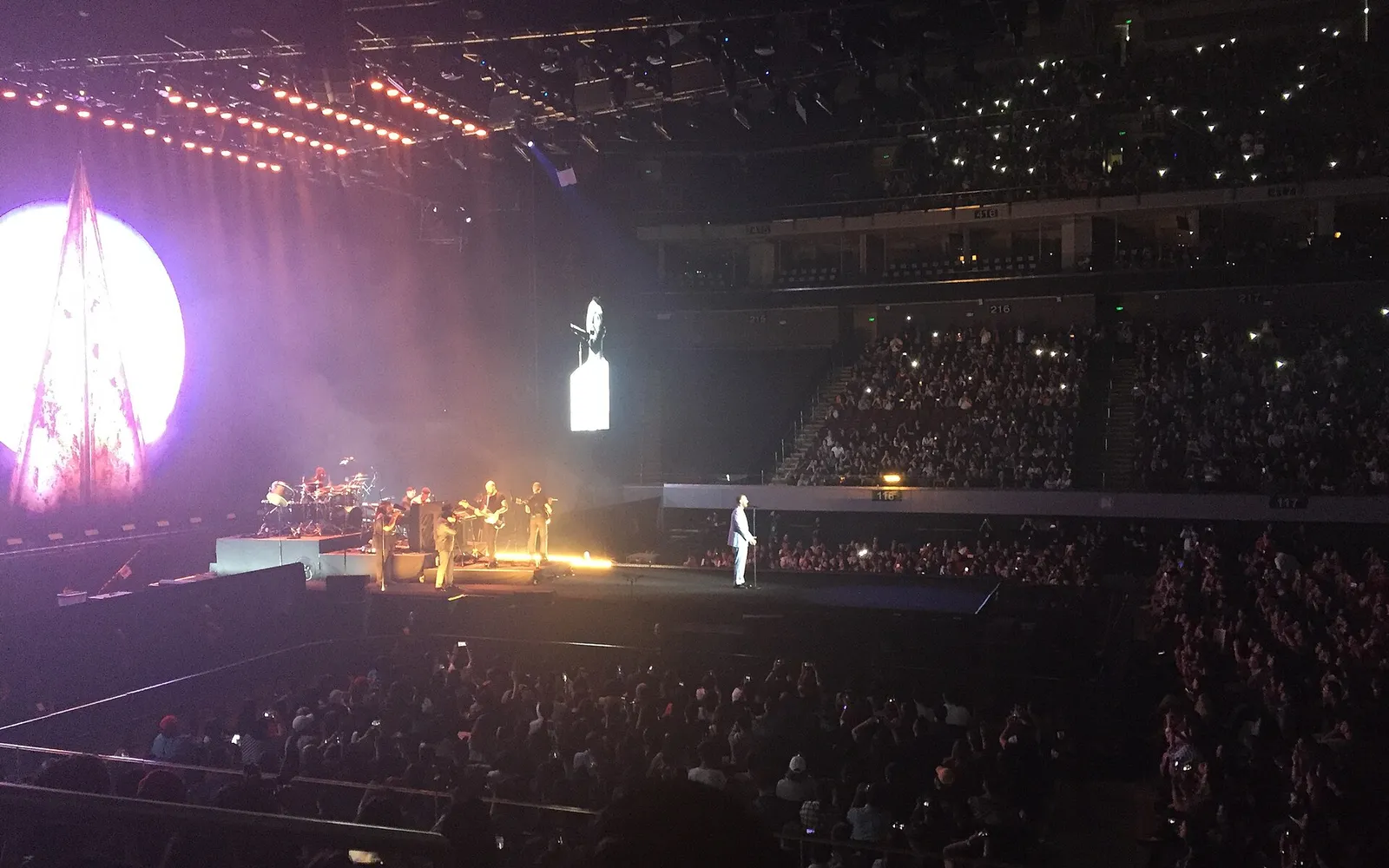
Sam Smith performing in Manila during The Thrill of It All Tour in 2018. Photo by Patrick Cristiano via Wikimedia Commons, licensed CC BY-SA 4.0.
Pray lets gospel scale carry doubt
On "Pray," gospel vocabulary does not signal settled belief. It gives uncertainty a collective architecture. Smith's voice moves between close confession and broader declaration while the arrangement supplies drums, choir and dramatic space.
The tension is productive: a prayer does not require certainty, only address. Smith's performance understands that doubt can be active rather than empty. The large arrangement becomes a room in which unanswered questions can be spoken together.
Dancing with a Stranger redistributes intimacy
The Normani collaboration "Dancing with a Stranger" places Smith in sleek, nocturnal pop. Its restraint is different from the piano ballads: programmed rhythm and polished surfaces turn loneliness into social motion. Both singers keep their performances cool enough for desire and displacement to coexist.
Smith adapts by reducing theatrical pressure. Phrases sit closer to the beat, and tone carries more information than volume. The record confirms that exposure in Smith's work does not depend on acoustic seriousness. A dance floor can reveal absence as precisely as a piano.
How Do You Sleep? finds anger in articulation
"How Do You Sleep?" gives betrayal a sharper rhythmic body. Smith's consonants become percussive, and the chorus uses repetition less as pleading than interrogation. The production remains spacious, but space now creates threat rather than solitude.
This is an important extension of the voice. Smith's public image was initially organized around heartbreak received. Here the singer directs energy outward, letting precision carry accusation. Vulnerability and anger are not opposites; anger can be vulnerability refusing silence.
Love Goes accepts scale without closure
The Love Goes era moves between electronic pop, soul and ballad writing, sometimes struggling to make those modes cohere as a single album. Yet its strongest moments show Smith becoming less dependent on one emotional silhouette.
"Diamonds" uses a firm dance pulse and a cleaner attack. The title track, featuring Labrinth, returns to orchestral expansion but treats separation as something larger than a single dramatic climax. Smith's voice can still tower, though the songs increasingly ask what happens after the tower has been built.
Unholy makes theatricality physical
"Unholy," with Kim Petras, is a deliberate disruption: a compact, chant-driven pop record built from a Phrygian-flavored hook, heavy low end and a premise staged like gossip in a mechanical cabaret. Smith's voice is not pleading for admission. It controls the doorway.
The record's impact lies partly in this changed posture. Queer and trans artists occupy a mainstream hit without translating desire into respectability. Smith uses a darker, lower, more character-driven delivery, while the chant turns private misconduct into public spectacle.
Its bluntness is not as emotionally layered as Smith's best ballads, but that is not the assignment. "Unholy" demonstrates that exposure can be playful, confrontational and costumed rather than solemn.
Gloria treats the voice as a public body
On Gloria, Smith's musical and visual presentation becomes more explicitly theatrical. Gospel, club music, pop and cabaret coexist around questions of liberation, judgment and self-display. The album is uneven, but its excess is purposeful: the singer once framed primarily as a wounded voice now insists on being seen as a changing body.
"I'm Not Here to Make Friends" turns social permission into disco theater. "Who We Love," with Ed Sheeran, reaches for direct affirmation. The short title piece treats the inner voice almost as a sacred chorus. Across them, Smith tests whether openness can become pleasure without losing emotional detail.
To Be Free removes the scaffolding
The later single "To Be Free" returns attention to acoustic space and close harmony. After the visual and sonic abundance of Gloria, its relative sparseness feels less like retreat than recalibration. Smith does not need to choose permanently between intimate singer and theatrical pop figure.
The performance suggests that freedom is not one triumphant register. It can be the ability to change the size of the frame while remaining recognizable inside it.
Falsetto is not an escape hatch
Smith's upper register is sometimes discussed as a decorative climax, but in the strongest recordings it changes narrative perspective. Chest voice can state the problem with warmth and solidity; falsetto removes that floor. The listener hears control becoming lighter, more conditional.
This is why copying the notes does not reproduce the effect. The expressive unit includes the transition between registers, the breath before ascent and the slight narrowing of tone. Smith makes technique legible without turning a song into demonstration.
Where the signature can harden
A vocabulary built on exposed longing carries risks. Some ballads rely on familiar chord progressions and climaxes that tell the listener where to feel before the lyric has earned the instruction. When every phrase arrives pre-wounded, vulnerability can become a polished genre.
Smith is most compelling when arrangement gives the voice a specific problem: the rhythmic lift of "Latch," the unresolved choir of "Stay With Me," the vertical danger of "Writing's on the Wall," or the theatrical low end of "Unholy." Exposure needs resistance to remain vivid.
The voice is strongest when the room changes
Sam Smith's career is not a journey from authenticity to spectacle or from sadness to liberation. Those binaries are too neat. The catalogue is more interesting as a series of rooms in which the same instrument learns different forms of address.
In a close ballad, breath can make one request feel uncomfortably private. In gospel, harmony makes doubt collective. In dance music, phrasing lets loneliness move. In theatrical pop, costume reveals that visibility can be another kind of truth.
Smith's gift is the ability to enlarge emotion without entirely protecting it from view. The notes rise, the production expands, and the listener still hears the human effort of reaching them. Focus rating: 8.8/10.
Sources: Sam Smith official releases and website; official Sam Smith videos; official Spotify recordings. Cover photo from Lollapalooza 2015 by pitpony.photography via Wikimedia Commons, licensed CC BY-SA 3.0. Inline photo by Patrick Cristiano via Wikimedia Commons, licensed CC BY-SA 4.0.