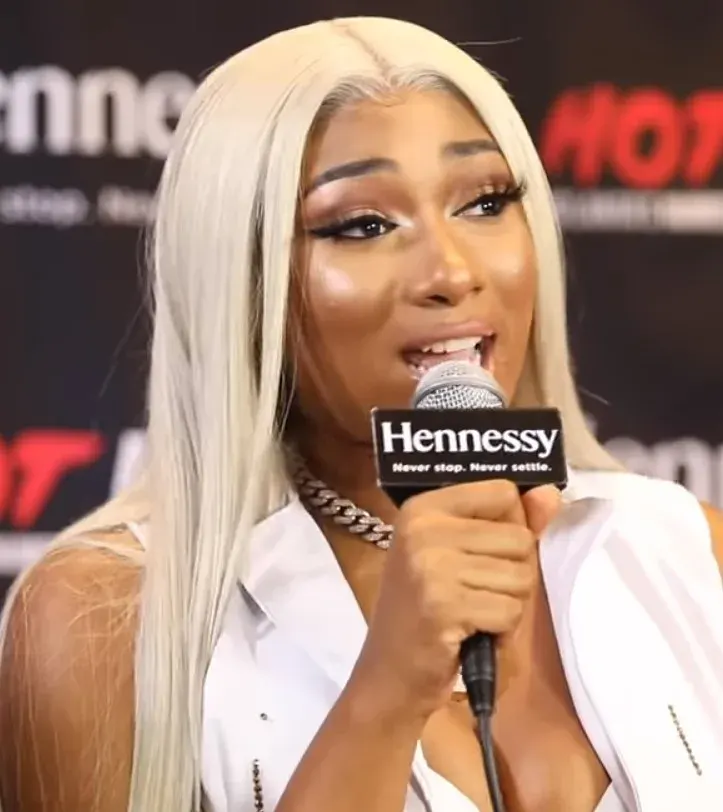
A closer look at the scenes and context surrounding Megan Thee Stallion's music.
Megan Thee Stallion's defining skill is not simply rapping fast. It is making rhythm visible. Consonants land like markers, stresses redraw the beat, and changes in character let one voice behave like an entire conversation.
Her records can be funny, sexually direct, combative and wounded, sometimes within the same verse. The consistency comes from physical command. Megan raps as though the mouth, shoulders and knees are parts of one percussion instrument, translating Houston freestyle discipline into pop-scale clarity.
That clarity is easy to underestimate because charisma makes difficult technique sound social. A Megan verse feels quotable on first contact, yet its internal mechanics reward replay: syllables grouped against the obvious pulse, vowels stretched to create swing, and punch lines positioned so the beat appears to answer them.
The Houston foundation is conversational pressure
Megan's early cyphers established a performer who could enter a shared space and change its temperature immediately. The appeal was not studio polish. It was the sense of thought becoming rhythm in public, with each bar addressed to listeners, competitors and the rapper herself at once.
Houston's rap lineage matters here: slowed texture, car-system weight, freestyle culture and a regional confidence that does not require New York or Los Angeles to validate it. Megan's delivery is faster and more sharply articulated than the city's most stereotyped sonic image, but her music retains that relationship to bodily time and local authority.
Tina Snow turns control into a character
The Tina Snow persona gives Megan a cooler, harder point of attack. Alter egos in rap are not disguises that hide authorship; they are technical permissions. Tina can compress vulnerability, sharpen competition and let composure become a dramatic surface.
On the Tina Snow material, Megan's low register carries unusual stability. She rarely sounds rushed even when the syllable count rises. That calm center lets details around it become more extreme: a sudden laugh, a barked ad-lib, a line delivered with almost teacherly emphasis.
Big Ole Freak makes articulation sensual
"Big Ole Freak" is built on an unhurried groove and a sample that leaves room for language to occupy the foreground. Megan does not treat sexual confidence as a vague atmosphere. She makes it specific through verbs, timing and control of address.
Her consonants give the verse edges, while longer vowels relax into the pocket. The alternation creates a push-and-pull between command and pleasure. Even the most explicit lines feel composed rather than merely declared because sound and meaning arrive at the same point.
The song also demonstrates why Megan's technique translates visually. Gesture seems encoded in the delivery. A listener can imagine where the head turns or the hand lands because the stresses imply choreography.
Cash Shit treats the feature as competition
On "Cash Shit," featuring DaBaby, Megan establishes the record's terms before the guest enters. Her opening is not a warm-up; it is a full claim on tempo, tone and point of view. The beat feels sparse because her voice supplies so much of its motion.
She uses repetition strategically, returning to sounds that make the verse easier to retain without flattening its internal variation. This is pop intelligence operating inside rap craft. Memorability is designed at the phonetic level.
Hot Girl Summer becomes an open social script
"Hot Girl Summer" moved beyond one single because the phrase could be inhabited by other people. Its power was not a narrow beauty standard or a fixed set of behaviors. It named an attitude of self-directed pleasure, friendship and visibility.
Megan's role in that expansion matters. She delivers confidence as invitation and boundary at once: listeners can join, but the originating voice remains clear. The phrase became a cultural container without fully losing its author's cadence.
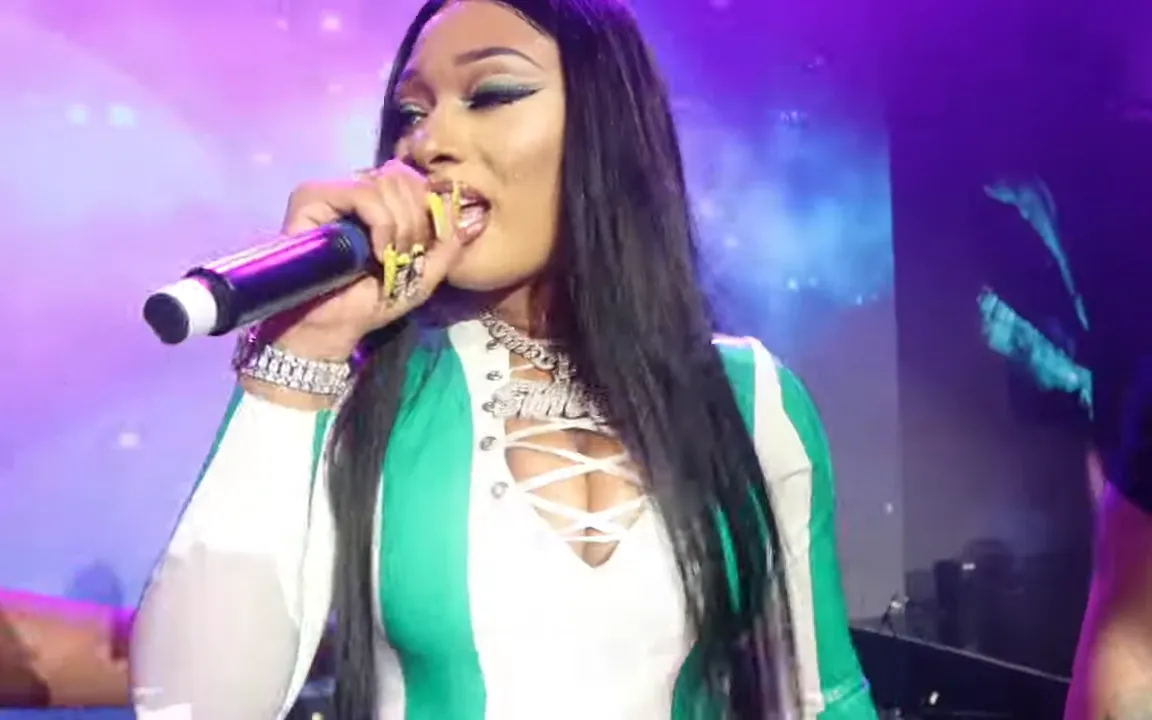
Megan Thee Stallion performing in Lagos in 2019. Image by BABYGIRLTOS via Wikimedia Commons, licensed CC BY 3.0.
Savage turns categories into percussion
"Savage" is organized around adjectives that function as rhythmic blocks. Each word arrives with enough space to become pose, joke and hook. Megan then fills the verses with denser movement, creating a productive contrast between the hook's modular simplicity and the bars' agility.
The record's social-media life did not happen because the song was empty enough for a trend. It happened because the hook already contained instructions for segmentation. Listeners could map gesture onto each stressed unit.
The Beyoncé remix deepened the Houston connection and transformed the record into a dialogue between two approaches to control. Megan responds by maintaining her own center rather than treating the guest as external validation. The collaboration enlarges the world of the song without displacing its architecture.
WAP makes comic timing structural
Cardi B and Megan's "WAP" is explicit, but explicitness alone cannot explain its precision. The performances depend on escalation, contrast and comic timing. Each rapper understands when to crowd the beat and when to leave a phrase exposed long enough for the image to register.
Megan's verse moves with athletic clarity. Internal rhymes create propulsion, while changes in vocal weight prevent the sequence from becoming a single blur. Humor does not interrupt technique; humor is the listener's recognition of technique arriving exactly on time.
The cultural argument around the song also revealed how female sexual authorship is often treated differently from equivalent male material. Megan's performance refuses the premise that authority and pleasure must be separated to become legitimate.
Body writes choreography into the beat
"Body" reduces its hook to a repeated physical word, but the production and vocal arrangement keep repetition active. Megan changes inflection, surrounding textures shift, and the verses supply dense counterweight.
The song understands embodiment as rhythm rather than illustration. Its dance potential comes from accents already embedded in the voice. Where some records add choreography after composition, "Body" sounds choreographic at the level of syllable.
Thot Shit lets Tina Snow return with force
"Thot Shit" reactivates the Tina Snow persona against moral panic and surveillance. Megan's delivery is blunt, mobile and delighted by its own refusal. The beat hits hard, but her voice determines where the impact feels strongest.
The song's video expands that refusal into satire, turning judgment back on a hypocritical observer. Musically, the key is how Megan alternates grounded low phrases with more animated attacks. One character does not replace another; they share the verse.
Plan B uses direct address as a blade
"Plan B" draws energy from older East Coast production vocabulary, but Megan does not abandon Houston identity to inhabit it. The sample provides a rough, insistent surface against which her diction becomes even more exact.
There is little ambiguity in the target of the address. Yet the performance stays musically alive because contempt receives multiple shapes: clipped dismissal, stretched mockery, sudden volume and deadpan control. Anger is arranged rather than simply released.
Anxiety allows the voice to split
Traumazine complicates the invulnerable public persona by letting pressure and grief appear without removing wit or technical command. "Anxiety" is especially effective because its bright, almost conversational motion coexists with admissions of instability.
Megan does not present vulnerability as the hidden truth that invalidates confidence. Both states are true, and the friction between them is the record's subject. The repeated daily check-in resembles a routine designed to contain feelings that do not remain contained.
This is where the alter-ego system gains emotional depth. Tina Snow, Hot Girl Meg and Megan Pete are not a simple mask-and-person binary. They are different rhythmic strategies for surviving different forms of attention.
Cobra makes the wound audible
"Cobra" opens a new independent chapter with a darker, rock-inflected frame and unusually direct writing about depression, betrayal and isolation. Megan's voice remains controlled, but the control now sounds costly.
The song resists converting pain into a neat motivational arc. Its hook circles the image of shedding skin while the verses document what transformation cannot immediately repair. The heaviness of the production gives the words material resistance.
Hiss restores attack without erasing context
"Hiss" begins with spoken contempt before the beat fully claims the space. That opening matters: Megan frames the record as refusal to keep explaining herself. When the rapping begins, her delivery is dense but exceptionally legible, each target separated by changes in stress and tone.
The track works beyond the public references because it treats attention as an economy. Other people gain clicks, relevance and narrative position by attaching themselves to her name. Megan's answer is to make the mechanics of that attachment part of the attack.
The record's chart success confirmed the commercial force of direct rap without requiring a sung pop hook. More importantly, it showed that independence could sharpen rather than diminish the scale of her address.
Megan expands the visual universe
The 2024 album Megan and its second act draw on snake imagery, anime, games, horror and global collaboration. "Boa" places competitive rap inside arcade-like visual language. "Mamushi," with Yuki Chiba, uses a bilingual hook and Tokyo-set imagery without pretending the collaboration erases cultural difference.
These references are not evidence that a rapper has unexpectedly discovered nerd culture; they are part of Megan's long-standing authorship. The visual world gives her personas additional stages, while the flow remains the connective tissue.
The ad-libs are a second score
Megan's signature vocal sounds are sometimes treated as branding alone. They also organize performance. An ad-lib can mark a transition, answer a punch line, reset breath or tell the listener how seriously to receive a boast.
This secondary score makes the main verse feel social even when one rapper occupies the track. Megan can be narrator, subject, audience and commentator in rapid succession. Character switching becomes arrangement.
Speed matters less than placement
Technical rap discussion often reduces skill to velocity or rhyme density. Megan can deliver both, but her more distinctive strength is placement. She knows which syllable needs the full weight of the beat and which can slide past it. The result is readable at high energy.
That readability is not simplification. It is control over hierarchy. A listener understands the main image on first pass and discovers internal construction later. Megan makes complexity hospitable without making it small.
Confidence is a craft, not a mood
Megan Thee Stallion's catalogue does not ask listeners to believe that confidence is permanent. It shows confidence being built through rhythm: breath managed, consonants placed, characters summoned, jokes timed and boundaries repeated until they become physical.
The vulnerable records do not expose the earlier boasts as false, and the attack records do not erase the vulnerable ones. Each mode is a technique for occupying space under different conditions.
Her finest verses make the beat seem newly engineered around the voice, even when the instrumental has barely changed. That is the measure of her command: Megan does not merely ride rhythm. She makes rhythm reveal where she stands. Focus rating: 9.0/10.
Sources: Megan Thee Stallion official releases and store; official Megan Thee Stallion videos; official Spotify recordings. Cover image from a 2019 HOTSPOTATL interview via Wikimedia Commons, licensed CC BY 3.0 and license-reviewed. Inline image by BABYGIRLTOS via Wikimedia Commons, licensed CC BY 3.0 and license-reviewed.