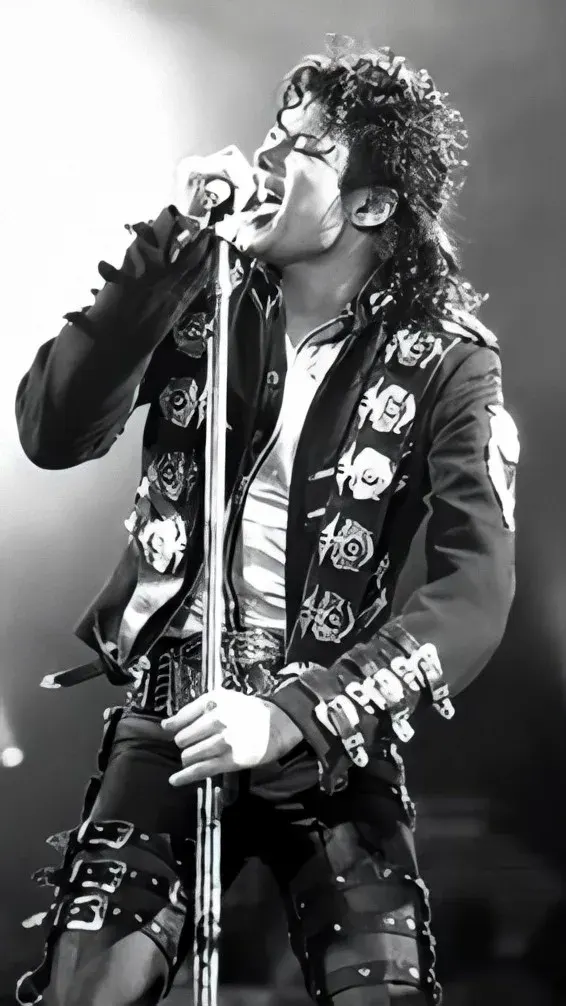
A closer look at the scenes and context surrounding Michael Jackson's music.
Michael Jackson did not merely become the biggest pop star of his era. He changed the unit in which pop ambition was measured. A song could now be a recording, a dance vocabulary, a cinematic event, a fashion silhouette and a global broadcast at the same time.
That transformation did not emerge from scale alone. Jackson's work was built on minute decisions: a breath placed before the beat, a bass line stripped to its essential shape, a heel held still for one extra count, a camera movement timed to a vocal accent. Monumentality was assembled from precision.
His career also resists a clean heroic narrative. Extraordinary artistic achievement, industrial power, racial transformation, personal isolation and grave public controversy became entangled around one figure. A responsible account must hold those realities apart long enough to examine them, rather than using any one as permission to erase the others.
The Jackson 5 turned childhood into professional time
With the Jackson 5, Michael entered popular culture not as an unformed prodigy but as a remarkably complete lead performer. "I Want You Back," "ABC" and "The Love You Save" require rhythmic authority, melodic brightness and the ability to make rehearsed precision feel spontaneous.
His young voice already understood attack. Phrases leap forward, consonants help the groove, and exclamations make the arrangement feel responsive. The famous Motown polish does not conceal labor; it converts labor into exuberance.
Yet the achievement came inside an adult industry and an intensely managed family enterprise. Childhood became schedule, repertoire and public identity. That early compression of private development into professional time would remain essential to Jackson's story: the performer matured under observation while the image of the child star never fully disappeared.
Ben revealed stillness before reinvention
Early solo recordings such as "Ben" demonstrated that Jackson's appeal was not dependent on the group's kinetic energy. The performance is tender and controlled, with a light vibrato and careful rise into emotional emphasis. He could hold attention without choreography or vocal acrobatics.
This stillness matters because later spectacle can make it seem as though scale was always the center. Jackson's most effective work repeatedly returns to the vulnerability of one exposed line. The machinery grows around that line, not instead of it.
Off the Wall makes adulthood move
Off the Wall, produced by Quincy Jones, is the decisive passage into adult authorship. Disco, funk, soul and pop are not treated as separate markets; they become one fluid architecture. Rod Temperton's writing, Jones's arrangements, elite session musicians and Jackson's expanding vocal character meet with extraordinary balance.
"Don't Stop 'Til You Get Enough" begins with intimate spoken anticipation, then opens into strings, percussion and falsetto exhilaration. Jackson's voice behaves like another rhythmic section. Breaths, yelps and short attacks fill the spaces around the groove without crowding it.
"Rock with You" demonstrates the opposite skill. The vocal relaxes into the pocket, smoothing the beat rather than striking it. On "She's Out of My Life," restraint gives way at the edge of control. The album presents adulthood as a range of physical states rather than a declaration that the former child has grown up.
Thriller makes the album a global event
Thriller did not simply collect songs with broad appeal. It sequenced distinct forms of appeal so that rock, post-disco, R&B, funk and balladry reinforced one another. "Wanna Be Startin' Somethin'" carries restless polyrhythmic energy; "Human Nature" creates nocturnal suspension; "P.Y.T." turns vocal play into propulsion.
Quincy Jones's production is spacious even at its most elaborate. Instruments receive clear functions, leaving Jackson room to animate transitions. His signature vocal sounds are therefore not decorative eccentricities. They cue momentum, fill negative space and make the body audible before the lyric arrives.
The album's commercial scale changed expectations for worldwide pop, but its craft remains audible at ordinary volume. The records do not require historical statistics to explain their endurance. They survive because every layer knows when to enter and when to leave.
Billie Jean turns suspicion into a walking bass line
"Billie Jean" is built around one of pop's most instantly legible bass patterns, yet the arrangement delays gratification. Drums establish a dry, controlled space. Keyboard and string colors enter gradually. Jackson sings from inside accusation, fear and self-defense, never allowing the narrator complete authority.
His phrasing repeatedly pulls against the bass. Short inhalations and hiccup-like sounds make anxiety physical, while the chorus achieves clarity without resolving the story. The groove walks forward; the narrative remains trapped.
The Motown 25 performance transformed the song again. The moonwalk mattered not because one step appeared from nowhere, but because Jackson framed it with stillness, isolation and musical timing. A televised gesture became inseparable from the recording's identity.
Beat It crosses format without losing force
"Beat It" brings rock guitar into a track whose underlying discipline remains dance music. Eddie Van Halen's solo is spectacular, but the record does not pause to display it as imported prestige. Guitar, drum machine, synthesizer and Jackson's clipped vocal inhabit the same urgent geometry.
The song helped challenge the racial segmentation of American radio and music television. Crossover, however, should not be described as neutral access to a universal center. Jackson's success exposed how supposedly general pop spaces had been structured by exclusion.
Thriller turns the music video into cinema
The "Thriller" short film expanded the commercial and narrative possibilities of music video. Directed by John Landis, it used transformation, horror choreography, costume, makeup and a story-within-a-story structure on a scale associated with film production.
Its crucial innovation was integration. Dance does not interrupt narrative; dance becomes the monster world's logic. Jackson moves between romantic lead, creature and performer, showing that identity can change with editing, gesture and gaze.
After "Thriller," a major release could be expected to arrive with a visual event capable of renewing the song itself. The modern album campaign, in which images generate distinct waves of attention around audio, owes part of its operating system to this moment.
Bad claims the frame more aggressively
Bad faced an impossible assignment: follow the best-selling scale of Thriller while proving that Jackson was not only the vessel of Quincy Jones's perfection. Jackson wrote more of the material and adopted a harder visual and vocal edge.
The title track uses sharp synthetic surfaces and confrontational call-and-response. "The Way You Make Me Feel" lets desire stride rather than float. "Smooth Criminal" converts narrative violence into impossible rhythmic elegance, its bass and vocal accents locked to a choreography of angles.
"Man in the Mirror" turns personal change into gospel escalation. The song's moral language is broad, but Jackson's performance gives it structure: intimate self-address expands into collective demand. Again, the large gesture succeeds because the small voice remains audible at its center.
The Bad Tour makes the body an arena instrument
The Bad World Tour established Jackson as a solo stadium performer. In that environment, choreography had to read across enormous distance. Silhouette, contrast and held poses became as important as velocity.
Jackson understood that stillness could enlarge motion. A crowd reacts before the next step because the pause makes expectation communal. Hat, glove, jacket and cropped trousers created high-contrast markers that allowed gesture to remain legible from the farthest seat.
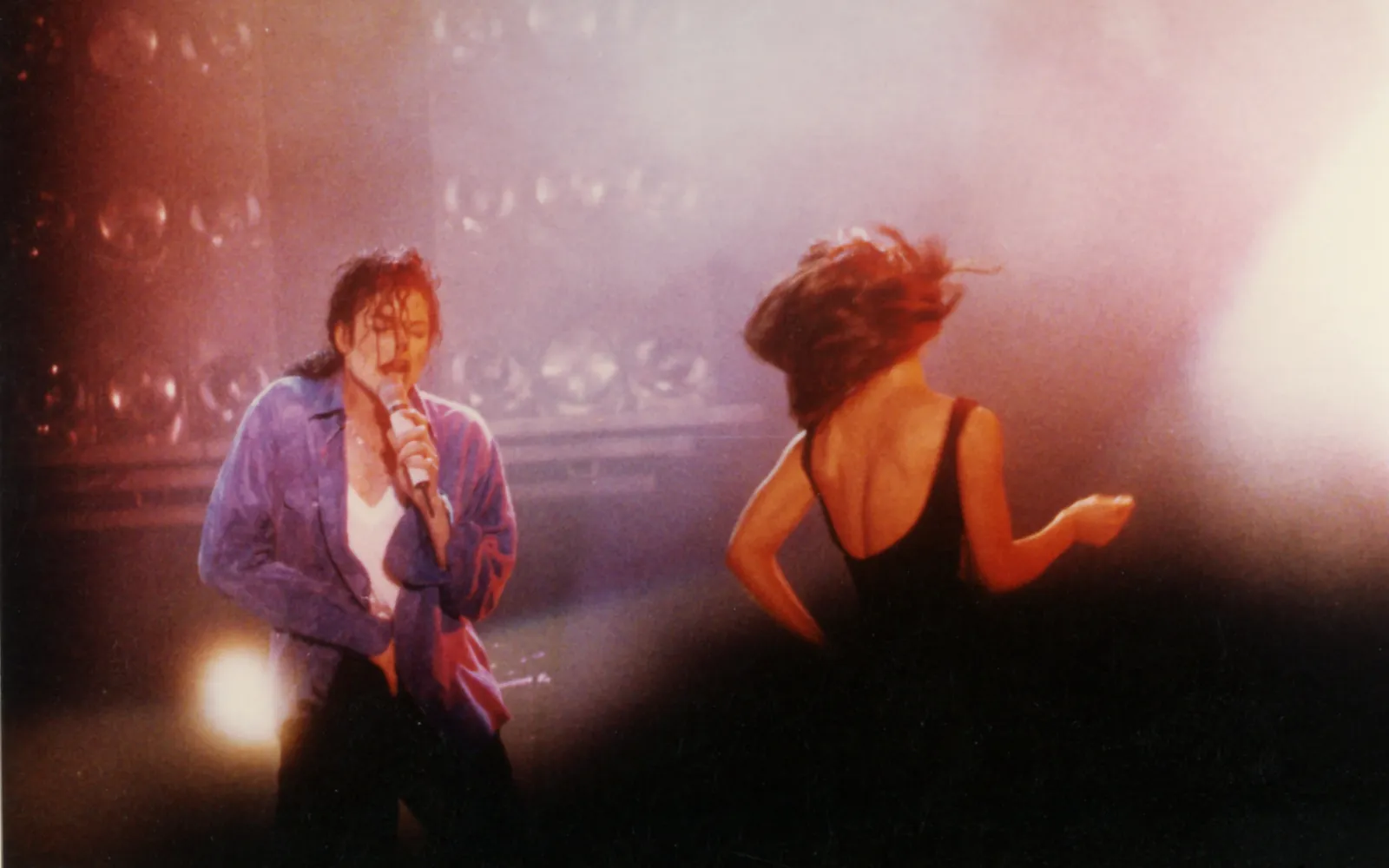
Michael Jackson performing during the Dangerous World Tour in Monza, Italy, in 1992. Photo by Daniele Dalledonne via Wikimedia Commons, licensed CC BY-SA 2.0.
Dangerous enters the new jack swing machine
After separating creatively from Jones, Jackson worked with Teddy Riley and others on Dangerous. The album's hardest tracks embrace new jack swing: dense programmed drums, industrial textures, clipped samples and aggressive syncopation.
"Jam" sounds like machinery learning to dance. "Remember the Time" balances a warm melodic center with intricate rhythmic detail. "In the Closet" uses whisper, breath and repetition to turn secrecy into pressure.
The album is less perfectly proportioned than its predecessors, but its excess documents an artist refusing to become a museum of his own 1980s sound. Jackson's voice meets harsher digital surfaces and discovers new forms of attack.
Black or White makes global scale visible
"Black or White" combines a direct guitar figure, pop-rock structure, rap passage and a message of racial equality. Its short film moved through globalized sets and concluded with then-new morphing technology, making faces transform across race and gender.
The imagery can now appear simplified, especially where cultural difference becomes a rapid visual catalogue. Yet the video's central ambition was unmistakable: mass pop could make the boundaries of representation part of its spectacle.
The extended ending complicated that universal optimism with rage, destruction and controversy. Jackson's visual work often sought total address, then revealed the instability beneath it.
Heal the World shows the limits of universal language
Jackson's humanitarian songs aimed for language broad enough to cross borders. At their best, massed voices and simple melodies create usable collective feeling. At their weakest, universality becomes abstraction, replacing political specificity with image and uplift.
This tension is part of the career's scale. Jackson wanted pop to function as common language, but common language can hide unequal conditions. The songs remain important evidence of ambition even when their solutions are less persuasive than their emotion.
HIStory turns persecution into monumental form
HIStory paired a greatest-hits disc with new material, placing present grievance beside an already canonized past. The gesture is defensive and imperial at once. "Scream," with Janet Jackson, uses industrial production and sibling chemistry to answer media pressure with controlled fury.
"They Don't Care About Us" is rhythmically formidable, built on marching force and a chorus designed for crowds. Its history also includes justified criticism over antisemitic language in the original lyric, which Jackson revised. Artistic force does not exempt language from consequence.
Across the album, public scrutiny becomes sound: distortion, military scale, tabloid fragments and wounded balladry. The result can be overbearing, but it makes celebrity pressure material rather than merely biographical.
Invincible contains craft inside an impossible image
By Invincible, Jackson's public image had become so saturated with history that new music struggled to arrive without being treated as referendum. The album is long and uneven, yet tracks such as "You Rock My World," "Butterflies" and "Break of Dawn" preserve detailed vocal arrangement and rhythmic sensitivity.
"Butterflies" is especially revealing because it reduces the need for spectacle. Neo-soul warmth and layered harmonies allow Jackson to sound conversational, reminding listeners that the instrument remained capable of subtle pleasure beneath the machinery of myth.
The allegations cannot be edited out of the legacy
Any contemporary account must acknowledge the allegations of child sexual abuse made against Jackson. He denied the allegations during his lifetime, reached a civil settlement in one case, and was acquitted of criminal charges in 2005; later testimony and documentaries continued public scrutiny after his death.
Listeners and institutions have reached different conclusions about how to respond. This article cannot adjudicate experiences it did not witness, and artistic analysis must not be used to dismiss serious claims or the people making them. The difficulty is real: cultural influence can be documented without converting documentation into moral absolution.
Jackson's scale makes that responsibility more urgent, not less. The industry, fandom and media systems built around extraordinary fame also shaped what could be seen, challenged or protected.
Dance became a form of editing
Jackson's choreography is often remembered through isolated signatures—the moonwalk, the toe stand, the lean—but his deeper innovation was editorial. He selected from street dance, mime, jazz, tap and theatrical gesture, then organized movement for camera and mass recognition.
A shoulder accent can behave like a cut. A spin compresses transition. A held pose freezes the frame without stopping the music. Jackson danced not only to the beat but to the imagined edit, which is why performance and video remain difficult to separate.
The breath became percussion
Jackson's vocal vocabulary includes gasps, clicks, grunts, hiccups and fragments that resist ordinary lyric transcription. These sounds reveal an understanding shared by great rhythm singers: the line between voice and drum is optional.
On records as different as "Don't Stop 'Til You Get Enough," "Billie Jean," "Smooth Criminal" and "Jam," breath indicates force, fills subdivisions and tells the body how to hear the groove. Producers could remove instruments because Jackson supplied motion inside the vocal track.
Pop after Michael became audiovisual by default
Jackson's influence is visible whenever an artist treats choreography, video, styling and release strategy as one composition. That includes K-pop's integrated performance system, stadium pop's cinematic interludes, dance challenges built around precise gestures and the expectation that a major single will possess an instantly recognizable visual world.
Influence does not mean every later performer imitates his sound. It means the infrastructure of ambition changed. Artists now enter a field in which Jackson's synthesis is part of the baseline.
The monument is made of details
Michael Jackson's title as the King of Pop can make the career sound inevitable, as though scale generated itself. The recordings argue otherwise. Listen below the monument and one hears thousands of local solutions: the drum sound chosen, the harmony withheld, the camera delayed, the breath left in.
His legacy is therefore neither a spotless crown nor a catalogue that can be responsibly erased into silence. It is an immense, contested archive that changed how popular music moves through bodies and screens.
Jackson made pop audiovisual before that word described everyday culture. The achievement remains astonishing; the history around it remains difficult. Serious listening requires the capacity to hold both truths without asking either to make the other disappear. Cover Story rating: 9.7/10.
Sources: Michael Jackson official releases and videos; official Spotify recordings; public Motown and Epic catalogue documentation. Cover photo from the Bad World Tour in Vienna by Zoran Veselinovic via Wikimedia Commons, licensed CC BY-SA 4.0 in the enhanced version. Inline photo by Daniele Dalledonne via Wikimedia Commons, licensed CC BY-SA 2.0.