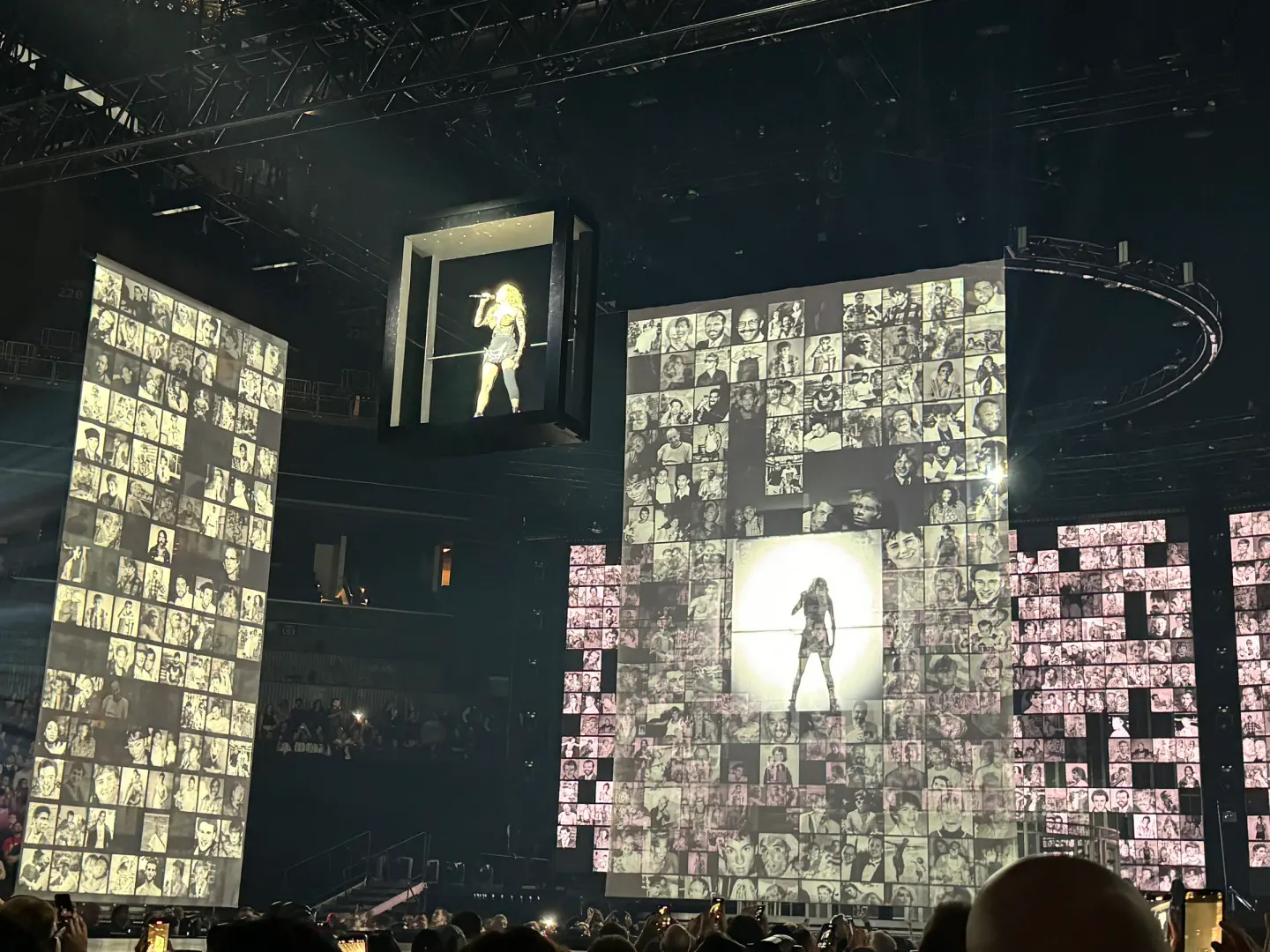
A closer look at the scenes and context surrounding Madonna's music.
Madonna did not merely keep reinventing herself. She made reinvention part of the authorship of pop: a way to control the image, test the culture around it, discard the answer and begin again before the audience could decide that the previous version was permanent.
That distinction matters. Reinvention can sound like a wardrobe change, a sequence of market corrections or a defense against age. In Madonna’s work, it is closer to composition. A record, video, photograph, tour and controversy form one temporary argument about who may speak, desire, pray, age and command attention. Then the argument moves.
More than four decades after her debut, the machinery is still visible. The career-spanning Celebration Tour treated the archive as live material rather than a museum display. Confessions II, released on July 3, 2026 and produced principally with Stuart Price, returns to the dance floor without pretending that return means repetition. Madonna’s subject has always been motion itself: the freedom to become a moving target.
I. The Dance Floor Before the Throne
The origin is not royalty but community. Early Madonna records understand the dance floor as a place where identity is made among strangers. “Everybody” begins with an invitation, not a proclamation. “Holiday” turns escape into a shared rhythm. “Lucky Star” makes desire sparkle through economical synths, drum machines and a voice whose directness is more important than technical display.
The voice is often underestimated because it is so functional. Madonna can sound girlish, severe, devotional, conversational or electronically processed, but she rarely sings to prove that the song deserves her. She makes the vocal serve posture and scene. The early singles carry the urgency of someone who knows a crowded room will not wait for a long explanation.
New York club culture gave her more than a beat. It provided a model of pop as exchange: fashion, gesture, dance, photography and music circulating through communities before the mainstream learned their language. Madonna’s lasting gift was not simply taking that exchange to a mass audience. It was understanding that a pop artist could direct the whole circuit.
II. MTV and the Image That Answers Back
Like a Virgin transformed visibility into authorship. The wedding dress, lace, crucifixes and exposed roots were not accessories around a neutral song. They complicated its title. Innocence became something performed with full knowledge of the camera; scandal and comedy occupied the same frame.
“Material Girl” sharpened the method. Its Marilyn Monroe quotation could be read as worship, parody or strategic self-advertisement. Madonna did not resolve the ambiguity. She occupied it. The song turned the accusation of materialism into a role she could exaggerate until the viewer had to confront their own appetite for the image.
This is where the modern self-directing pop star comes into focus. Music videos were not promotional leftovers. They were texts that could argue with the song, change its speaker and produce meanings the lyric did not contain alone. Clothing, choreography and casting became editorial decisions. The artist’s image stopped being the packaging and became part of the record.
III. Belief, Desire and the Refusal to Separate Them
“Like a Prayer” remains central because it brings Madonna’s recurring materials into one charged space: Catholic iconography, erotic surrender, racial imagery, gospel release and pop discipline. The arrangement moves from intimate confession to communal elevation. The video makes spiritual and bodily longing impossible to file into separate categories.
The controversy was not incidental publicity attached afterward. It revealed the argument. Institutions often allow women to embody purity or transgression, devotion or appetite, but become anxious when one person claims both without apology. Madonna’s work repeatedly enters that anxiety and uses mass entertainment to keep it visible.
“Express Yourself” turns the demand outward. Its industrial world is monumental, but the message is practical: desire without self-respect is another hierarchy. The song’s command is not simply romantic advice. It is a theory of performance. To express yourself is to refuse the identity another system has prepared for you.
These records established a durable Madonna pattern. A pristine pop hook opens the door; an image introduces conflict; public reaction completes the work. She does not control every interpretation. She controls the conditions under which interpretation becomes unavoidable.
IV. Erotica and the Cost of Controlling the Frame
The Erotica era pushed that strategy until culture pushed back. Album, videos, the Sex book and the Girlie Show formed an extended inquiry into fantasy, shame, power and spectatorship. Its most famous images were explicit, but the music is frequently colder, lonelier and more analytical than its reputation suggests.
“Erotica” uses a controlled spoken delivery over a shadowed club track. “Deeper and Deeper” sounds euphoric while treating desire as a truth that cannot stay buried. “Bad Girl” looks past provocation toward self-punishment. The persona is in command, yet the record keeps asking what command costs.
The backlash exposed a limit in the contract between female celebrity and audience. Reinvention was welcomed while it remained consumable, but sexual self-authorship was recast as excess when Madonna made looking itself part of the subject. That period is crucial precisely because it was not a frictionless triumph. It showed that controlling the frame does not mean controlling the punishment.
Bedtime Stories did not retreat so much as change temperature. Its R&B surfaces, emotional hesitation and the Björk-assisted “Bedtime Story” allow vulnerability and abstraction back into the image. Reinvention here means refusing to let opposition define the next move.
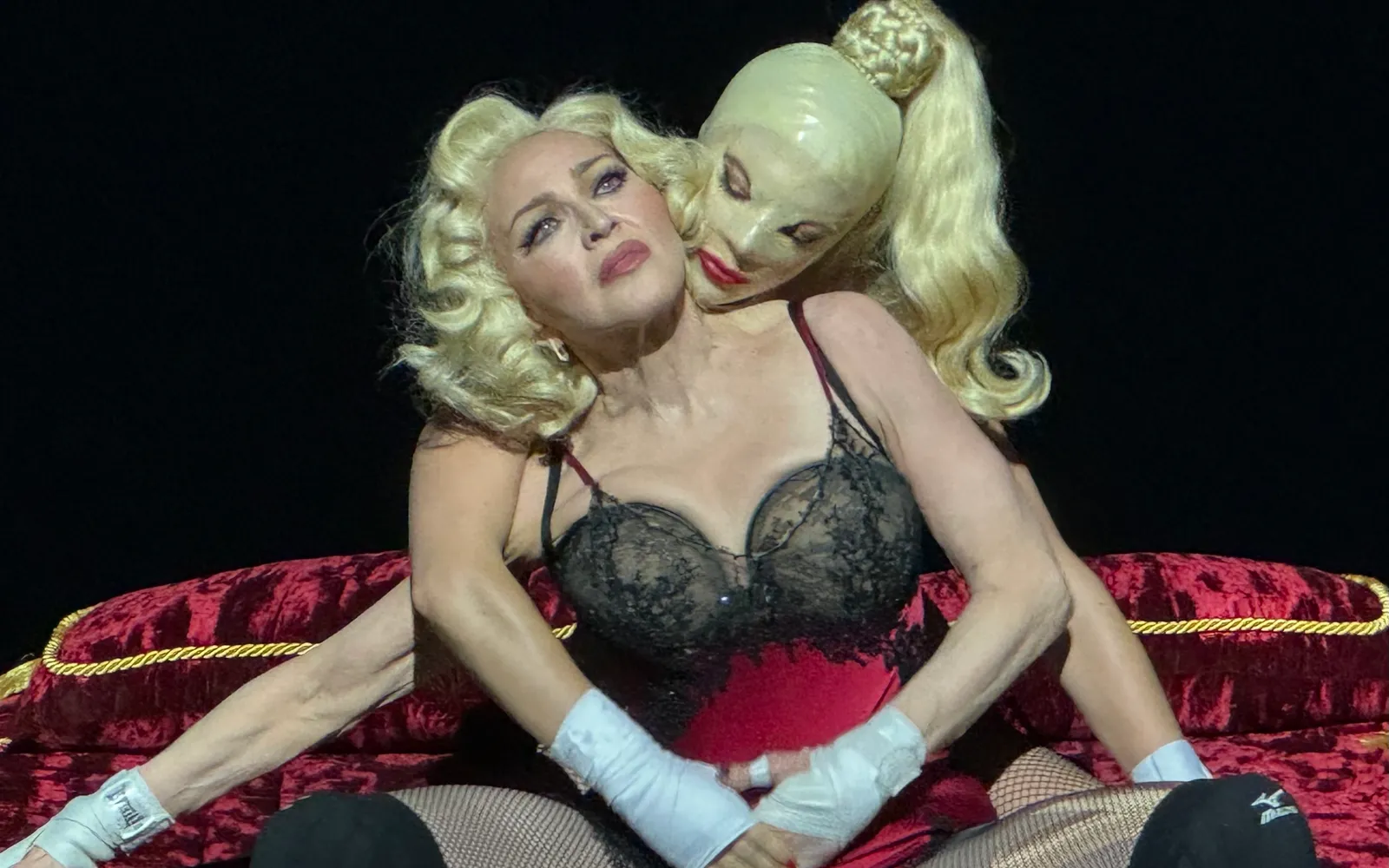
Photo: Madonna performing on The Celebration Tour at Barclays Center, New York, December 13, 2023. David Shankbone / Public Domain Mark, via Wikimedia Commons.
V. Ray of Light: The Body Becomes Weather
Ray of Light is often described as a mature reinvention, language that risks reducing adulthood to a genre. Its achievement is stranger. Working with William Orbit, Madonna lets electronic production dissolve the hard outline of the celebrity image. Synthesizers flicker, stretch and erode; breakbeats make spiritual inquiry physical.
“Drowned World/Substitute for Love” opens by questioning the bargain of fame. “Frozen” makes emotional closure sound architectural. The title track races with the sensation that revelation may be too fast for the body receiving it. Motherhood, loss, mysticism and technology coexist without becoming a tidy redemption narrative.
Her singing changes with the world. Training undertaken for Evita is audible in the breath and control, but the performance never becomes merely respectable. On the title track, the voice strains toward the top of its range because transcendence should sound difficult. On “Nothing Really Matters,” clarity arrives over music that keeps moving beneath it.
The album expanded the possibilities of mainstream electronic pop because it did not treat dance production as an escape from interior life. It made the club, the body and the spiritual question the same environment.
VI. “Vogue” and the Ethics of Borrowed Light
“Vogue” is one of Madonna’s most perfect pop constructions: a piano figure, a house pulse, spoken names, clean commands and poses timed like percussion. It also requires context. Voguing was developed in Black and Latino queer ballroom communities; Madonna’s global platform brought extraordinary visibility while also becoming part of an enduring debate about who receives credit, access and profit when subculture enters the mainstream.
A serious reading holds both realities. The video and performances featured ballroom figures, and the song directed mass attention toward a form many viewers had never encountered. At the same time, Madonna became the name most commercially attached to a culture she did not create.
This tension belongs inside her legacy rather than outside it. Her career is inseparable from collaboration with dancers, stylists, producers, photographers and queer communities. The self-directing star is never a solitary invention. Madonna’s power lies in synthesis, but synthesis creates responsibilities: to name sources, preserve complexity and resist turning community into texture.
VII. Confessions on a Dance Floor: Return as Forward Motion
By 2005, returning to disco could have looked like nostalgia. Confessions on a Dance Floor instead behaves like one continuous present. Stuart Price’s production joins tracks into a sustained mix; the transitions make stopping feel less natural than continuing.
“Hung Up” builds on an ABBA sample whose familiarity becomes a clock. The lyric waits for a lover, but the track refuses stillness. That contradiction captures Madonna’s career in miniature: time is pressure, movement is the answer. “Sorry” turns multilingual dismissal into propulsion, while “Jump” makes risk sound like a communal instruction.
The album’s leotards and mirrored-ball imagery knowingly recall dance history, but the sound is too streamlined to live in retro comfort. Madonna does not return to the club to become young again. She returns because the club has always been her laboratory for turning repetition into change.
VIII. The Tour as a Living Archive
Madonna helped establish the modern pop tour as authored spectacle: set list, costume, narrative, choreography and political image assembled into a temporary city. Songs are not simply reproduced. They are recast by the scene around them, often answering earlier versions of the performer.
The Celebration Tour made that principle explicit. Her first full retrospective did not arrange four decades into a polite chronology. It staged memory as collision: club beginnings beside imperial pop, religious imagery beside loss, sexual performance beside the names and faces of people claimed by AIDS. The archive moved because bodies moved through it.
Its final free concert on Copacabana Beach in May 2024 turned personal retrospective into public scale. Associated Press reported an estimated 1.6 million attendees, citing Rio’s tourism agency. More important than the number was the shape of the event: a career that began in compressed New York rooms projected across a beach, still organized around the dance floor as a temporary commons.
The tour also reframed survival. After a serious illness delayed its opening, performance carried the knowledge that continuity is physical, not guaranteed. Reinvention looked less like escape from the past than the ability to stand inside it and keep directing.
IX. Confessions II and the Next Temporary Answer
Confessions II arrives twenty-one years after its named predecessor. The title promises continuity, and Stuart Price’s central role makes the bridge audible. Yet its very existence tests Madonna’s old rule: a return must become a new proposition or it is only branding.
The official credits map a contemporary network around the partnership, including collaborators and guests such as Arca, Sabrina Carpenter, Feid, Tainy and Martin Garrix. The dance floor is no longer the same room it was in 1982 or 2005. Pop has absorbed house, techno, Latin music and queer club aesthetics into its everyday vocabulary, sometimes without carrying their histories.
That makes a new confession more than sequel mechanics. It asks what Madonna can still say from inside a language she helped mainstream, and how an artist associated with permanent transformation handles the cultural demand to revisit a beloved era. The answer is necessarily temporary. That is the point.
X. The Moving Target
Madonna’s influence is visible whenever a pop album arrives as a complete visual world, whenever a tour rewrites a catalog, whenever controversy is used to expose the rules governing a woman’s body, or whenever a performer changes genre before the market has approved the move. But influence should not flatten the contradictions.
Her work has opened doors and borrowed from communities whose contributions deserve precise credit. It has challenged moral policing while mastering commercial attention. It has made aging in public an arena of control and also revealed how punishing that arena remains. The legacy is powerful because it is contested, not because it is pure.
The essential Madonna gesture is therefore not any cone bra, crucifix, beat or pose. It is the cut between poses: the decision that the current image is an authored sentence, not a life sentence. She invented the pop star as a moving target, then spent four decades proving that movement can carry memory rather than erase it.
Where to Start
“Holiday” — the dance floor as shared possibility
“Like a Prayer” — belief, desire and mass-pop drama in one frame
“Vogue” — a perfect single that opens a necessary conversation about source and visibility
“Bad Girl” — the loneliness inside the Erotica era’s control
“Ray of Light” — electronic motion as physical revelation
“Hung Up” — time pressure transformed into dance-floor momentum
Cover image: Madonna performing on The Celebration Tour at Barclays Center, New York, December 13, 2023. David Shankbone / Public Domain Mark, via Wikimedia Commons.