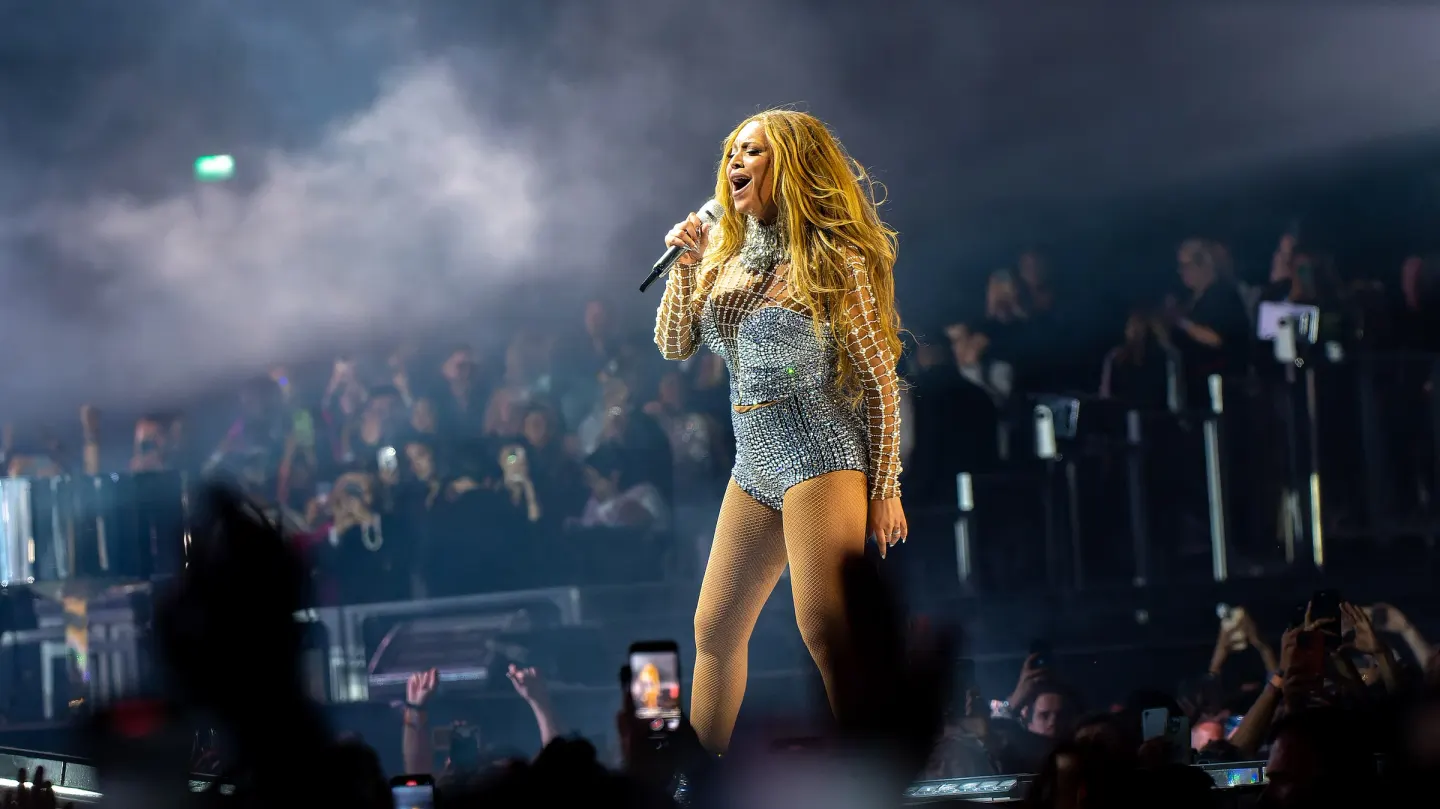
A closer look at the scenes and context surrounding Beyoncé's music.
Beyoncé’s catalog is often described through mastery: the voice, the staging, the albums that arrive as cultural events. A better way in is through transformation. Across five movements, she turns rhythm into command, technique into feeling, private rupture into cinema, the dance floor into archive, and genre into a question about ownership.
This is not a ranking of the biggest hits. It is a listening route built around contrasts. Each movement places familiar songs beside records that complicate them, revealing an artist whose precision is valuable because it keeps changing purpose.
Beyoncé began her solo career inside the grammar of early-2000s R&B and pop. She gradually made the album, the concert and the surprise release into larger compositional forms. By RENAISSANCE and COWBOY CARTER, sequencing itself had become part of her voice. The five movements below follow that expansion without treating early pleasure as a primitive stage she had to outgrow.
Movement I: Command Is Rhythm
Begin with: “Crazy in Love” → “Déjà Vu” → “Get Me Bodied”
The opening horn blast of “Crazy in Love” sounds like an announcement, but Beyoncé’s authority comes from what she does after it. She does not simply sing over the Chi-Lites sample. She reorganizes its momentum through breath, attack and short rhythmic cells. The verse darts, the pre-chorus stretches, and the hook lands with the ease of something that had been waiting inside the sample all along.
“Déjà Vu” makes the body even more visible. Live bass and drums create a restless field; Beyoncé treats each instrument as a partner rather than accompaniment. Her vocal can snap like a snare, hold against the bass or rise above the arrangement without abandoning groove. Desire appears as rhythmic recognition before it becomes language.
“Get Me Bodied” converts that intelligence into instruction. Names of dances, counts and call-and-response phrases transform the track into a social space. Beyoncé is leader and participant at once. The song does not ask the listener to admire control from a distance; it uses control to organize collective release.
These records establish a principle that never leaves her work: command is not the same as loudness. It is the ability to decide where everyone hears the beat.
Movement II: The Voice Climbs Toward Vulnerability
Continue with: “1+1” → “Love on Top” → “Rather Die Young”
Technical discussions of Beyoncé often isolate the range from the drama. 4 makes that separation impossible. “1+1” begins with guitar, spacious drums and a vocal that seems almost too exposed for the scale it will reach. The song’s arithmetic is deliberately simple because the performance supplies complexity: rasp against purity, restraint against eruption, certainty against the fear that certainty may be all the lovers have.
“Love on Top” turns modulation into narrative. Its repeated key changes are famous as a vocal test, but virtuosity alone would make them a stunt. Beyoncé uses each ascent to renew delight. The arrangement rises because affection keeps finding another floor.
“Rather Die Young” complicates that brightness with devotion pushed toward danger. Its retro-soul language could invite tasteful distance; Beyoncé sings close enough to the risk that the polish becomes unstable. She understands that a flawless note can carry flawed desire.
The second movement reveals why vocal power remains central even as the albums grow more conceptual. Technique is not decoration around the idea. It is where the idea becomes bodily.
Movement III: The Album Becomes Cinema
Turn to: “Haunted” → “Partition” → “Formation”
The surprise release of BEYONCÉ in 2013 changed the scale of the pop album by making image and sound arrive together. “Haunted” is an ideal threshold. Its two-part structure moves from spoken frustration with industry routine into sparse, nocturnal electronic music. The song feels like a corridor between public career and private appetite.
“Partition” treats editing as composition. A limousine divider becomes a theatrical curtain; beat changes create rooms; French speech and breath turn fantasy into production design. The track is explicit, but its real subject is authorship over being seen. Beyoncé directs the gaze that consumes her.
Lemonade widens this visual method into narrative, history and geography. “Formation” is both finale and new beginning: New Orleans images, Southern speech, family lineage, wealth and state violence occupy the same frame. The song’s clipped low end leaves space for declarations that move between joke, memory and political fact.
What makes “Formation” durable is its refusal to translate itself into one respectable message. Beyoncé does not choose between personal style and collective history. She shows how style can contain history, then builds a visual world large enough for both.
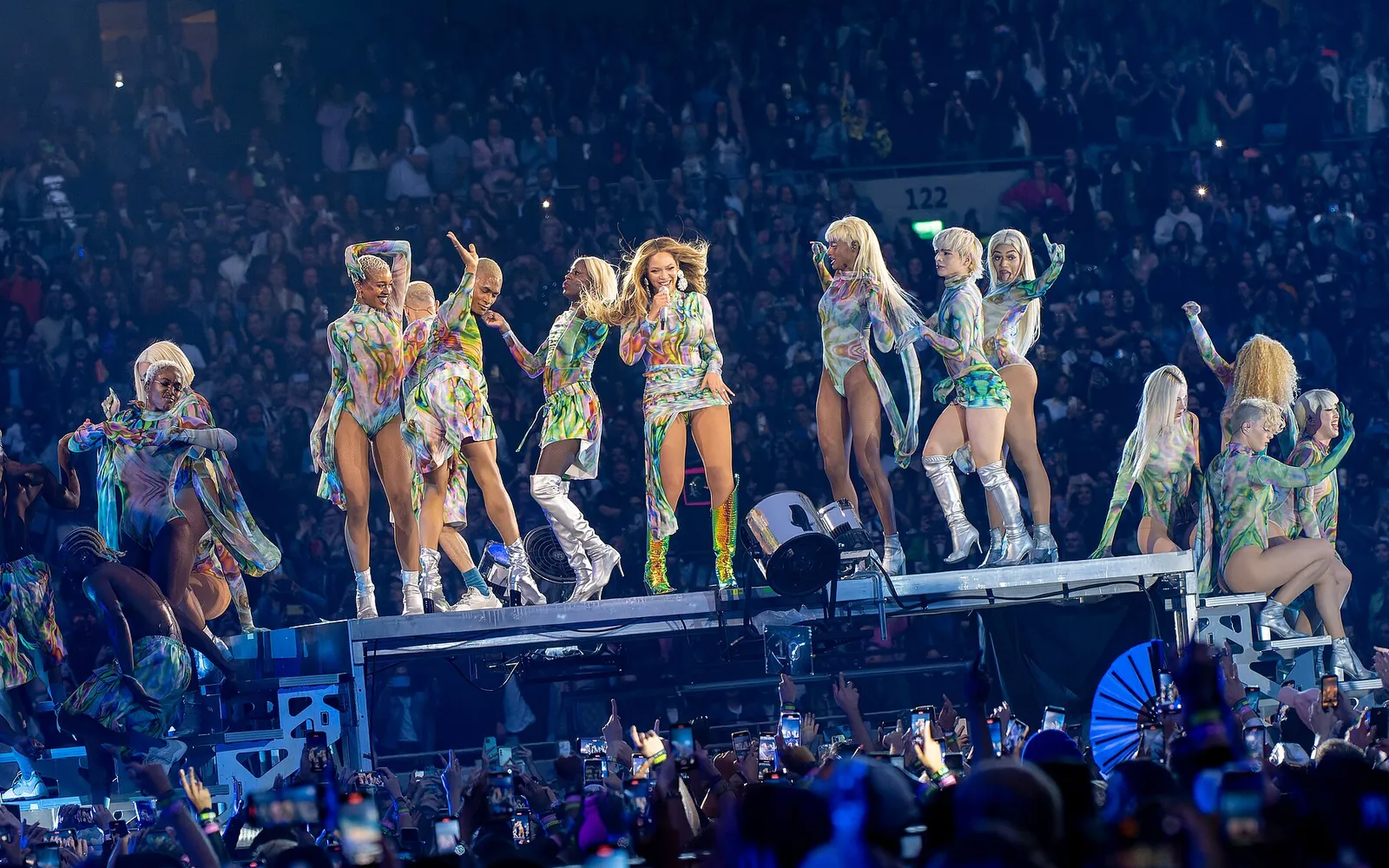
Photo: Beyoncé performing on the Renaissance World Tour at Tottenham Hotspur Stadium, London, June 2023. Raph_PH / CC BY 2.0, via Wikimedia Commons. Cropped for presentation.
Movement IV: The Dance Floor Remembers
Move without stopping: “BREAK MY SOUL” → “VIRGO’S GROOVE” → “PURE/HONEY”
RENAISSANCE should be heard as a continuous environment rather than a collection of singles. Transitions behave like doors between adjacent rooms. Samples and references do not sit behind Beyoncé as proof of taste; they create a living network of Black and queer dance traditions.
“BREAK MY SOUL” enters through release: work, exhaustion and refusal translated into house pulse. Beyoncé’s delivery is deliberately communal. The hook is broad enough to be carried by a room, while Big Freedia’s sampled voice gives the record an engine and lineage that cannot be separated from its message.
“VIRGO’S GROOVE” stretches beyond six minutes because intimacy needs time to become physical. Bass, guitar and layered harmonies keep changing proportion without breaking the spell. Beyoncé moves from soft invitation to stacked vocal architecture, making technical abundance feel like touch.
“PURE/HONEY” links ballroom attitude, house pressure and disco sheen. Its two-part form moves from category and pose toward sweetness, turning competition into celebration. The song understands the dance floor as an archive stored in gestures, voices and names.
This movement is crucial because it reframes Beyoncé’s perfectionism. On RENAISSANCE, precision does not sterilize pleasure. It protects the conditions in which pleasure can keep moving.
Movement V: Genre Is an Archive, Not a Fence
Finish with: “AMERIICAN REQUIEM” → “16 CARRIAGES” → “YA YA”
COWBOY CARTER opens by questioning the category it has already been placed inside. “AMERIICAN REQUIEM” layers psychedelic rock, gospel harmony and country signifiers while Beyoncé addresses the demand that she prove belonging. The doubled “I” in the title visually unsettles the nation it names.
“16 CARRIAGES” narrows the argument to labor. The narrator looks back at adolescence, touring and the cost of carrying ambition across years. Steel guitar and slow percussion provide country vocabulary, but the emotional engine is work: family work, performance work, the work of leaving and returning.
“YA YA” explodes the borders. Rock-and-roll drive, soul revue energy, country imagery and American standards flash through a track that treats genre history as contested public memory. Beyoncé is not asking permission to cross from one shelf to another. She is showing that the shelves were assembled after the music had already mixed.
“TEXAS HOLD ’EM” is the accessible doorway into this movement, but the deeper route ends with the album’s refusal of purity. Country, rock, gospel, blues and pop are not costumes in separate closets. They are overlapping histories shaped by migration, exclusion, commerce and Black invention.
After the Fifth Movement
The most revealing arc in Beyoncé’s catalog is not from entertainer to artist, as if “Crazy in Love” required later seriousness to validate it. The artistry was present in the rhythmic decisions from the beginning. What changed was the scale of the container.
A single became a visual album. A visual album became a film of family and national memory. A dance record became an archive. A country classification became an argument about classification itself. Through every expansion, the voice remains the organizing intelligence.
That is why these five movements can coexist without becoming a career summary. Beyoncé does not leave one method behind when she discovers another. Rhythm returns inside narrative; cinema returns inside the concert; vocal technique returns inside genre history. The catalog accumulates capacities.
Listen in this order and the achievement becomes less about flawlessness than transformation. Beyoncé’s control matters because she repeatedly uses it to enter unstable territory—desire, betrayal, communal memory, pleasure and belonging—then redesigns the form around what she finds.
The Five-Movement Playlist
Command Is Rhythm: “Crazy in Love,” “Déjà Vu,” “Get Me Bodied”
The Voice Climbs: “1+1,” “Love on Top,” “Rather Die Young”
The Album Becomes Cinema: “Haunted,” “Partition,” “Formation”
The Dance Floor Remembers: “BREAK MY SOUL,” “VIRGO’S GROOVE,” “PURE/HONEY”
Genre Is an Archive: “AMERIICAN REQUIEM,” “16 CARRIAGES,” “YA YA”
Cover image: Beyoncé performing on the Renaissance World Tour at Tottenham Hotspur Stadium, London, June 2023. Raph_PH / CC BY 2.0, via Wikimedia Commons. Cropped for presentation.