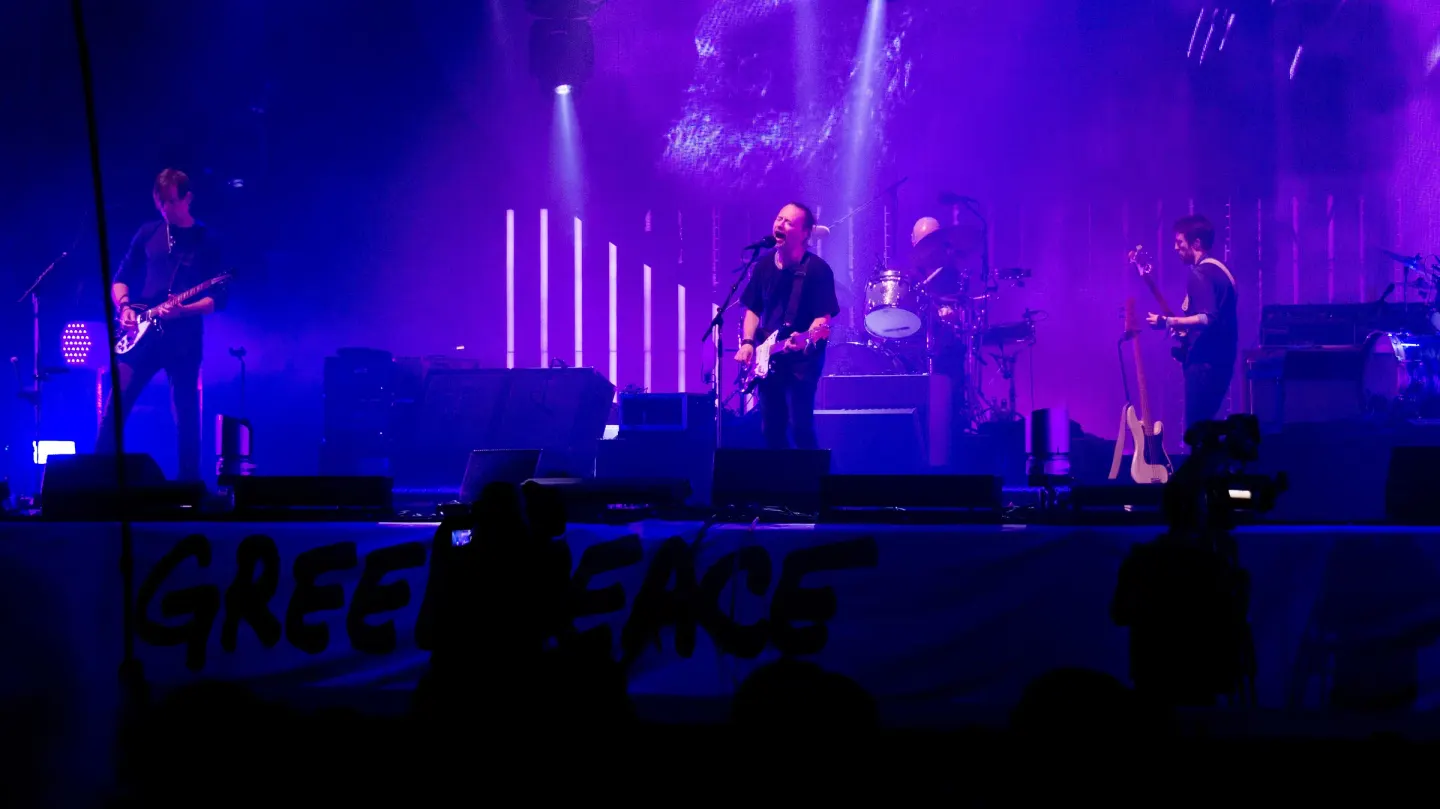
A closer look at the scenes and context surrounding Radiohead's music.
Radiohead’s most distinctive instrument is not Thom Yorke’s falsetto, Jonny Greenwood’s guitar or any particular machine. It is space: the distance between a pulse and a voice, the room around a string arrangement, the pressure created when familiar rock sounds are moved somewhere they no longer feel safe.
That is why the band’s catalog can change radically without losing its identity. The guitars of The Bends, the dislocated rock architecture of OK Computer, the processed electronics of Kid A, the bodily warmth of In Rainbows and the orchestral grief of A Moon Shaped Pool use different materials. They share a method: anxiety is not merely described in the lyric. It is designed into the environment surrounding the listener.
Radiohead make songs that behave like places. Doors close unexpectedly. Floors tilt. A beautiful surface contains a mechanical noise. A rhythm repeats until it stops feeling like time and starts feeling like surveillance. The listener does not receive a report about unease; the listener is placed inside its architecture.
I. From Guitar Impact to Negative Space
The early Radiohead sound is often reduced to the loud-soft detonation of “Creep.” Yet The Bends already shows the band learning that impact depends on what surrounds it. “Planet Telex” opens with smeared piano and studio atmosphere before the band enters. “Fake Plastic Trees” lets restraint accumulate until distortion feels like an emotional consequence rather than a required rock climax.
“Street Spirit (Fade Out)” is the decisive lesson. Its guitar pattern repeats with almost no promise of release. Yorke’s melody rises over it, but the harmony does not grant escape. The song creates dread through persistence, not volume. It is less a performance of despair than a corridor built from arpeggios.
This approach separates Radiohead from bands that treat atmosphere as decoration. Every texture has structural work to do. Ed O’Brien’s sustained tones expand the room; Colin Greenwood’s bass defines the unseen floor; Phil Selway’s drumming can anchor a song or quietly make its balance uncertain. Jonny Greenwood often introduces the object that does not belong. Yorke moves through the space as both narrator and exposed nerve.
II. OK Computer: The System Enters the Song
OK Computer enlarges private anxiety into infrastructure. Roads, transport, corporate language, automated voices and social performance surround characters who cannot tell whether technology is serving them or absorbing them. The album’s achievement is not that it predicted particular devices. It recognized a psychological condition: modern systems become intimate long before they become understandable.
“Airbag” begins with a guitar sliced into an unusual loop, making a rock riff feel sampled from wreckage. “Paranoid Android” joins incompatible sections without pretending that one is the stable center. Acoustic unease, distorted attack and choral suspension occupy the same body. Form itself becomes the nervous system.
“Fitter Happier” removes the human singer and lets a synthetic voice recite optimized life instructions. The arrangement does not need to announce horror; the gap between reassuring language and the damaged soundscape does the work. “No Surprises” reverses the strategy. Its glockenspiel is gentle enough for a nursery, which makes the exhaustion inside the song more severe.
The Library of Congress essay on the album identifies breaks with conventional rock form, timbre and lyrical subject. Those dimensions converge as spatial decisions. Familiar instruments are deformed, sections refuse expected returns, and the lyric is surrounded by a system that seems to continue whether the individual can endure it or not.
III. The Productive Refusal of Kid A
After OK Computer, Radiohead could have expanded the same stadium-rock language. Kid A refuses that room. Guitars recede or become unrecognizable; synthesizers, drum machines, brass, strings and processed voice reorganize the band. The change is often described as a turn toward electronic music, but the deeper shift is from performance to environment.
“Everything in Its Right Place” opens with a keyboard harmony that feels settled and unstable at once. Yorke’s voice is cut, repeated and layered until language becomes another surface. The title promises order while the production reveals a mind unable to experience it.
“The National Anthem” builds a bass pattern into congestion. Brass improvisation does not decorate the groove; it crowds it. “How to Disappear Completely” uses strings arranged by Jonny Greenwood to create a horizon that bends around the vocal. Yorke sings withdrawal, while the orchestra makes disappearance physically impossible: the world keeps moving through him.
“Idioteque” turns sampled electronic sound and an urgent beat into collective panic. The rhythm is danceable, but safety never arrives. Radiohead understand that a beat can organize the body while destabilizing the mind. This is a central craft principle: pleasure and alarm do not alternate. They occupy the same pulse.
IV. Five Musicians, One Unstable Room
Radiohead’s experiments remain compelling because they are not exercises in replacing a band with technology. They are studies in how a band can distribute attention. A part may become almost invisible so another part can alter the perceived size of the song.
Colin Greenwood often plays melodically without demanding the foreground. On “How to Disappear Completely,” bass movement gives the drifting arrangement a private gravity. Phil Selway’s restraint lets programmed and acoustic rhythm coexist without becoming a demonstration. Ed O’Brien specializes in sounds that are hard to identify as guitar but easy to feel as atmosphere.
Jonny Greenwood is often cast as the disruptive experimentalist, but disruption works because the ensemble creates context for it. The violent guitar entrances in “Creep,” the alien tone in “Subterranean Homesick Alien,” the string dissonance of “How to Disappear Completely” and the orchestration of “Burn the Witch” are different answers to the same question: what sound changes the emotional geometry of this room?
Yorke’s voice completes the structure by remaining vulnerable to it. His falsetto can float above a mix, but it rarely sounds protected. Breath, strain and repeated fragments make the singer seem acted upon by the arrangement. Radiohead’s collective intelligence lies in allowing the song to be larger than its narrator.
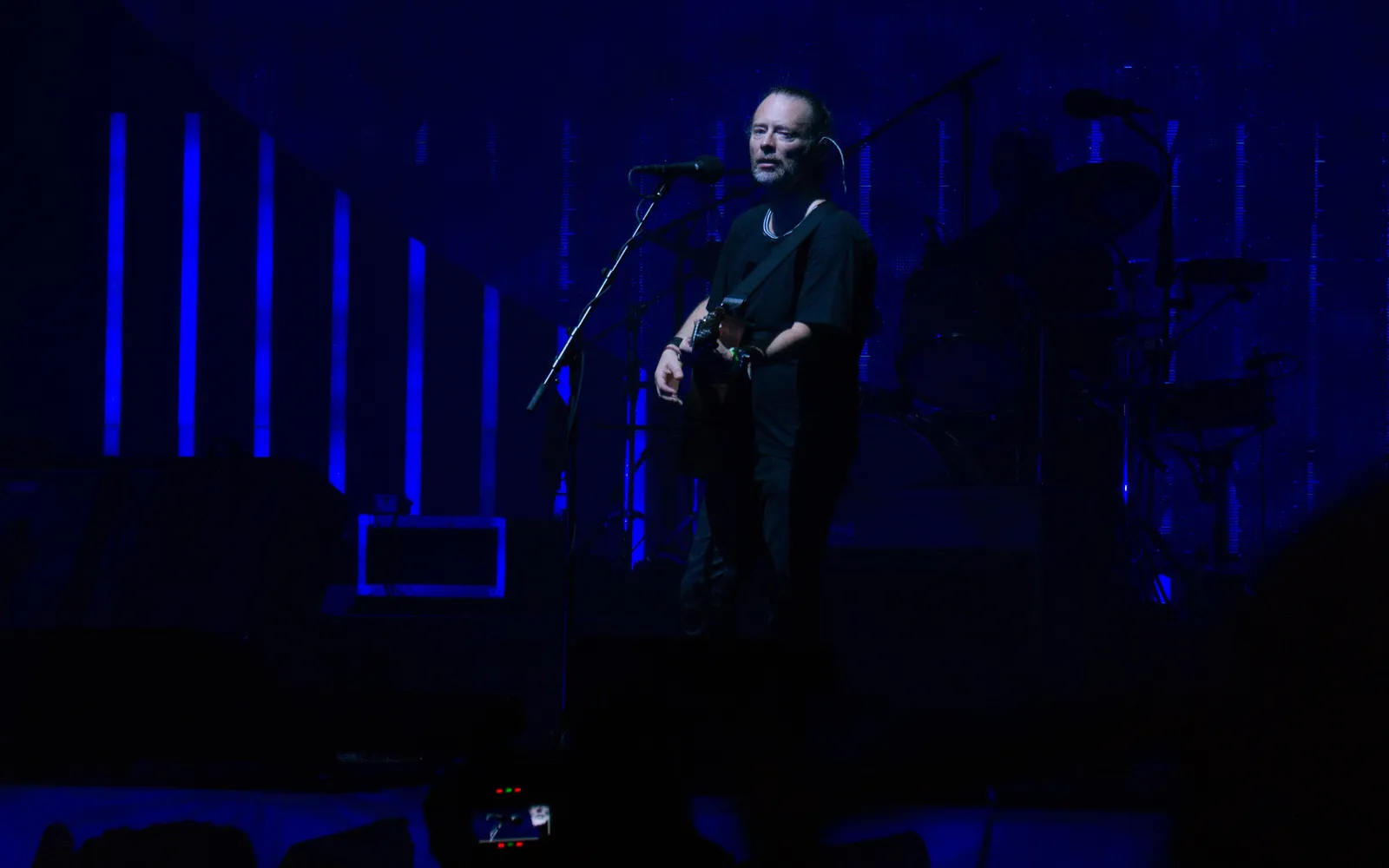
Photo: Radiohead performing at Glastonbury Festival, June 23, 2017. Raph_PH / CC BY 2.0, via Wikimedia Commons. Cropped for presentation.
V. In Rainbows: Anxiety Learns the Body
In Rainbows is sometimes framed as Radiohead becoming warm or accessible after the colder systems of the early 2000s. The record is warmer, but it does not abandon instability. It moves anxiety from the institution into skin, breath, appetite and intimacy.
“15 Step” places a bright guitar figure against a five-beat pulse that keeps the body fractionally off balance. “Nude” opens space around one of Yorke’s most exposed vocals; the arrangement withholds weight until the bass enters like a slow change in gravity. “Weird Fishes/Arpeggi” layers repeating guitars so that forward movement feels indistinguishable from descent.
The record’s production, again developed with Nigel Godrich, is detailed without turning sterile. Instruments retain air around them. On “All I Need,” low-end pressure grows beneath a restrained vocal until the final piano and cymbal release feels enormous. The climax works because the song has spent minutes measuring the room.
“Reckoner” offers the clearest version of Radiohead’s gentleness. Percussion flickers at the edges, guitar glows in the middle distance, strings open behind the voice. Beauty is not used to cancel anxiety. It makes fragility audible.
VI. Rhythm as a Machine With Human Error
From Kid A onward, Radiohead repeatedly blur played rhythm and programmed rhythm. The point is not to make musicians imitate computers perfectly. It is to locate the expressive gap between repetition and touch.
The King of Limbs pushes this method furthest. “Bloom” layers loops and drums until meter feels like overlapping weather systems. Onstage, the band expanded the percussion setup because the studio construction demanded a new physical solution. A recording technique became an arrangement problem, then a performance language.
“Lotus Flower” is more economical. Bass, clipped rhythm and Yorke’s dancing create space through subtraction. The song demonstrates that complexity need not mean density. Radiohead can make a room unstable by removing the wall the listener expected to lean against.
VII. A Moon Shaped Pool: Memory in the Arrangement
A Moon Shaped Pool gathers songs written across different periods and makes them feel haunted by the same weather. Orchestration is central, but strings are not a prestige coating. They carry memory, threat and grief.
“Burn the Witch” uses col legno strings, struck with the wood of the bow, to produce a dry collective attack. The rhythm sounds ceremonial and coercive. “Decks Dark” lets a choir widen the sky above a rhythm section that remains close to the ground. “The Numbers” places ecological urgency inside an arrangement that gradually reveals its scale.
Paul Thomas Anderson’s video for “Daydreaming” follows Yorke through a chain of doors and unrelated spaces. It is an exact visual analogue for Radiohead’s music: continuity created by passage, not stable location. The song moves through piano, reversed texture and orchestral shadow as if each sound opens another room.
The album closes with the studio version of “True Love Waits,” a song carried through the band’s live history for years. Instead of preserving its familiar acoustic shape, Radiohead surround the vocal with overlapping piano figures. Memory is not restored; it is refracted. The arrangement accepts that a song returning after time cannot occupy its old space.
VIII. Why the Architecture Endures
Radiohead’s influence is often measured through surface markers: falsetto melancholy, fractured electronics, irregular meter, anxious lyrics or the refusal to repeat a successful album. Their deeper influence is architectural. They showed a wide audience that experimental decisions could clarify emotion rather than obscure it.
That clarity does not mean explanation. Radiohead songs rarely solve the systems they enter. Instead, they give uncertainty dimensions. A listener can feel how far the voice is from the beat, how much pressure sits under a quiet passage, how an arrangement narrows or opens around a line.
The band’s official Public Library reinforces this relationship to space by organizing decades of recordings, art, videos and ephemera as an explorable archive. The catalog is not a single heroic progression from guitar to electronics. It is a network of rooms revisited with different tools.
Radiohead make anxiety inhabitable without making it comfortable. That is the craft: to build a structure precise enough for disorientation to become shared experience, then leave enough air inside it for every listener to hear their own footsteps.
Listening Route
“Street Spirit (Fade Out)” — repetition as a corridor with no exit
“Paranoid Android” — fractured form as a nervous system
“Everything in Its Right Place” — promised order destabilized by processed voice
“How to Disappear Completely” — strings bending the horizon around the singer
“Weird Fishes/Arpeggi” — interlocking guitars that turn motion into descent
“Daydreaming” — memory organized as passage through rooms
Cover image: Radiohead performing at Glastonbury Festival, June 23, 2017. Raph_PH / CC BY 2.0, via Wikimedia Commons. Cropped for presentation.