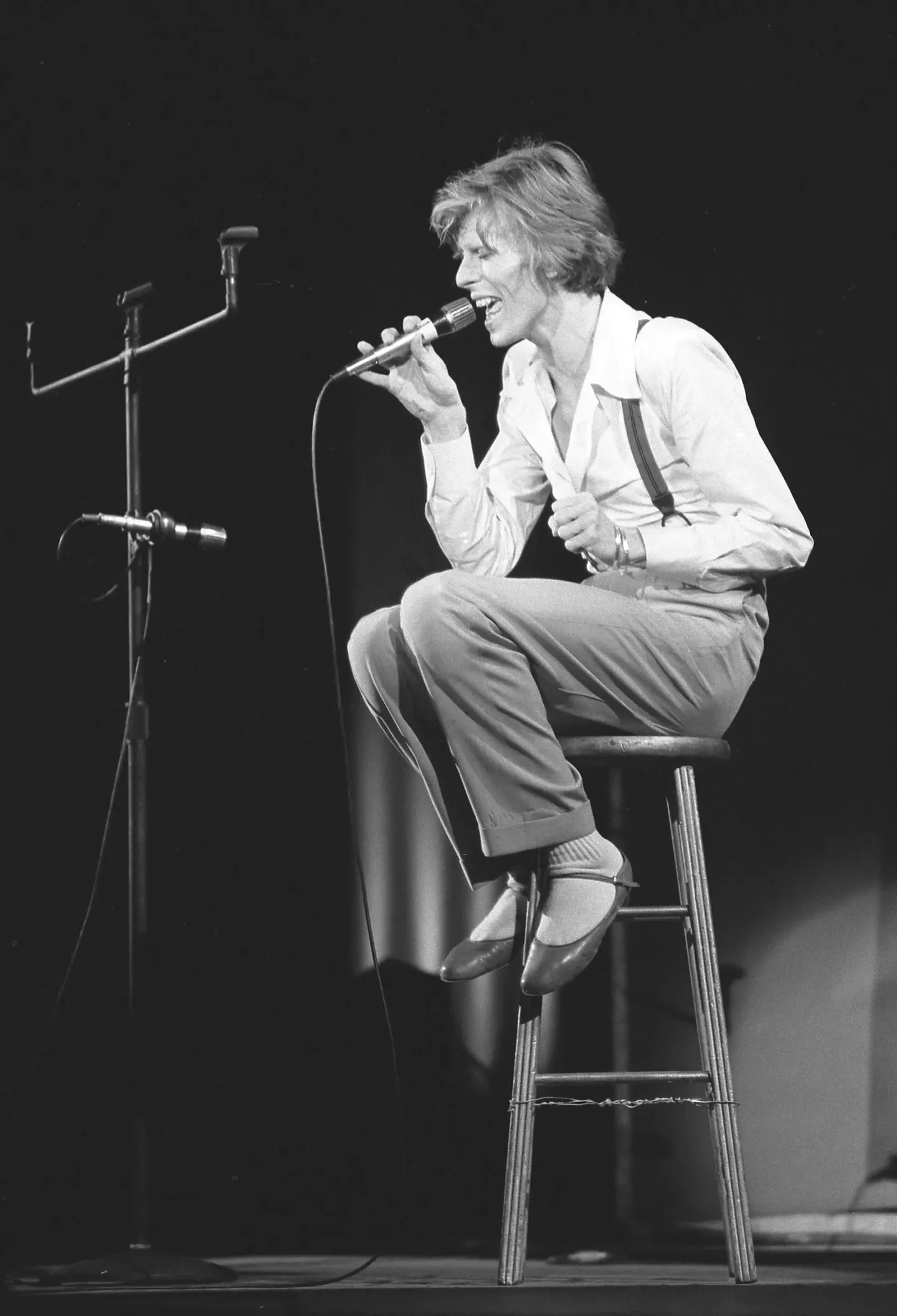
A closer look at the scenes and context surrounding David Bowie's music.
David Bowie did not invent artistic change, but he made change itself legible as an art form. Each new voice, silhouette and production system asked the same question from a different angle: what can a pop identity do if it is treated as a method rather than a possession?
The familiar word is reinvention. It can make Bowie's career sound like a wardrobe of disconnected masks, with one character discarded whenever novelty fades. The records tell a more rigorous story. Bowie carried problems forward—alienation, performance, modernity, desire, aging—even as he changed the tools used to approach them.
His achievement was not endless originality in isolation. It was a talent for attention and combination. Mime, science fiction, soul, electronic music, visual art, theatre, fashion and experimental production became materials in a public laboratory. Bowie knew how to learn visibly.
Before the breakthrough, failure was information
Bowie's 1960s work moved through beat groups, novelty singles, music hall, folk and theatrical presentation without establishing a durable commercial identity. This period is often treated as a preface, but it formed a crucial habit: style could be entered, studied and left.
Early instability gave Bowie a different relationship to authenticity. He was not protecting one natural voice from contamination. He was discovering that the act of choosing a voice could itself reveal character.
Space Oddity turns distance into narrative technology
"Space Oddity" used the cultural atmosphere surrounding space travel while refusing simple technological triumph. Major Tom's journey becomes a story of detachment, communication failure and eerie release. Acoustic guitar, Stylophone, Mellotron, strings and studio effects create distance in layers.
Bowie sings both ground control and astronaut, shifting address without requiring a fully theatrical accent. The split voice establishes a recurring device: identity becomes clearer when divided into roles.
Major Tom would return in later work because Bowie understood characters as open systems. They could age, acquire new meanings and expose the artist's changed relationship to an earlier invention.
Hunky Dory learns how a song can think
Hunky Dory brings Bowie's songwriting into sharper focus. Piano-led arrangements, melodic confidence and portraits of artists and outsiders create an album that is intellectually restless without losing pop shape.
"Changes" offers reinvention as both promise and instability. The stutter in its chorus makes transformation rhythmically awkward rather than purely heroic. "Life on Mars?" moves from domestic frustration into a surreal catalogue of images, with Rick Wakeman's piano and Mick Ronson's arrangement expanding private boredom into cosmic theatre.
The song does not solve the relationship between spectacle and ordinary life. It makes the collision beautiful enough to examine.
Ziggy Stardust makes fame a science-fiction plot
Ziggy Stardust was more than a stage costume. The character provided a narrative frame in which rock stardom could observe itself. Alien arrival, messianic performance, sexual ambiguity, fandom and destruction became parts of one accelerated mythology.
The Rise and Fall of Ziggy Stardust and the Spiders from Mars works because the band gives the concept physical force. Mick Ronson's guitar is glamorous and heavy; the rhythm section keeps theatrical songs grounded; Bowie's voice moves between narrator, character and conspirator.
"Starman" turns broadcast into visitation. "Moonage Daydream" treats the body as impossible collage. "Rock 'n' Roll Suicide" ends not in private extinction but in direct address to the audience. Ziggy's world is built from the circuit between performer and witness.
Killing Ziggy prevents the method becoming merchandise
Bowie's announcement that the Spiders from Mars were ending shocked the band and audience. Artistically, it protected the underlying method. A character designed to dramatize the danger of fame could not become a permanent franchise without losing its critical force.
The decision also reveals the cost of reinvention. Other musicians, collaborators and workers experienced Bowie's transformations as material changes to their own lives. Creative mythology should not erase the labor around its central figure.
Aladdin Sane moves the alien into America
Aladdin Sane takes glam's visual intensity on tour through a fractured American landscape. The title's pun suggests instability, while Mike Garson's piano brings avant-garde dissonance into songs that still behave like rock and roll.
The lightning-bolt image became one of popular culture's most reproduced faces, but the music beneath it is restless and abrasive. Bowie was learning that mass recognition could carry experimental sound if image opened the door.
Diamond Dogs turns a failed adaptation into a city
Unable to secure rights for a direct musical version of George Orwell's Nineteen Eighty-Four, Bowie recombined dystopian material with his own post-apocalyptic characters on Diamond Dogs. The result is not a clean concept album; its seams are part of the atmosphere.
Bowie played more guitar himself, creating a rougher surface after Ronson's departure. "Rebel Rebel" offers an immortal riff and a character whose gender refuses easy inspection. The elaborate tour translated the record into a collapsing theatrical city.
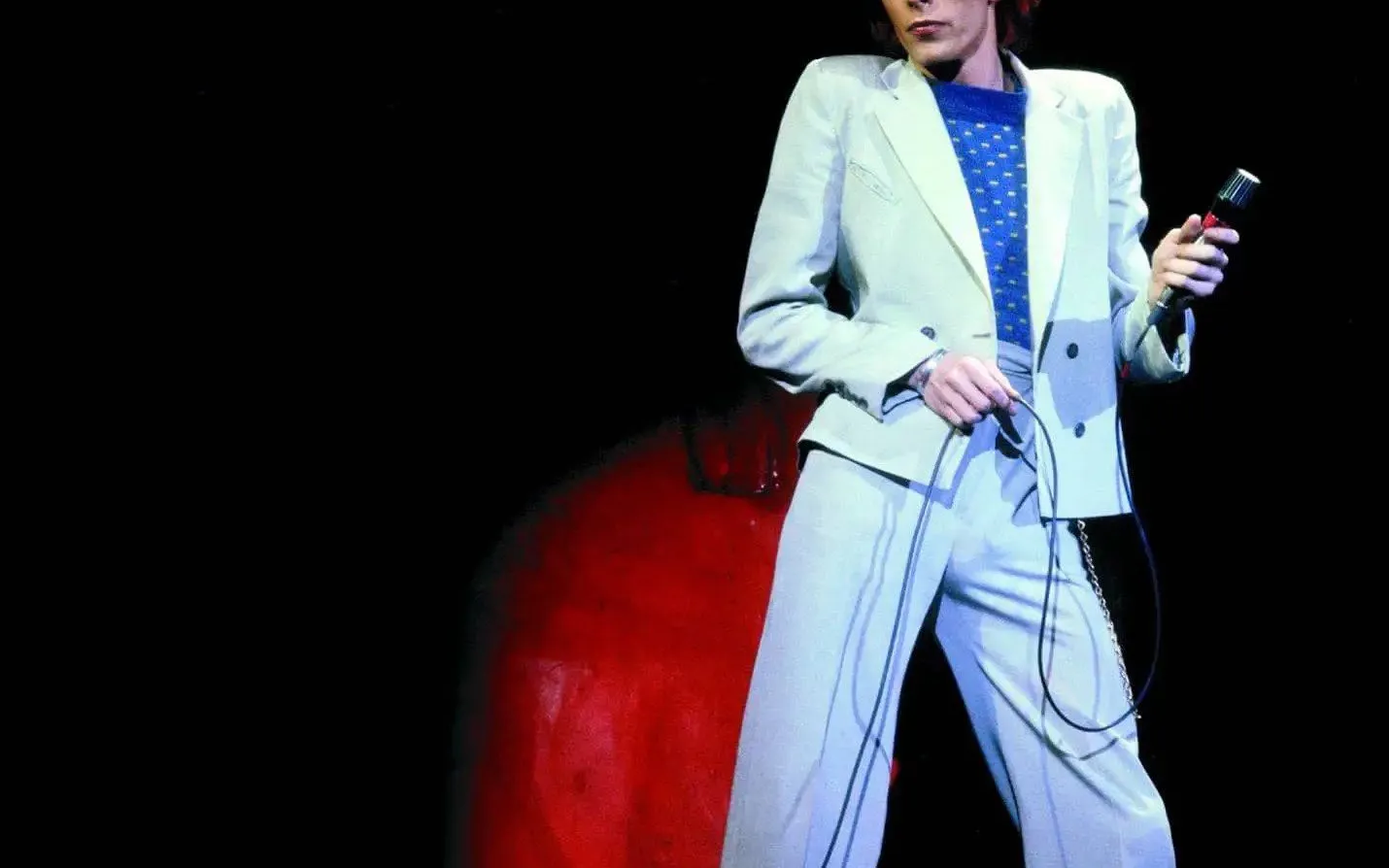
David Bowie performing during the Diamond Dogs Tour in 1974. Public-domain RCA Records image via Wikimedia Commons.
Young Americans studies the music of proximity
Moving into American soul, Bowie assembled musicians including Carlos Alomar, Luther Vandross and David Sanborn. Young Americans is sometimes summarized through Bowie's phrase "plastic soul," but the label should not excuse the unequal history of a white British star entering Black American forms.
The record is most valuable when heard as collaboration and tension, not solitary invention. "Fame," developed with John Lennon and Alomar, reduces celebrity to a clipped, circling groove. Bowie's voice is electronically altered and rhythmically fragmented, as though fame has entered the body as machinery.
Station to Station builds a bridge while denying stability
Station to Station connects American funk and soul to the electronic and European experiments that followed. Its title track moves through distinct sections with the confidence of a train changing landscapes without stopping.
The Thin White Duke persona gave this era a chilling elegance. Bowie later described a period of severe cocaine use and fragmented memory, and the character's authoritarian imagery remains disturbing. Acknowledging artistic power does not require romanticizing the conditions or symbols around it.
"Golden Years" makes rhythm gleam; "Wild Is the Wind" ends the album with exposed vocal devotion. The record's control sounds extraordinary partly because the life around it was becoming dangerously uncontrolled.
Berlin is a useful myth, not the whole geography
Low, "Heroes" and Lodger are known as the Berlin Trilogy, though recording also took place elsewhere. The phrase remains useful if it describes a creative orientation rather than a literal address: withdrawal from Los Angeles, collaboration with Brian Eno and Tony Visconti, and openness to new compositional systems.
On Low, conventional songs are compressed into fragments while the instrumental second side creates environments rather than narratives. Gated drum textures, synthesizers and abrupt structures make incompletion feel deliberate.
Bowie did not simply discover electronic music. He entered a field shaped by German groups including Kraftwerk and Neu!, then combined those influences with his own songwriting and collaborators' ideas. The work's originality lies in transformation through encounter.
Heroes makes one moment larger than certainty
"Heroes" begins with restraint and expands through Robert Fripp's sustained guitar, Visconti's production and a vocal recorded with microphones that opened as Bowie sang louder. The technology turns emotional escalation into audible space.
The lyric offers lovers a temporary zone of freedom, not permanent victory. Its quotation marks on the original album title matter: heroism is conditional, perhaps theatrical, yet no less necessary for being brief.
Bowie's performance moves from close observation to a near-shout without abandoning vulnerability. The song is monumental because it knows the monument lasts one day.
Lodger treats travel as disorientation
Lodger lacks the obvious split structures of its predecessors, but its songs are full of migration, accident and unstable perspective. Eno's oblique methods, unusual instrument assignments and rhythmic experiments make the album feel deliberately off balance.
"Boys Keep Swinging" uses gender performance as satire and pleasure, while its video lets Bowie occupy multiple aging female personas. The work's politics are not beyond criticism, but its central proposition remains potent: gendered authority can be exposed by changing who performs its gestures.
Ashes to Ashes edits the archive
On Scary Monsters (and Super Creeps), Bowie returns to Major Tom not as nostalgic fan service but revision. "Ashes to Ashes" recasts the astronaut as a damaged figure, while its video places the Pierrot costume inside a dreamlike procession.
The song demonstrates how an artist can quote earlier work without treating it as sacred. Bowie's archive was available for contradiction. Reinvention did not require amnesia.
Let's Dance turns scale into a new instrument
Working with Nile Rodgers, Bowie made Let's Dance with exceptional clarity and international reach. The title track expands from blues-derived material into spacious dance-rock, with Stevie Ray Vaughan's guitar cutting across the polished frame.
"Modern Love" moves with ecstatic speed while the lyric remains skeptical of belief. "China Girl," co-written earlier with Iggy Pop, was remade as glossy pop accompanied by a video that attempted to critique racism through imagery that also participates in exoticism.
The era proves that commercial scale was not automatically artistic surrender. It was another medium. The subsequent difficulty came when the medium began dictating the questions.
The 1980s show what happens when change becomes obligation
After Let's Dance, Bowie sometimes appeared trapped by the audience created through his largest success. Tonight and Never Let Me Down contain strong moments but often sound less driven by discovery than by the maintenance of contemporary scale.
This period is essential because it prevents reinvention from becoming a magical personality trait. Methods can harden into expectation. An artist famous for changing can become obligated to display change on schedule.
Tin Machine gives up central control
With Tin Machine, Bowie entered a band framework alongside Reeves Gabrels and the Sales brothers. The project was abrasive, uneven and often treated as a detour, but it restored friction. Bowie could be one musician inside a loud collective rather than the sole image around which every decision revolved.
The experiment's value lies partly in what it made possible afterward: a renewed appetite for risk without the requirement that every risk become a cultural epoch.
Black identity and digital anxiety enter the 1990s work
Black Tie White Noise returned Bowie to Nile Rodgers amid reflections on marriage and racial tension. Outside, made again with Eno, created an intentionally excessive detective narrative around art, murder and institutional control. Earthling engaged drum and bass textures with aggressive speed.
These albums resist the tidy canon built around Bowie's 1970s work. Their unevenness is productive evidence of an artist listening to the present rather than curating only his established significance.
BowieNet and other digital ventures also showed his interest in the internet as cultural space. He understood early that the relationship among artist, audience and archive was about to change.
Heathen and Reality let age enter the frame
With producer Tony Visconti again central, Heathen and Reality combine mature songwriting with questions of mortality, faith and unstable modern life. Bowie's voice had gained grain and weight; he used those changes rather than disguising them.
The tours showed that a legacy artist could revisit a catalogue without turning the concert into a sealed museum. Old songs changed meaning because the person singing them had changed.
The Next Day weaponizes absence
After years of public silence, The Next Day arrived without a conventional advance campaign. Its cover placed a white square over the "Heroes" image, making erasure and quotation the visual concept.
The music revisited rock forms from across Bowie's career while refusing a simple return. Absence had altered reception: the lack of explanation made listening itself the event.
Blackstar turns finality into form
Blackstar, released two days before Bowie's death, was made with jazz musicians including Donny McCaslin's ensemble and producer Tony Visconti. The album avoids the comfort of a retrospective farewell. Its long structures, electronic details and difficult harmonies remain exploratory.
The title track moves through ritual, menace and luminous transformation. "Lazarus" places a body under pressure inside a performance that now feels inseparable from Bowie's illness, though the work should not be reduced to a coded announcement.
What makes the album extraordinary is not that Bowie designed a perfect death. It is that he continued to treat limited time as compositional material. Mortality became another condition under which form could change.
The collaborators are inside the signature
Bowie's name unifies the catalogue, but its transformations were collective. Mick Ronson, Mike Garson, Carlos Alomar, Luther Vandross, Brian Eno, Tony Visconti, Nile Rodgers, Reeves Gabrels, Gail Ann Dorsey, Donny McCaslin and many others did not merely decorate predetermined visions.
They brought methods, sounds and challenges that altered the work. Bowie's particular authorship included selecting collaborators and creating conditions in which their difference remained audible.
Persona is a tool for telling the truth indirectly
Ziggy Stardust, Aladdin Sane and the Thin White Duke are memorable because they clarified forces already active in culture: celebrity worship, fractured identity, sexuality, authoritarian glamour. A persona was not necessarily a lie placed over a true self.
It was a controlled distance from which truth could be staged. The danger came when character and life collapsed, or when provocative imagery carried consequences beyond the artist's intended experiment.
Influence means permission to remain unfinished
Bowie's influence extends through glam, punk, post-punk, new wave, alternative rock, electronic music, fashion, video and contemporary pop's fluid presentation of identity. Yet the most valuable inheritance is not a particular haircut or synthesizer.
It is permission to remain unfinished in public. Artists can change genre, body language, collaborators and scale without treating the previous self as fraud. Continuity can live in the quality of inquiry rather than the stability of surface.
The work keeps the doors between eras open
David Bowie's catalogue is often divided into eras because the images are so distinct. Listen closely and the doors remain open. Major Tom returns. Fame changes form. The alien becomes citizen, icon, older body and disappearing voice.
Reinvention was never merely escape. It was a way to approach the same human limits without allowing one vocabulary to become final. Bowie changed masks, but more importantly he changed the room, the collaborators and the rules governing what a song could contain.
His career makes transformation feel less like betrayal than attention: the disciplined recognition that the world, the body and the artist have moved, and the form must move with them. Cover Story rating: 9.8/10.
Sources: David Bowie official website and catalogue; official David Bowie videos; official Spotify recordings. Cover photo from the Universal Amphitheatre in 1974 by Tony Barnard, Los Angeles Times, via Wikimedia Commons, licensed CC BY 4.0. Inline RCA Records image from the Diamond Dogs Tour via Wikimedia Commons, public domain in the United States.