A closer look at the scenes and context surrounding Mariah Carey's music.
Mariah Carey's voice is usually introduced as an instrument of range. That description is accurate but incomplete. Her greater innovation was learning to treat the voice as a production studio: lead, counterline, rhythm, atmosphere and architecture built from the same body.
The whistle register became an instantly recognizable signature, yet Carey's records endure because the spectacular note is rarely the whole design. She writes melodies that move through registers as if changing camera distance. Background vocals answer, contradict and surround the lead. A breathy phrase can be as structurally important as a belt.
Carey is also a songwriter and producer whose authorship has often been obscured by the cultural tendency to treat female vocalists as interpreters. Her career is not only the history of a gifted singer. It is the story of an artist negotiating control over sound, image, collaboration and the terms on which virtuosity could enter pop.
Vision of Love introduces a new grammar
"Vision of Love" arrived in 1990 with gospel-inflected harmony, spacious production and a lead vocal that moved from intimate lower phrases to melisma and high release. The runs were not detached ornaments. They extended the lyric's sense of revelation, allowing one syllable to contain several emotional turns.
Its influence on later pop and R&B singing is enormous, including less productive imitation. Melisma can become a generic display when separated from phrasing. Carey made it persuasive because each run has direction: tension gathers, a peak is delayed, and the line eventually lands.
The debut also established her role as co-writer. Carey was not simply handed a vehicle for technique. The melodic architecture was part of the composition.
Love Takes Time understands the value of restraint
"Love Takes Time" proves that Carey's early impact did not rely on constant vocal density. Piano, synthesizer and a gradual arrangement give the performance space to develop. She begins with controlled regret and saves the full weight of the instrument for the point at which denial can no longer hold.
The climax works because the quieter lines have taught the listener how to measure distance. Power is relational. A large note means more when the record remembers how softly it began.
Emotions turns whistle into arrangement
On "Emotions," house and disco energy give Carey's upper register a kinetic function. The whistle notes behave like flashes above the groove, answering the lead and extending the song's harmonic brightness.
The track is exuberant, but its vocal construction is meticulous. Lower lines anchor the verse; layered harmonies widen the chorus; ad-libs create a second composition over the final section. Carey does not merely sing higher as the record progresses. She increases the number of simultaneous perspectives.
Music Box translates intimacy into global scale
Music Box refined Carey's ballad vocabulary for a vast international audience. "Dreamlover" uses the Emotions' "Blind Alley" sample to create warmth and ease, while "Hero" builds from private encouragement into a universal anthem.
The accessibility of this period sometimes invites dismissal, as though direct melody were evidence of limited authorship. Carey's skill lies in making elaborate vocal decisions feel inevitable. "Anytime You Need a Friend" moves from gospel gravity into stacked release without losing the song's basic invitation.
At the same time, the polished image and adult-contemporary framing reflected a label environment in which commercial strategy could narrow how her musical identity was presented.
Merry Christmas writes a new standard in real time
"All I Want for Christmas Is You," co-written with Walter Afanasieff, succeeds because it behaves like an older standard without merely copying one. Piano, bells, backing vocals and Phil Spector-influenced density create instant seasonal memory, while the melody remains unmistakably Carey's.
Her lead performance combines conversational excitement with gospel lift. The song keeps moving; even its nostalgia has rhythmic urgency. Annual return has since turned it into a modern ritual and a major recurring commercial force.
Its dominance can flatten public understanding of Carey's catalogue into one season. The irony is that the record's longevity depends on the same skills found throughout her work: songwriting economy, vocal arrangement and a precise balance between familiarity and personal signature.
Fantasy changes the relationship between pop and rap
"Fantasy" samples Tom Tom Club's "Genius of Love" and turns its buoyant loop into euphoric pop. Carey's melody rides the sample rather than smoothing it into background texture. The record is already a sophisticated conversation with musical memory.
The Bad Boy remix featuring Ol' Dirty Bastard was more disruptive. A major pop vocalist placed an unpredictable rap voice inside the center of her single rather than treating hip-hop as a peripheral promotional add-on. Carey's sweetness and ODB's rough, comic presence do not resolve into polite compatibility; contrast is the point.
This helped normalize the pop-rap remix as a major release strategy. More importantly, it reflected Carey's own listening and creative preference at a time when the industry often tried to separate her from Black musical identity.
Daydream perfects the layered interior
Daydream moves between enormous ballads and finely textured R&B. "Always Be My Baby" sounds effortless, but its vocal stack is an intricate social world. The lead holds affectionate certainty while backing parts loop, soothe and echo around it.
"Underneath the Stars" uses soft-focus production and close vocal detail to create memory as atmosphere. "One Sweet Day," with Boyz II Men, expands grief into ensemble form, multiple virtuoso voices negotiating when to lead and when to support.
Carey's control of register is central. Chest voice provides statement, breathier tone creates privacy, and upper extensions open emotional space. Range becomes narrative geography.
Butterfly is an album about authorship
Butterfly is often described as personal and creative emancipation following Carey's separation from Tommy Mottola. The music supports that reading, though liberation is not presented as a single victorious moment. It arrives through desire, grief, risk and the discovery of new collaborators.
"Honey" opens with a sleek hip-hop/R&B frame shaped by Puff Daddy, Q-Tip and Stevie J, while the video stages escape from captivity with camp humor. "The Roof" uses Mobb Deep's "Shook Ones Pt. II" to make memory rainy, tactile and unresolved.
On "Breakdown," featuring Bone Thugs-n-Harmony, Carey adapts to the group's rapid melodic rap without turning the performance into imitation. Her phrasing becomes rhythmically compressed, and the lyric's emotional collapse is delivered through remarkable technical calm.
The title track returns to open ballad form but frames love as release rather than possession. Carey's quieter vocal choices are crucial. Freedom sounds fragile because it is being learned.
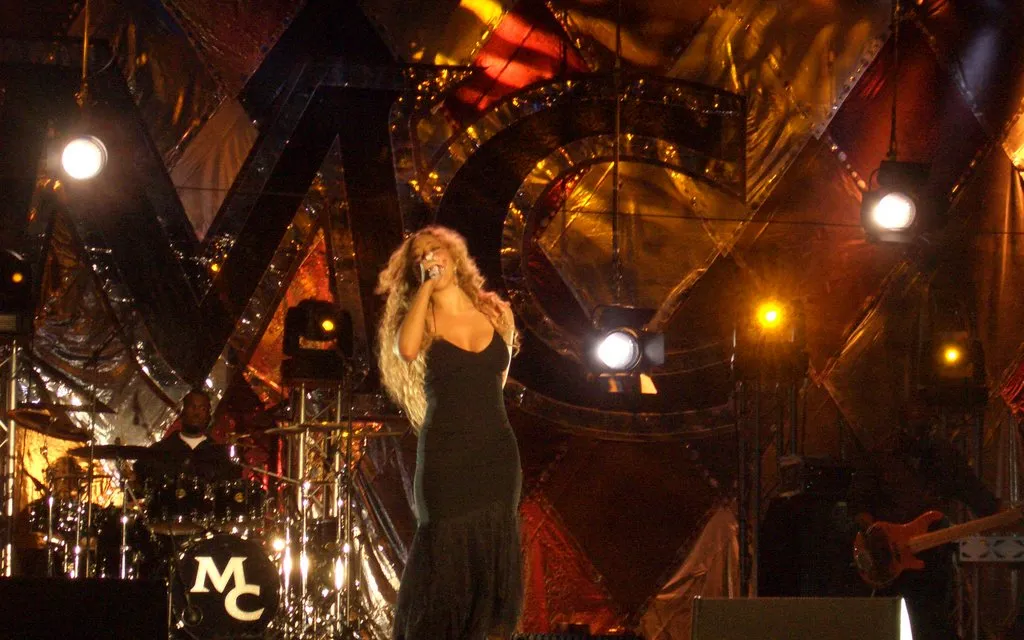
Mariah Carey performing in 2005. Photo by Wikimedia Commons user Concert, licensed CC BY 3.0.
My All makes negative space sensual
"My All" draws on Latin guitar color, slow percussion and a melody that gives silence real weight. Carey begins near a whisper, allowing aspiration and restraint to share the same phrase.
When the chorus expands, the effect is not simply louder singing. The record changes physical distance. Intimacy becomes public without losing the memory of the close microphone.
Rainbow makes collaboration a survival skill
Rainbow was created amid increasing tension with Carey's label. Its range of collaborators and styles can feel less unified than Butterfly, but the album documents an artist accelerating toward contractual freedom.
"Heartbreaker" and its remix treat versions as distinct creative spaces. Jay-Z's feature, the animated sample and Carey's bright phrasing produce pop ease, while the remix reconfigures the track's social world. For Carey, a remix is not merely the original song with an extra verse. It can receive new vocals, structure and atmosphere.
Glitter became a cultural pile-on
The 2001 film Glitter and its soundtrack arrived during a period of highly publicized exhaustion and institutional instability. The project was quickly converted into shorthand for failure, with criticism often exceeding the work itself and feeding a tabloid narrative about Carey's health and career.
The soundtrack deserves more precise listening. Its engagement with 1980s funk and post-disco, including "Loverboy" and "Didn't Mean to Turn You On," anticipated later pop nostalgia. It is not flawless, but neither is it the cultural void its reputation once implied.
The episode shows how quickly a powerful female performer can be recast as spectacle when control appears to weaken. Reassessment does not require pretending the film succeeded; it requires separating evidence from appetite for collapse.
Charmbracelet rebuilds through detail
Charmbracelet is transitional, emphasizing breathy textures and dense layering over immediate anthem. Some performances sound guarded, but songs such as "The Roof"-adjacent "Lullaby" and the gospel lift of "My Saving Grace" preserve Carey's attention to arrangement.
Rebuilding was not a single comeback montage. It involved re-establishing trust in process, audience and the instrument itself.
The Emancipation of Mimi makes return sound current
The Emancipation of Mimi succeeded because it did not attempt to reproduce Carey's early-1990s sound. Working with Jermaine Dupri, The Neptunes, Kanye West and others, she placed her melodic and vocal identity inside contemporary R&B.
"It's Like That" opens the era with restraint and social ease. Carey does not lead with a maximal vocal demonstration. She reenters public space through groove, confidence and a hook built for collective response.
We Belong Together makes the climax arrive late
"We Belong Together" is constructed with extraordinary patience. The verses are conversational and rhythmically close, drawing lyrical memory from Bobby Womack and Babyface references. Carey sounds less like a diva addressing an arena than someone replaying a private mistake too quickly.
The harmonic loop remains controlled while intensity accumulates through phrasing. Only near the end does the vocal open fully, and the sustained final section feels enormous because the song has denied that scale for so long.
This is masterful pop dramaturgy. The famous voice is not displayed at the start; it is withheld until structure requires it.
Don't Forget About Us understands the echo of a formula
"Don't Forget About Us" resembles the architecture of "We Belong Together," but its emotional angle is different. Rather than pleading for reunion, the narrator asks for the past to retain significance. Similar production language becomes a study in residual attachment.
Carey's career contains many self-echoes because she understands catalogues as living systems. A familiar cadence can acquire new meaning when age, context and power have changed.
E=MC² lets humor lead
E=MC² loosens the monumental comeback narrative. "Touch My Body" is light, funny and rhythmically economical, with a lead vocal that prioritizes conversational character over force.
The song demonstrates an undervalued part of Carey's authorship: humor. She uses diction, pop-culture detail and self-aware glamour to keep technical polish from becoming solemn.
Memoirs of an Imperfect Angel turns one team into continuity
Working primarily with The-Dream and Tricky Stewart, Carey gave Memoirs of an Imperfect Angel unusual production coherence. "Obsessed" uses a clipped electronic hook and deadpan dismissal, while "H.A.T.E.U." stretches heartbreak into sustained harmonic haze.
The album's title acknowledges imperfection without converting it into confession-by-numbers. Carey's persona remains playful, evasive and musically exact.
Me. I Am Mariah. places the catalogue in conversation
The 2014 album moves through gospel, hip-hop, ballad and modern R&B with a density that rewards patient listening. "The Art of Letting Go" and "Camouflage" foreground layered harmony, while "Dedicated" links memory, Nas and old-school references.
By this stage, Carey's work is openly archival. Samples, lyrical callbacks and collaborators allow eras to speak across one another.
Caution proves understatement can be authority
Caution is concise, contemporary and controlled. Producers including Dev Hynes, Timbaland, Skrillex and others build spaces that respect Carey's phrasing rather than demanding a heritage-act display.
"GTFO" turns dismissal into murmured precision. "A No No" uses the Lil' Kim-associated "Crush on You" lineage for elastic, quotable refusal. The title track lets tension sit in the groove.
Carey sounds authoritative because she no longer needs every song to prove the entire range. Texture, timing and authorship carry the weight.
The whistle register is a color, not a score
Public fascination with Carey's whistle notes often turns singing into athletics: highest pitch, longest duration, proof of exceptional anatomy. Carey uses that register more musically than the competition language suggests.
A whistle can function as exclamation, countermelody, texture or transition. Sometimes it sits behind the lead like another instrument. Evaluating only whether she reaches it misses why it appears.
Background vocals contain hidden compositions
Carey's backing arrangements are among her most important contributions to pop production. She layers timbres and registers so that the background does not merely thicken harmony. It establishes movement, perspective and call-and-response.
Listen to the final minutes of "Fourth of July," "Outside," "Fly Like a Bird" or "Giving Me Life." Beneath the principal melody, other songs seem to emerge. The studio becomes a choir whose members share one author but occupy different emotional positions.
The remixes are alternate universes
From the David Morales house reworkings to hip-hop versions with newly recorded vocals, Carey treats remixing as composition. A ballad can become club music not through mechanical acceleration but through new melodic lines designed for another rhythmic world.
This practice joined audiences often divided by radio formats. It also gave Carey a route toward the dance and hip-hop identities that her main releases did not always foreground.
Songwriting is the continuity beneath the voice
Carey's catalogue contains an exceptional number of co-written hits, and her lyrical habits are recognizable: conversational detail, internal rhyme, rare vocabulary, humor, spiritual imagery and the transformation of memory into weather.
The voice changes with age, health, schedule and recording context, as every human instrument does. Songwriting allows the identity to persist without requiring physical time to stop.
Mariah made virtuosity intimate
Mariah Carey's legacy cannot be summarized by five octaves, chart records or one annual holiday resurgence. Those facts describe scale. The music explains method.
She made virtuosity feel like interior dialogue: one voice speaking, another remembering, a third warning from above. She connected pop balladry to hip-hop without treating either as a temporary costume. She built remixes that changed a song's world and background arrangements that reward listeners decades later.
The greatest Mariah Carey performances do not ask us merely to admire what a voice can reach. They invite us inside the studio of that voice, where range becomes authorship and every register has a dramatic job. Cover Story rating: 9.6/10.
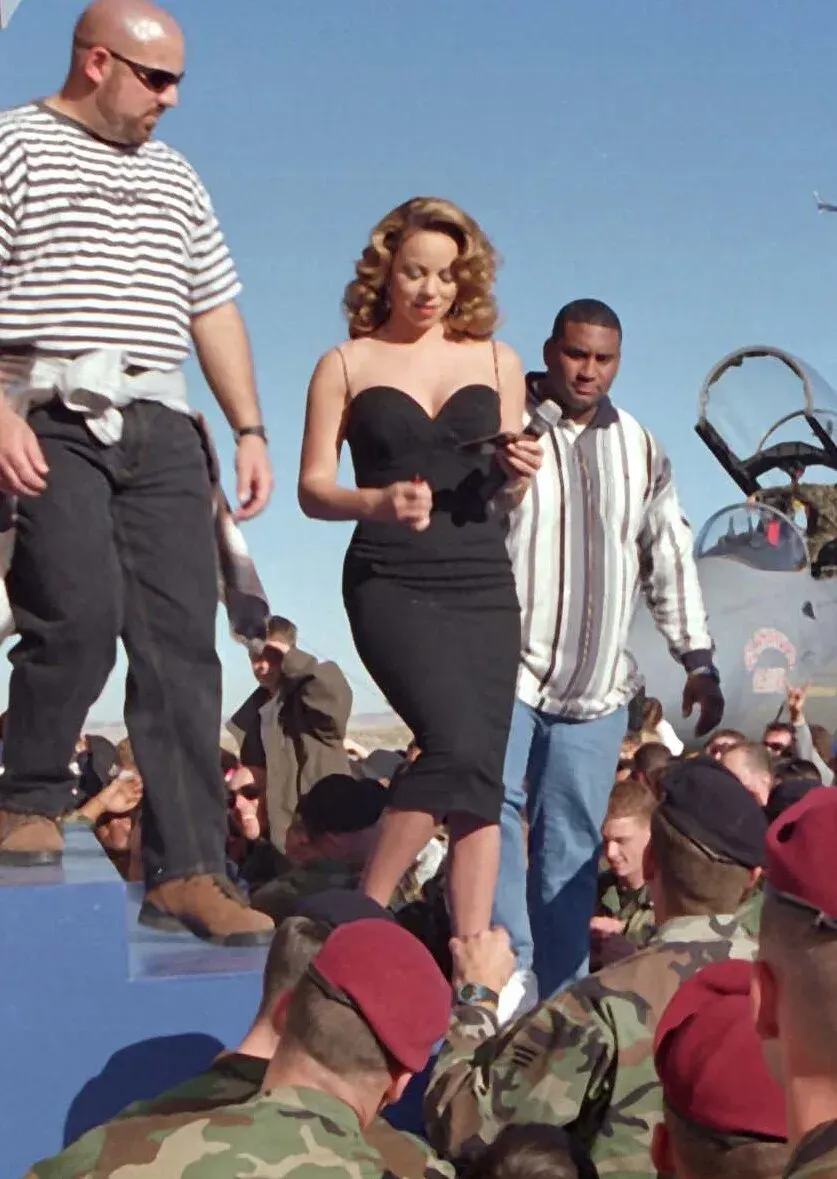
Sources: Mariah Carey official releases and videos; official Spotify recordings; Columbia, Virgin and Island catalogue documentation. Cover image from the 1998 "I Still Believe" video production at Edwards Air Force Base via Wikimedia Commons, public domain as a U.S. Air Force work. Inline photo by Wikimedia Commons user Concert, licensed CC BY 3.0.