
A closer look at the scenes and context surrounding Miley Cyrus's music.
Miley Cyrus changes genres, images and production systems with unusual speed, yet her career never feels completely discontinuous. The reason is in the voice: a rough, low-centered grain that makes reinvention sound like memory rather than escape.
From Disney precision to country-pop, electronic provocation, psychedelic experiment, glam rock and the cinematic scale of Something Beautiful, Cyrus repeatedly replaces the frame around herself. Her timbre keeps evidence of every prior frame.
This is the creative signature that matters now. In an era when visual eras can be switched overnight, Cyrus lets vocal texture carry the cost of change.
The Climb makes strain part of the promise
“The Climb” is built as an inspirational ballad, but Cyrus prevents it from becoming frictionless. Her younger voice already contains a grain that catches against the long melodic rise. The title suggests progress; the vocal keeps the effort audible.
She does not float above the arrangement. Breath and pressure remain present as drums and guitar widen the chorus, giving the song a physical center. The performance teaches an early version of her later method: uplift is more credible when the voice sounds marked by the route.
Wrecking Ball separates size from control
“Wrecking Ball” surrounds Cyrus with enormous drums, piano and a chorus designed for architectural impact. Her performance begins smaller than the production promises. The verse is guarded, almost conversational, so the first eruption feels like a loss of containment rather than a scheduled power note.
The rasp does crucial dramatic work. It adds abrasion to clean pop engineering and makes the sustained vowels sound less like technical display than emotional overexposure. Even when the recording is highly polished, the voice suggests material breaking under pressure.
The famous visual campaign around the song threatened to overwhelm its musical design. Yet the recording survives because Cyrus understands dynamics. She knows that a wrecking ball only feels heavy after the room has been quiet.
Provocation was never the whole instrument
The Bangerz era made rupture its public language. Hair, styling, performance and controversy announced separation from a child-star identity. That strategy gained attention but also encouraged audiences to treat every musical decision as an accessory to spectacle.
Cyrus’s subsequent catalog clarifies what the spectacle obscured. Her strongest transformations are vocal, not merely visual. She can sharpen the same timbre into pop attack, let it drag behind a country rhythm or push it against distorted guitar. The body of the voice keeps authorship intact when the image changes.
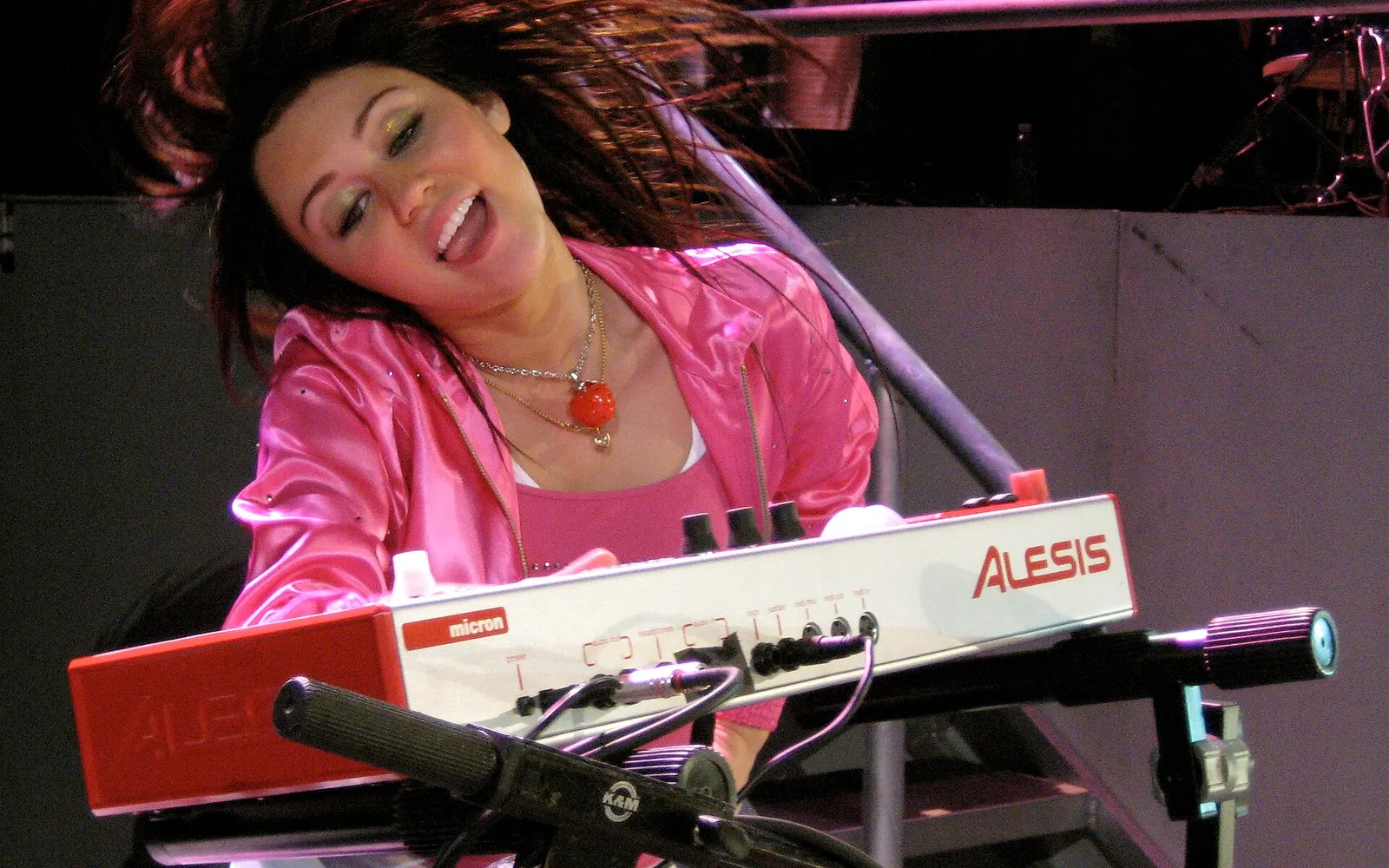
Miley Cyrus performing in 2008 during the Best of Both Worlds era. Photo by Mike Schmid via Wikimedia Commons, licensed CC BY-SA 2.0.
Midnight Sky turns rasp into propulsion
On “Midnight Sky,” synth-pop and rock meet in a bass-driven arrangement that could have become an exercise in retro styling. Cyrus’s voice prevents nostalgia from sealing the song. She sings with a low, forward pressure that cuts through the glossy electronics.
The chorus is about autonomy, but its strength comes from rhythm rather than slogan. Phrases push across the beat, and the rough edge of the vocal creates friction against the polished groove. Freedom sounds less like a clean exit than a body learning a different gait.
This is why Plastic Hearts felt convincing. Cyrus did not borrow rock as a costume. The genre gave amplification to qualities her voice had carried for years.
Flowers uses restraint as maturity
“Flowers” offers self-sufficiency through a deliberately relaxed disco-pop pulse. A more obvious performance might have turned every line into defiant triumph. Cyrus stays conversational, allowing dryness and small shifts in tone to make the hook feel lived rather than declared.
The production leaves space around bass, guitar and percussion, trusting the voice to supply character. Her lower register makes the verses feel private; the chorus opens without abandoning that grounded placement. Independence arrives as routine, not revenge fantasy.
The song’s global reach came partly from its simplicity, but simplicity alone does not explain its staying power. Cyrus makes familiar affirmations sound like conclusions reached after fatigue.
Something Beautiful treats the voice as film stock
On 2025’s Something Beautiful, Cyrus frames music as a visual album and moves through rock, pop, electronics and cinematic transitions. The project can be overdetermined, with concept and styling occasionally announcing importance before a song earns it.
Yet her voice functions like film stock across the sequence. Whether surrounded by orchestral scale or distorted production, its grain records continuity. The surface may become surreal, but the vocal keeps a trace of physical age, use and survival.
Cover songs reveal the mechanism
Cyrus has repeatedly used live covers to test her voice against established material. Rock, country and classic pop songs become laboratories for placement: where to harden a consonant, where to let a note fray, where to refuse a polished imitation of the original singer.
The best covers do not prove versatility by sounding anonymous. They prove it by showing how one recognizable instrument can reorganize another writer’s architecture.
Reinvention without amnesia
Pop reinvention is often sold as erasure. A new era declares that the previous self was incomplete, embarrassing or false. Cyrus’s catalog is more interesting because the voice contradicts total separation. Its texture carries earlier performances forward even when the surrounding genre changes.
That continuity allows her to revisit former identities without becoming trapped by them. “The Climb” can coexist with “Midnight Sky” because both depend on pressure made audible. The songs differ in aesthetic but share a physical logic.
Where texture can become shorthand
A distinctive rasp can be overused as automatic evidence of authenticity. At weaker moments, Cyrus leans on vocal grain while the lyric or composition supplies less specific emotional information. Roughness is a resource, not a guarantee.
Her finest work pairs texture with structural choice: the delayed explosion of “Wrecking Ball,” the rhythmic autonomy of “Midnight Sky,” the unforced space of “Flowers.” The voice matters because the song knows what to ask it to do.
Why the signature matters now
In contemporary pop, production can change a singer’s environment instantly and visual identity can be refreshed at platform speed. Cyrus offers a model of reinvention anchored in embodied continuity. She does not need every era to resemble the last; she needs the voice to remember what change feels like.
That is the productive force in her catalog. Miley Cyrus makes transformation credible because the new surface never fully hides the wear underneath. Focus rating: 9.0/10.
Sources: Miley Cyrus and Columbia Records official release materials; official Miley Cyrus videos; official Spotify recordings. Cover photo from Primavera Sound 2019 by Raph_PH via Wikimedia Commons, licensed CC BY 2.0.