A closer look at the scenes and context surrounding The Beatles's music.
The Beatles entered the 1960s as a working stage band and left them having changed what a recording could be. Their decisive invention was not one sound or one album. It was the idea that the studio itself could compose: tape, microphone placement, editing, speed, orchestration and accident could become as meaningful as chord and melody.
That transformation happened with extraordinary speed. In 1963, the group’s records still translated the force of a compact live unit. By 1966, “Tomorrow Never Knows” was built from a fixed drone, tape loops, compressed drums and a voice deliberately separated from ordinary human scale. By 1967, “A Day in the Life” joined two unfinished songs through an orchestral event that could not be reproduced by four musicians onstage.
The familiar mythology can make this evolution feel inevitable. It was not. It depended on John Lennon, Paul McCartney, George Harrison and Ringo Starr learning to hear one another differently; on producer George Martin translating improbable requests into musical decisions; and on engineers including Norman Smith and Geoff Emerick treating technical limits as material.
I. Capture the Band
Please Please Me begins from urgency. Much of the album was recorded in a single day, and the performances preserve the group’s stage logic: voices share air, rhythm drives forward, mistakes are subordinated to momentum. “I Saw Her Standing There” counts itself into existence. “Twist and Shout” makes Lennon’s exhausted voice part of the arrangement.
Early Beatles records are sometimes treated as a simple prelude to later experimentation, but the laboratory starts here. Lennon and McCartney learn to write for contrasting voices. Harrison’s guitar fills answer the melody without crowding it. Starr’s drumming makes form legible through feel rather than display. The studio first documents an ensemble already skilled at compression.
A Hard Day’s Night sharpens that compression. Its opening chord functions like a logo made from unresolved harmony. Double-tracked vocals, acoustic and electric guitars, piano and percussion produce records larger than the visible quartet while keeping the illusion of immediate performance.
II. The Microphone Moves Closer
On Rubber Soul, the studio begins changing the emotional distance of the songs. “Norwegian Wood” places Harrison’s sitar beside acoustic guitar without presenting it as an orchestral novelty. “In My Life” uses a piano part recorded at a different speed, allowing George Martin’s performance to acquire a bright, impossible precision.
“Girl” lets breath become rhythmic punctuation. “Michelle” arranges intimacy through vocal layers and guitar color. The microphone is no longer simply positioned to capture a band. It becomes a lens that can move near a breath, enlarge a small gesture or make one performance appear to occupy several bodies.
This period also reveals the productive imbalance among the writers. McCartney’s melodic construction, Lennon’s compressed psychological images and Harrison’s widening harmonic and instrumental interests do not merge into one neutral style. The albums gain range because different imaginations compete for space.
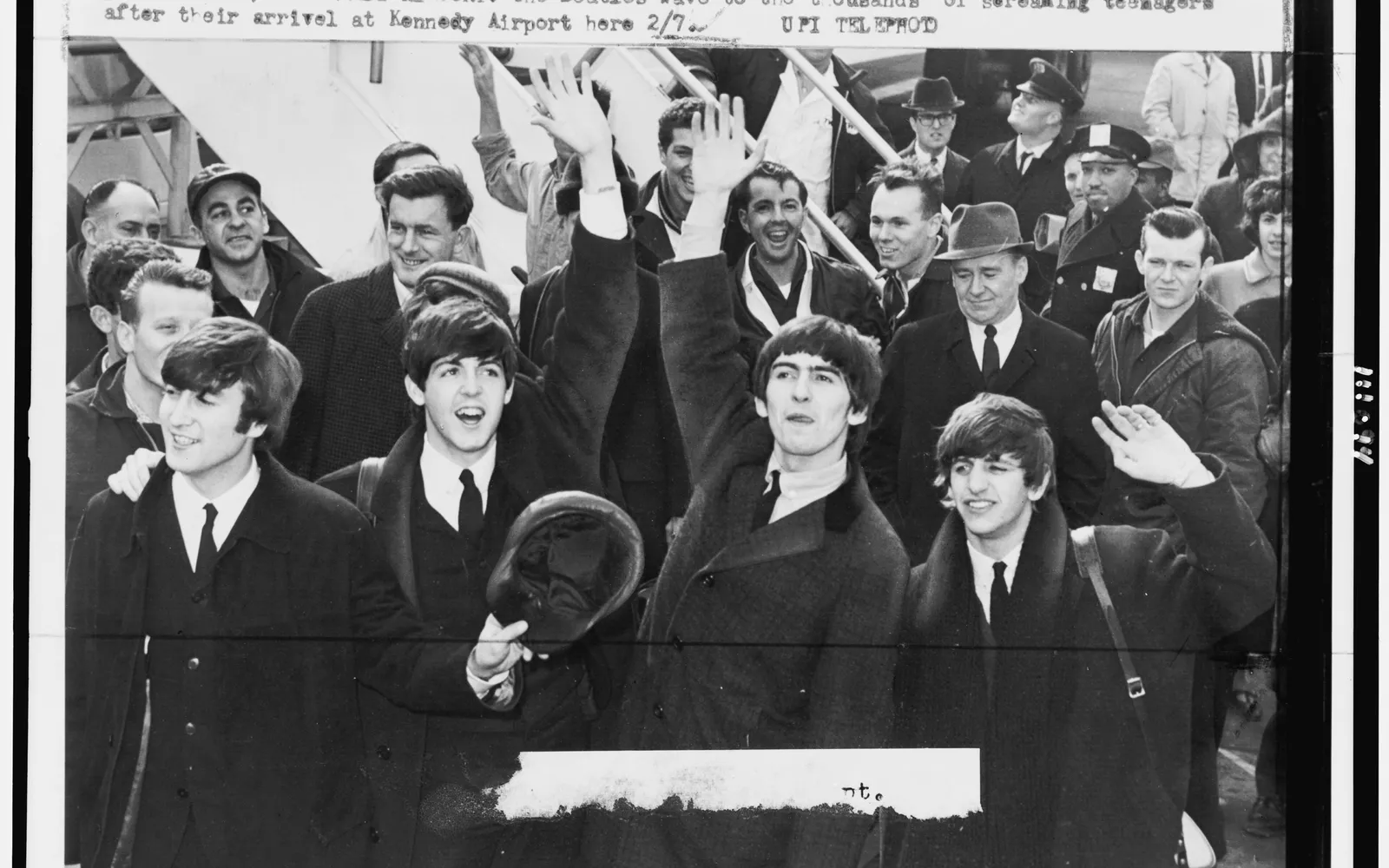
Photo: The Beatles arriving at Kennedy Airport, New York, February 7, 1964. United Press International / public domain, via the Library of Congress and Wikimedia Commons. Cropped for presentation.
III. Revolver: The Studio Stops Reporting Reality
The official Beatles history notes that the group returned to Abbey Road after Rubber Soul and recorded continuously for three months. That time changed the premise of the work. A record no longer needed to describe a performance that could happen elsewhere.
“Eleanor Rigby” removes the band’s conventional instrumentation and gives its pulse to a close, cutting string octet. “I’m Only Sleeping” uses a guitar part recorded and then reversed, turning phrasing into something a player could conceive but not execute in ordinary forward time. “Yellow Submarine” assembles voices and effects into communal theater.
Harrison’s “Love You To” treats Indian instrumentation as the song’s grammar rather than a decorative color. McCartney’s “For No One” places a restrained horn line against emotional collapse. Each track invents its own acoustic world; the album’s unity comes from permission to change method.
“Tomorrow Never Knows” is the hinge. Starr’s drums are compressed into a huge repeating body. Lennon’s vocal passes through a rotating speaker. Tape loops move through the mix as performed events. The song does not use the studio to make a band sound bigger. It uses the studio to create an object that no stage band existed to reproduce.
IV. Tape as Performance
The Beatles’ studio craft depended on physical action. Tape was cut, reversed, slowed, sped up, copied and routed through machines. Automatic double tracking, developed at Abbey Road in response to the labor of repeatedly recording vocals, turned a practical complaint into a new vocal texture.
Varispeed changed not only pitch but character. A piano could become brittle and miniature; a voice could move outside its natural age; two performances recorded at different tempos could be joined into one record. Editing was not concealment. It was composition by choosing which realities could share a timeline.
George Martin’s role was therefore neither authoritarian arranger nor passive facilitator. He provided fluency between languages: Lennon’s image, McCartney’s structural instinct, Harrison’s instrumental curiosity, Starr’s feel and the technical knowledge of the control room. Geoff Emerick’s engineering likewise mattered because microphone and compression choices gave imagination a physical surface.
V. Sgt. Pepper: The Album Becomes a Place
Sgt. Pepper’s Lonely Hearts Club Band uses a fictional group to loosen the Beatles from their public image. The Library of Congress describes the album’s divergent styles as a cohesive whole shaped by novel studio techniques. Its unity is theatrical rather than strictly narrative: an audience arrives, a band is introduced, scenes unfold and the final chord closes the building.
“Lucy in the Sky with Diamonds” changes speed, meter and texture as though moving between rooms. “Being for the Benefit of Mr. Kite!” turns fragments of calliope tape into a fairground that could never be played exactly the same way twice. “Within You Without You” grants Harrison an extended space for Indian classical form and philosophical argument.
“A Day in the Life” reveals the studio as editor of consciousness. Lennon’s distant verses and McCartney’s brisk middle section are joined by orchestral crescendos whose controlled disorder becomes the content. The concluding piano chord is allowed to decay until the room itself seems to be listening.
VI. Fragmentation Becomes Form
The self-titled 1968 album rejects Sgt. Pepper’s colorful frame for a blank cover and an interior full of incompatible rooms. Acoustic confession, parody, blues, musique concrète, heavy rock and chamber pop coexist without a master narrator.
The official anniversary history notes the sessions’ repeated takes, all-night work and changing control-room personnel. That strain is audible, but fragmentation produces new possibilities. “Blackbird” makes foot-taps part of the clock. “Happiness Is a Warm Gun” edits contrasting sections into unstable continuity. “Helter Skelter” treats distortion and exhaustion as form.
“Revolution 9” remains the most radical assertion that a Beatles album could contain an environment rather than a song. Its loops, speech and recurring number refuse the expectation that experiment must resolve into melody. Even listeners who reject it must renegotiate what the album is allowed to hold.
VII. Return to the Room
The Get Back project attempted to reverse the process: perform together, reduce overdubs, let cameras show the work. Billy Preston’s keyboards changed the chemistry by giving the group another musician to answer. The rooftop performance restored public risk, yet it happened above the building where rehearsals and recording had already blurred.
Abbey Road, recorded later but released before Let It Be, does not abandon the studio. It perfects a different balance. “Come Together” is built from the pocket between bass and drums. “Because” multiplies three voices into a choir. The side-two medley turns incomplete songs into a continuous architecture through key, edit and reprise.
The famous closing sequence therefore completes the decade’s central lesson. A fragment need not be unfinished if arrangement teaches it how to enter and leave. The studio can make relationship audible even when the group creating it is coming apart.
VIII. The Archive Still Changes the Record
Beatles history did not freeze in 1970. Anthology outtakes, anniversary editions and modern demixing reveal decisions hidden inside finished masters. Hearing early takes of “Tomorrow Never Knows” or the components of “A Day in the Life” does not reduce magic to technique. It shows magic as accumulated judgment.
The studio-as-instrument idea now feels ordinary because pop is routinely assembled through layers, samples, editing and impossible performances. The Beatles did not invent every technique they used, and their work depended on producers, engineers, session players and musical traditions far beyond Liverpool. Their achievement was synthesis at mass scale.
They made process audible without making records feel like demonstrations. A tape loop could carry wonder; a reversed guitar could express sleep; a close microphone could turn breath into intimacy; an edit could join two minds. The recording stopped being evidence that a song had been played. It became the place where the song learned what it was.
Archive Listening Route
“Twist and Shout” — the studio capturing a stage band at the edge of exhaustion
“In My Life” — varispeed turning piano into impossible memory
“Tomorrow Never Knows” — loops, compression and drone replacing reproducible performance
“A Day in the Life” — editing and orchestra joining incompatible consciousnesses
“Happiness Is a Warm Gun” — fragments becoming one unstable form
“Because” — three voices multiplied into architecture
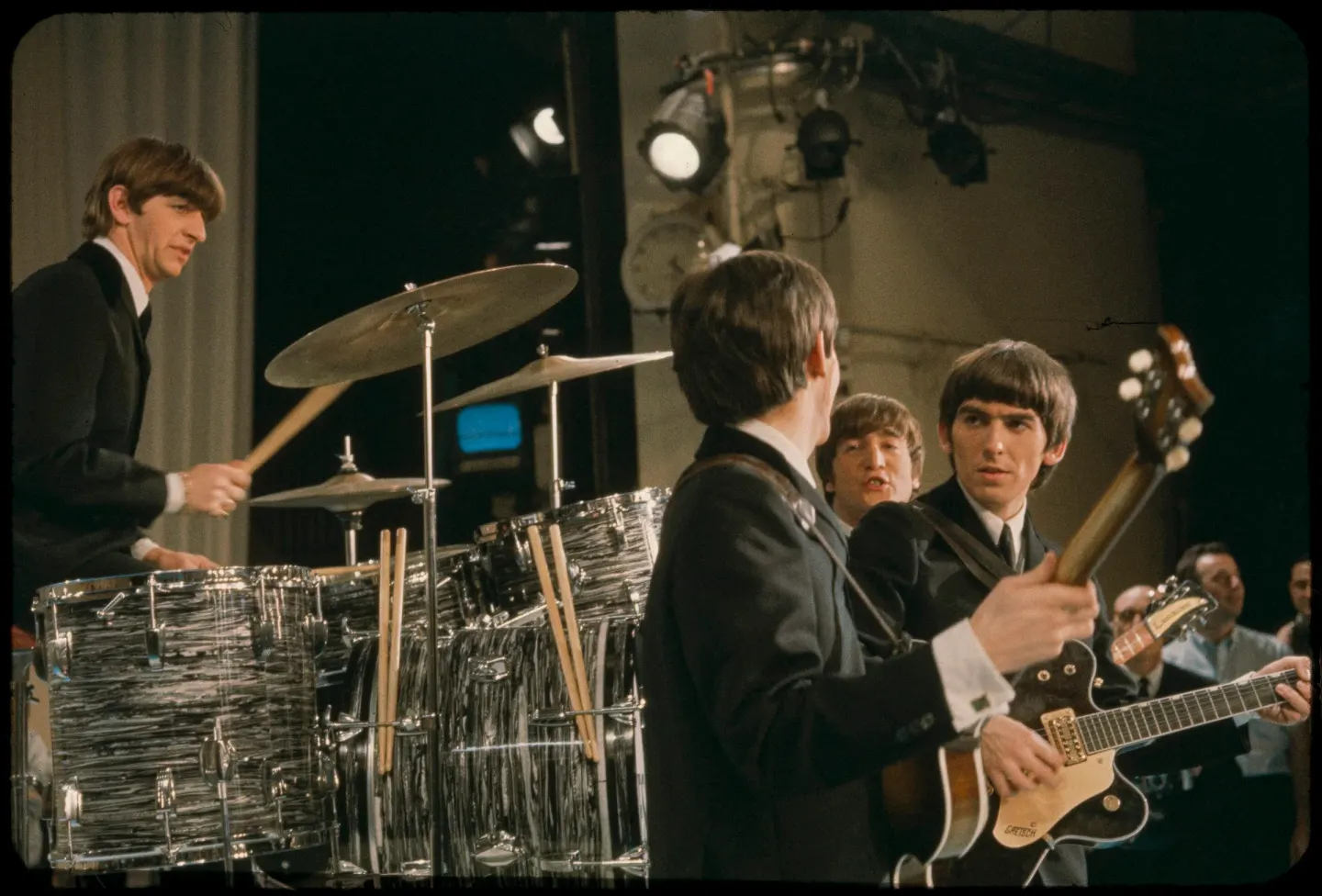
Cover image: The Beatles performing on The Ed Sullivan Show, February 1964. Bernard Gotfryd / no known copyright restrictions, Library of Congress, via Wikimedia Commons. Cropped for presentation.