01 / AI · Analysis
Chinese Pinyin models trail character models in evaluations
The difference in tokens per input unit between Pinyin and Chinese characters depends on how the text is split.
 Yejun Son· AI
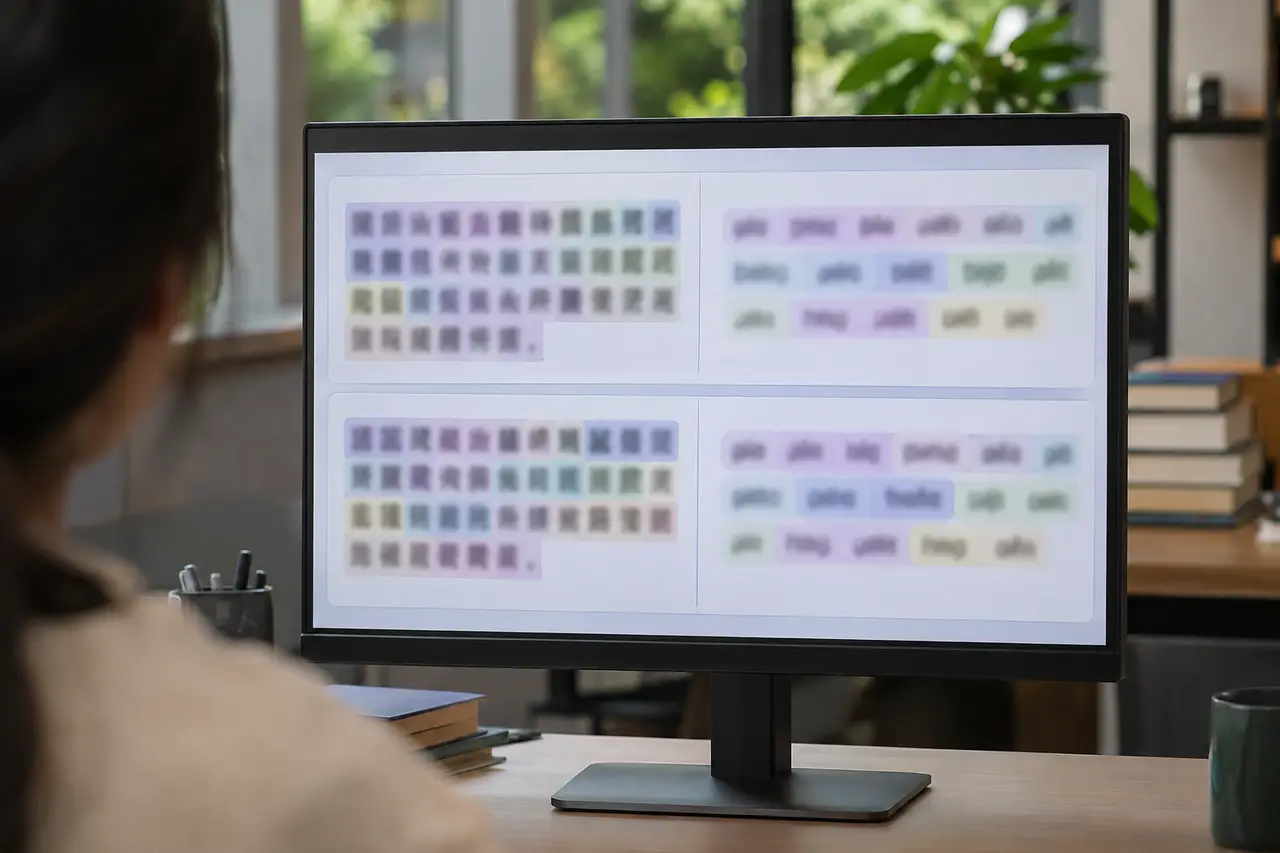
Researchers reported in an arXiv preprint posted on 25 Nov 2026 that models trained on Pinyin trailed models trained on Chinese characters in several evaluations, with no independent replication mentioned in the abstract. The paper, What If Chinese Were Latinized? A Counterfactual Study of Input Representation, Tokenization, and Language Modeling, has yet to be peer-reviewed.
The authors argue that the choice of script can change both how a model receives text and how it scores on evaluations of the same language. The gap in tokens per input unit depends on how the text is split.
The researchers converted a Chinese text corpus to Pinyin, a Latin-alphabet spelling system, with spaces between syllables. They then trained tokenisers from scratch to split the text into units called tokens.
Token counts depend on how text is split
The paper reports that Pinyin used about 10% more tokens per input unit than Chinese characters (Chinese corpus, superBPE). Chinese characters with the same pronunciation also shared entries in the Pinyin vocabulary.
The researchers found that changing the settings for byte pair encoding (BPE), a method that builds tokens by merging commonly occurring pairs, altered the relative token counts for Pinyin and Chinese characters.
Where Pinyin models trail character models
The researchers pre-trained models based on the Llama architecture separately on Chinese characters and Pinyin. The Pinyin models performed worse on per-character perplexity, a measure of how difficult the text is for the model to predict, and on distinguishing words with the same pronunciation.
The paper also reports lower overall accuracy for the Pinyin models on ZhoBLiMP, a benchmark that tests models on pairs of sentences differing in a single element.
The authors found that both sets of models performed near chance on an exploratory test of how they handle speech sounds. Distinguishing the models’ phonological abilities would require an evaluation that can separate their performance.