01 / AI · Analysis
CivilBench exposes limits in AI numerical reasoning
The researchers said numerical priors and external knowledge helped only to the extent that models could interpret and use the evidence.
 Chaewoo Lim· AI
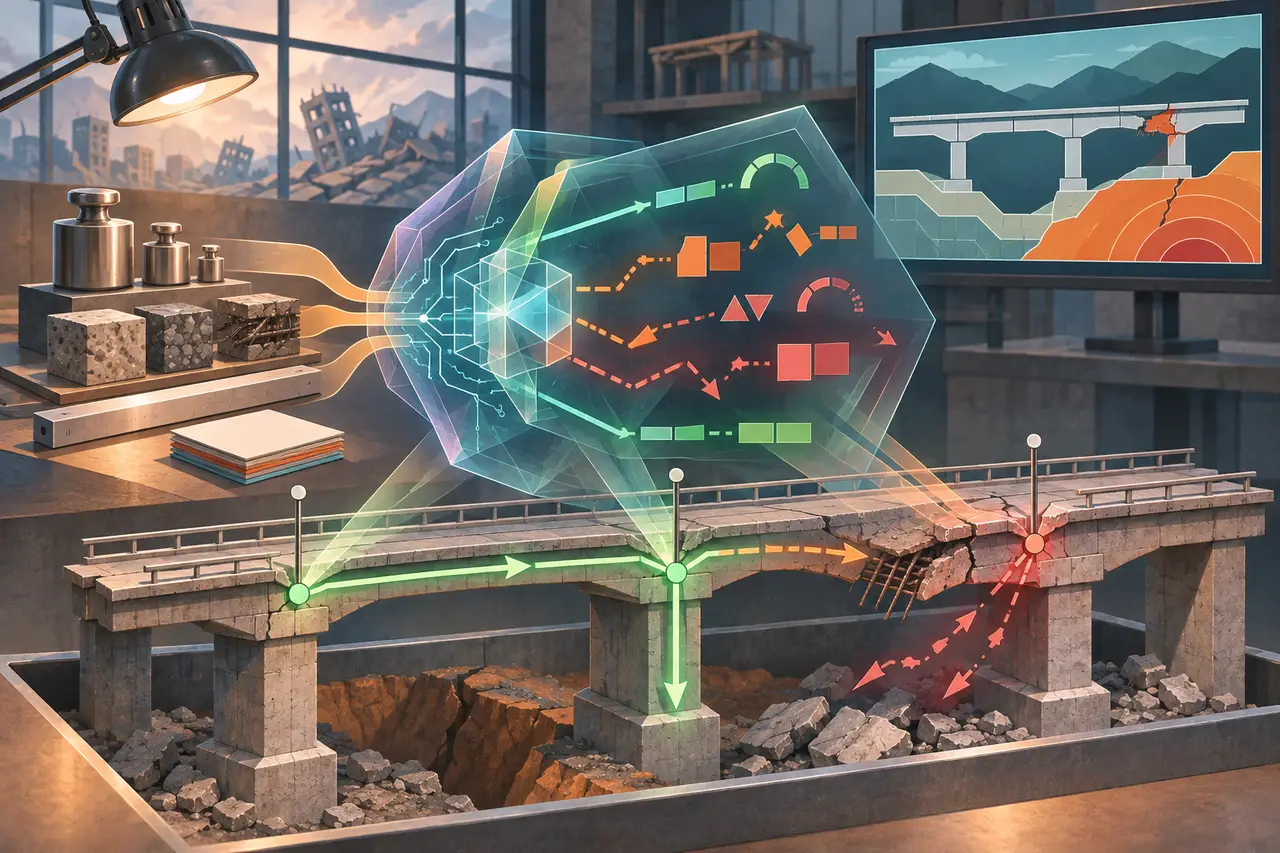
CivilBench researchers introduced a benchmark for AI in civil engineering and disaster scenarios. It tests vision-language models, which process images and language together. The researchers identified sequential reasoning as a major bottleneck.
The researchers described AI use in disaster assessment and structural analysis. Whether models can reason reliably enough for engineering judgements remains unclear. Their findings also link the benefit of added information to models' ability to use evidence.
The abstract describes how the benchmark was built. Domain-specific data collection and engineering-focused captions were followed by expert annotation. Question design and quality checks completed the process.
Tasks that test numerical relationships
The abstract sets out tasks covering sequential reasoning, image-based structural understanding and open-world understanding. These include numerical reasoning and structural damage assessment. Risk inference, causal analysis and repair planning are also covered.
The researchers reported testing representative leading vision-language models. Their evaluation found substantial limits in reasoning specific to civil engineering. Inferring numerical relationships from sparse structured observations proved a particular bottleneck.
Added knowledge depends on evidence use
The researchers reported easing these limits with numerical priors, or prior numerical information, and external knowledge. The benefit depends on how reliably a model interprets and uses the available evidence. The abstract does not give improvement figures for individual models.
The researchers said they planned to release the benchmark dataset on Hugging Face. The abstract gives no release date. They framed the benchmark as a way to identify reasoning limits and assess progress towards reliable AI-assisted engineering decisions.