Breaking01 / AI
AG-JEPA improves early cognitive impairment classification
Researchers reported that learning features of specific brain regions improved diagnosis and disease progression prediction.
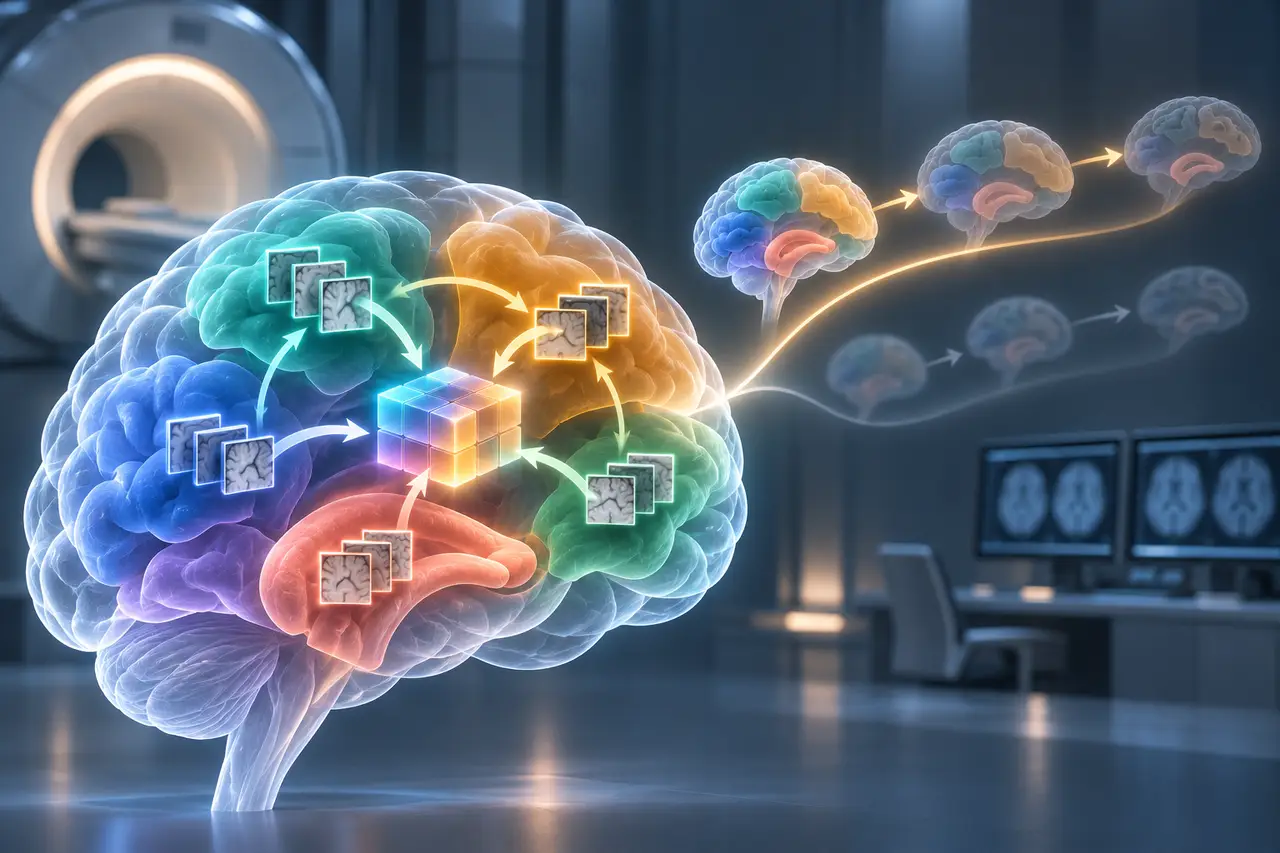
Researchers reported that AG-JEPA improved classification performance by 8.4 percentage points when distinguishing cognitively normal people from those with mild cognitive impairment.
The arXiv abstract published on 16 Nov identifies the metric as AUROC, a measure of how well a model distinguishes between groups across decision thresholds. The gain is a researcher-published benchmark result measured against the strongest comparison model.
According to the abstract, AG-JEPA makes tokens representing brain regions interact with tokens representing image patches during pretraining. This structure aims to learn features of brain regions relevant to neurodegeneration, the progressive loss of nerve cell function.
The researchers also reported that Prog-AG-JEPA models disease progression paths within the same learned feature space. Their published benchmark results put it ahead of all comparison models in predicting future diagnoses and changes in brain volume.
The abstract describes existing Joint Embedding Predictive Architecture (JEPA) models as learning general structural features. It states that these models do not explicitly capture the anatomical regions affected by Alzheimer's disease.
The arXiv abstract does not disclose the name of the strongest comparison model or the absolute AUROC scores.