01 / AI · Analysis
EEGProbe finds an alignment bottleneck in vision models
EEGProbe tests whether vision-language models need brain signals to answer questions and can connect those signals with other forms of information.
 Chaewoo Lim· AI
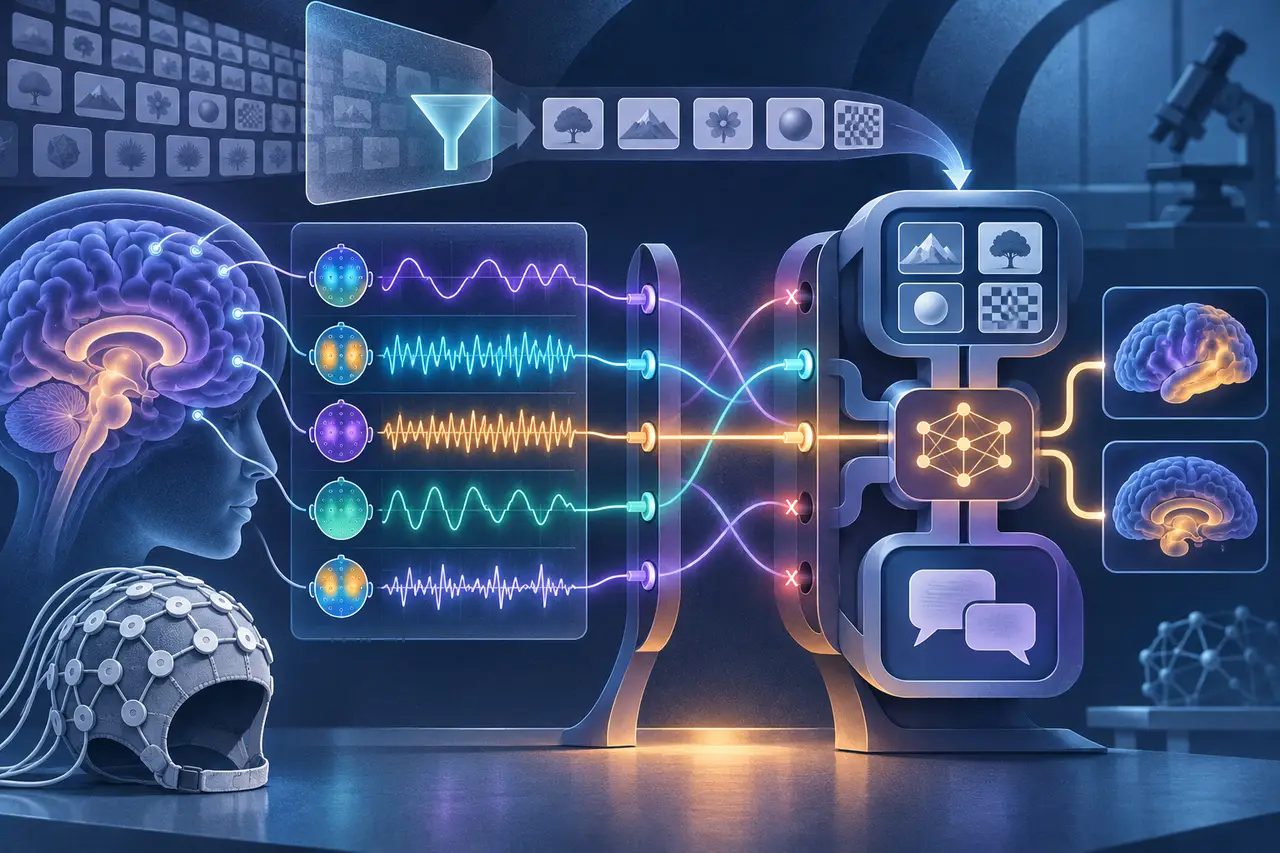
EEGProbe researchers introduced an evaluation of how general-purpose vision-language models understand electroencephalography (EEG), recordings of the brain's electrical activity. It presents models that interpret text and images with 620 EEG-centred questions. The paper reported that GPT-5.6 Sol achieved the highest score, at 41.63%.
The paper examines the gap between general multimodal ability and EEG understanding. It tests whether models extract information from input signals and reason from it. Alongside answer accuracy, it checks whether the EEG is necessary to reach the answer.
The researchers said they designed the evaluation to reduce shortcuts that allow answers without using the signal. Their analysis connects temporal, frequency, spatial and physiological structure with model successes and failures. They also examined whether neurophysiological guidance changes predictions during reasoning.
Testing whether answers require EEG
According to the paper, the evaluation covers signal classification, cross-modal alignment and neurophysiological reasoning. Its questions span 13 subtasks. The recordings retain their temporal structure wherever possible.
The researchers said they minimised signal processing introduced by the evaluation itself. Checks that the EEG is necessary for the answer were followed by expert verification. Models were tested without task-specific feature engineering or EEG-specific adaptation.
The bottleneck in signal alignment
The paper reported applying the same zero-shot evaluation to 11 open- and closed-source models. Zero-shot means models receive no worked examples for the tasks. The researchers identified cross-modal alignment, matching signals with information in other forms, as a major bottleneck.
The researchers reported that neurophysiological guidance during inference can change model predictions. They described it as helping models recognise patterns in the input and connect them with relevant neurological knowledge. The paper presents that connection as a direction for narrowing the gap between general multimodal ability and EEG understanding.