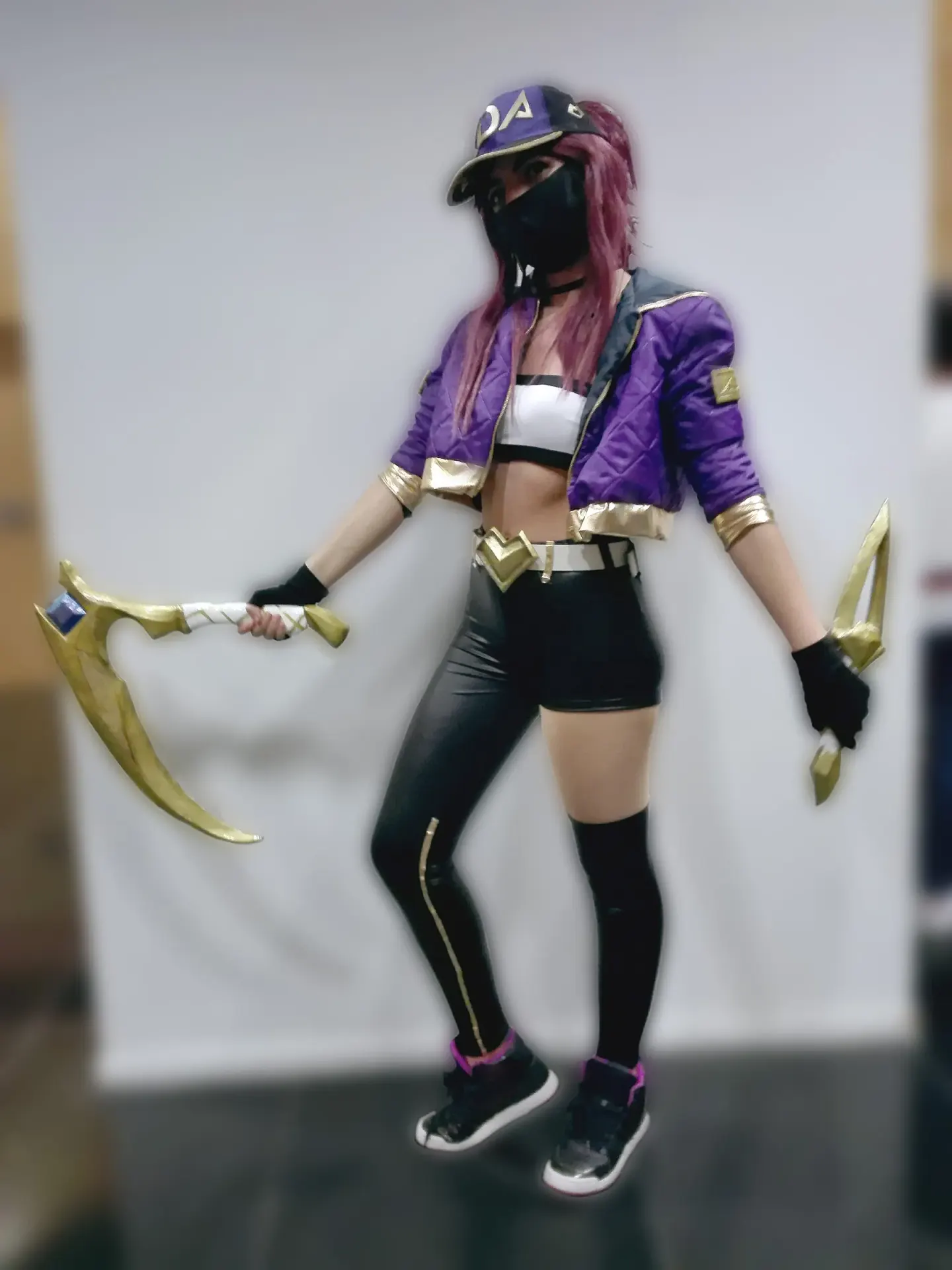
A closer look at the scenes and context surrounding K/DA's music.
K/DA’s central illusion is that four game characters became pop stars. Its real achievement is more interesting: a corporation built a virtual act whose music still depends on unmistakably human friction.
Riot Games introduced K/DA at the 2018 League of Legends World Championship in Incheon, placing augmented-reality versions of Ahri, Akali, Evelynn and Kai’Sa beside Miyeon, Soyeon, Madison Beer and Jaira Burns. Two years later, the five-track ALL OUT EP expanded that experiment into a compact study of how identity can travel between a performer, a voice and an animated body.
This distinction matters in an era that casually labels every synthetic-looking performer “AI.” K/DA is not an autonomous singer and its vocals are not machine-generated. It is a virtual group assembled from human singers, songwriters, producers, choreographers, animators, designers and an existing game mythology. The fantasy works because the labor remains audible.
POP/STARS begins with a voice, not an avatar
The opening seconds of POP/STARS do not ask the listener to understand League of Legends lore. A clipped synth figure clears space for Madison Beer’s cool entrance, then Jaira Burns adds pressure before Miyeon brings melodic lift. Soyeon’s Korean-English rap arrives like a blade changing the song’s temperature.
That sequence establishes K/DA’s best musical principle. The performers are not blended into a frictionless composite. Beer’s controlled glamour, Burns’s sharper attack, Miyeon’s bright stability and Soyeon’s rhythmic authority stay distinct enough to create character before the animation explains who anyone is.
The stage made two kinds of presence compete
At the 2018 Worlds opening ceremony, human singers performed while augmented characters appeared to move around them. The technology offered scale and impossible motion; the people supplied breath, weight and risk. Neither layer replaced the other. The tension between them was the performance.
That is why K/DA remains a useful model for virtual pop. The avatars can cross borders, survive styling changes and inhabit a world larger than any physical stage. But the moment becomes memorable when a specific rapper leans into a consonant or a singer lets a note carry texture the render cannot predict.
THE BADDEST sharpens the silhouette
Released ahead of ALL OUT, THE BADDEST pares the formula toward swagger. Wolftyla and Bea Miller join Soyeon and Miyeon, demonstrating that the characters can accommodate a changing vocal cast. The arrangement is leaner and more percussive than POP/STARS, built around negative space that lets each entrance feel like a pose.
The substitution is also revealing. A virtual member appears stable while the human voice behind that identity can change. K/DA turns casting into part of its production system, closer to theater than to a conventional band. Continuity belongs to the character; interpretation belongs to the performer.
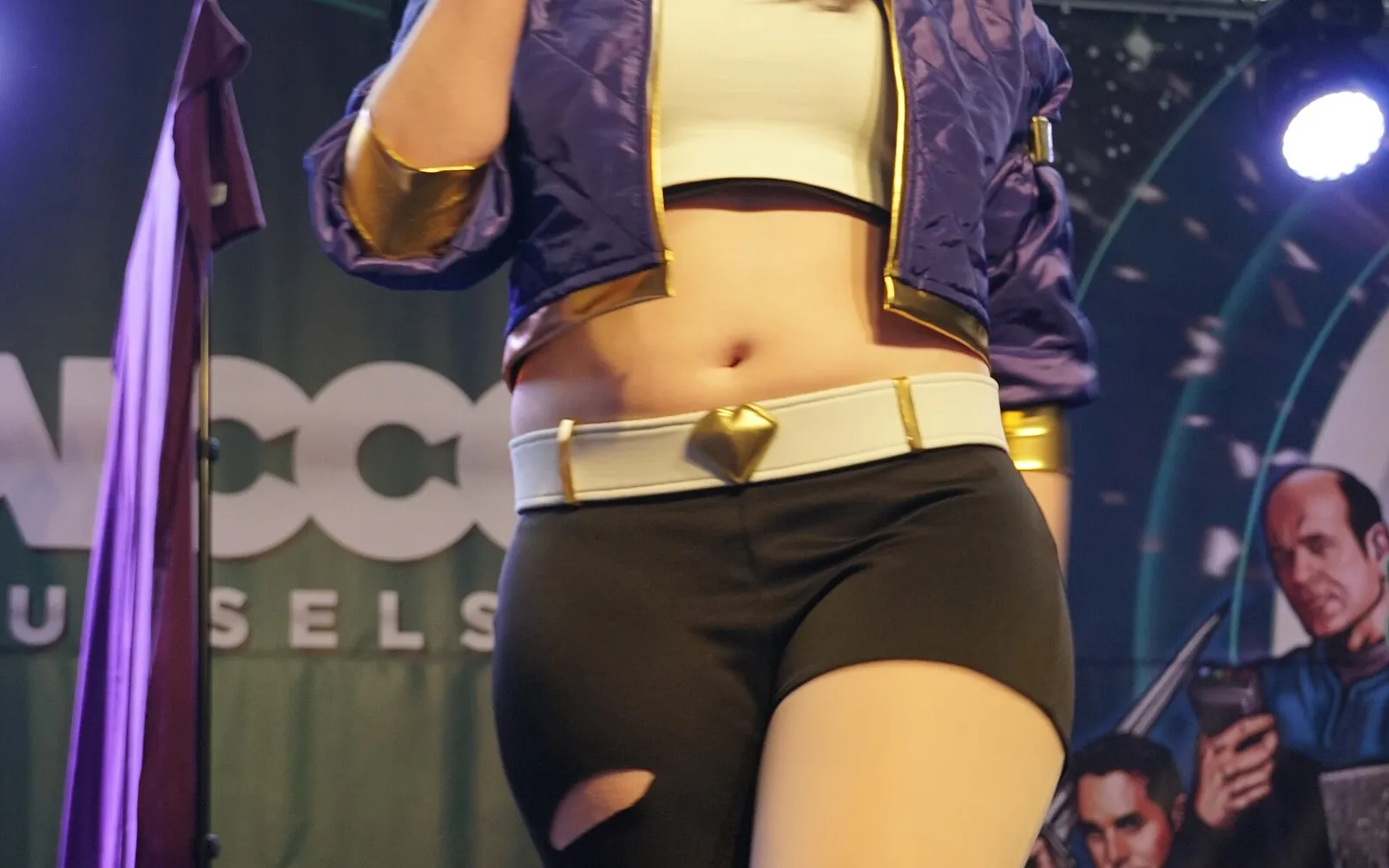
Akali cosplay at Brussels Comic Con 2019. Photo by Miguel Discart via Wikimedia Commons, licensed CC BY-SA 2.0.
MORE turns collaboration into structure
MORE reunites the original quartet and adds Lexie Liu as Seraphine. English, Korean and Mandarin circulate through the track, but the multilingual writing never feels like a tourism brochure. Languages arrive with different rhythmic responsibilities: Soyeon cuts across the beat, Miyeon opens the chorus, Beer and Burns deepen the hook, and Liu creates a suspended bridge.
The production makes room for those identities without losing velocity. Its synth bass is glossy but aggressive; the chorus rises through repetition rather than harmonic surprise. What could have been a crowded brand showcase becomes a relay in which every voice changes the song’s center of gravity.
VILLAIN gives Evelynn the camera
ALL OUT works best when it stops treating the group as a single block. VILLAIN, performed by Madison Beer and Kim Petras, moves into Evelynn’s nocturnal self-image. A crawling bass line and deliberately spacious beat make seduction feel like surveillance.
Beer’s restraint is crucial. She does not oversell menace; she lets consonants harden at the edge of an otherwise polished vocal. Petras answers with a brighter theatricality. Together they reveal why character songs can deepen a virtual group: personality becomes an arranging problem, not merely a costume description.
DRUM GO DUM tests the limits of pure function
Aluna, Wolftyla and Bekuh BOOM drive DRUM GO DUM as a Kai’Sa showcase. It is the EP’s most physical track, designed around command phrases, low-end impact and choreography-ready repetition. The precision is impressive, although the song sometimes behaves more like an immaculate performance tool than a drama with its own emotional stakes.
That limitation appears across the project. K/DA’s songs are engineered to survive trailers, stages, dance videos and game marketing. Their clean modularity is a strength, but it can also make surprise feel scheduled. The best moments occur when a performer exceeds the function assigned to her.
I’LL SHOW YOU makes resilience sound expensive
The closing track brings in TWICE members Jihyo, Nayeon, Sana and Chaeyoung alongside Bekuh BOOM and Annika Wells. Its warmer melody gives Ahri a narrative of recovery, trading the EP’s dominant posture of control for a more conventional anthem of self-belief.
The production is luminous and expertly proportioned, yet its emotional vocabulary is safer than VILLAIN’s. Even so, the rotating cast underscores K/DA’s unusual reach: Korean idol technique, American pop writing and game-world characterization meet inside a project that belongs fully to none of those systems.
The animation is not the authorship
K/DA’s visual polish can obscure how many decisions precede every finished frame. Songwriters define cadence; singers negotiate diction and attitude; choreographers establish physical identity; animators translate motion; creative directors decide which gestures belong to a character. The avatar is the point where those contributions become visible, not the source that generated them.
Calling this process “AI music” would erase the very thing that makes it compelling. K/DA is a coordinated fiction performed by people. Its characters do not replace artists; they reorganize how authorship is credited, marketed and remembered.
A global group built from translation
K/DA’s globalism is not simply a list of nationalities. The project translates between industries with different assumptions: K-pop’s exacting group performance, Western pop’s featured-vocal economy, game publishing’s expandable lore and animation’s control over the impossible body.
Those systems occasionally pull against one another, and the pull is productive. A character must remain recognizable, while a singer needs room to interpret. A game campaign wants instant clarity, while a song needs replay value after the event ends. POP/STARS endures because it satisfies the campaign and then escapes it.
Verdict
ALL OUT is too brief and too strategically polished to become a complete portrait of its virtual stars. Five tracks sketch possibilities that a longer album might have complicated. Its weaker passages confuse efficiency with personality, and its lore sometimes promises more interiority than the songs deliver.
Yet K/DA proved that virtual pop does not need to remove the human in order to expand what a performer can be. The project’s finest songs preserve the seams between voice, character, language and technology. Those seams are not flaws in the illusion. They are where the music lives. Rating: 8.7/10.
Sources: Riot Games and League of Legends official K/DA materials; official Riot Games Music videos; official Spotify release information. Cover photo of Akali cosplay by Alvaro Marques Hijazo via Wikimedia Commons, licensed CC BY-SA 4.0.