
A closer look at the scenes and context surrounding ROSALÍA's music.
On LUX, Rosalía does not decorate pop with sacred imagery. She uses faith as a production method.
Originally released November 7, 2025 through Columbia Records and expanded as LUX (Complete Works) on April 16, 2026, her fourth studio album treats voice, orchestra, choir and language as ways of testing what devotion can hold. The 18-track complete edition is ambitious enough to resemble a cathedral, but its most radical choice is that no single tradition owns the building.
Sexo, Violencia y Llantas begins in contradiction
The opening title places the body, harm and machinery beside one another before the record reaches toward transcendence. Rosalía has always understood that the sacred gains force from contact with the profane. Here, contrast becomes the structural grammar of an hour-long work.
The early sequence moves through orchestral weight, electronic abrasion and vocal detail without treating them as separate worlds. Instead of smoothing the transitions, Rosalía makes the listener hear the distance being crossed. Transformation is not an effect applied at the end. It is the movement between materials.
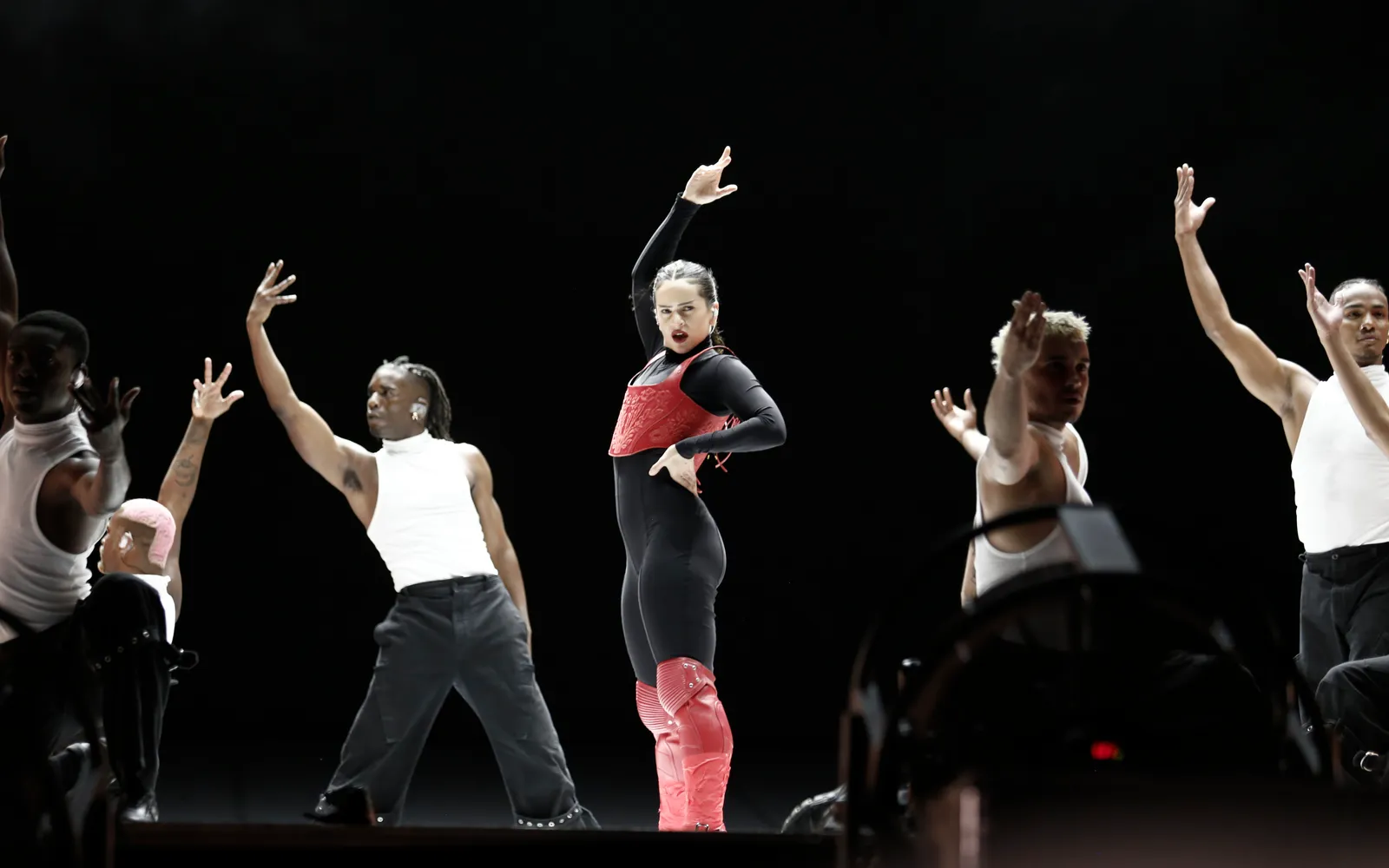
Photo: Rosalía performing at the Zócalo in Mexico City. Secretaría de Cultura CDMX via Wikimedia Commons, licensed CC BY 2.0.
The voice becomes architecture
Recorded with the London Symphony Orchestra and featuring choral ensembles, LUX gives Rosalía's voice an enormous frame. She refuses to become merely the soloist in front of it. Her flamenco-trained turns, breath, rasp and sudden changes of pressure determine how the arrangement moves.
On Reliquia and Mio Cristo Piange Diamanti, the orchestra does not certify importance. It responds to the physical intelligence of the singing. A tiny catch in the voice can redirect a grand phrase. Scale becomes intimate because the body remains audible inside it.
Berghain makes the club and cathedral share a wall
With Björk and Yves Tumor, Berghain stages one of the album's sharpest collisions. Strings accelerate with almost operatic urgency while electronic darkness gathers underneath. The famous club's name suggests secular ritual; the composition keeps pushing that ritual toward prayer, dread and transformation.
Björk's presence opens a different vocal space, while Yves Tumor introduces abrasion that prevents the arrangement from becoming pure beauty. The track does not merge its influences into a polite fusion. It lets them remain unstable enough to change one another.
Thirteen languages reject a single heaven
Rosalía moves across Spanish, Catalan, Italian, Portuguese, German, Latin and other languages throughout the project. The range could have become a display of cosmopolitan authority. Instead, pronunciation and timbre make language another kind of instrumentation.
No translation can fully preserve the sound of a consonant striking a rhythm or a vowel opening into choir. LUX treats that loss as productive. Devotion travels, but it never arrives unchanged. The album's spirituality depends on difference rather than erasing it.
La Perla lets anger enter the sanctuary
Featuring Yahritza y Su Esencia, La Perla turns romantic contempt into one of the album's most direct songs. Its humor and accusation prevent the sacred concept from floating above ordinary harm. A person can study saints and still need language sharp enough for betrayal.
The song's popularity makes sense because its target is clear, but its placement matters more. Rosalía refuses the fantasy that spiritual growth eliminates pettiness, fury or appetite. Illumination is not emotional cleanliness. It is the ability to see contradiction without looking away.
Sauvignon Blanc imagines renunciation
The song strips material abundance toward the possibility of a deeper bond. Its official video places luxury, fire and a sparse desert in the same visual argument. Objects do not simply disappear; they are burned, dropped or left behind so that attachment can be measured.
Rosalía sings with unusual calm, allowing the arrangement to feel like a private vow rather than a manifesto. The restraint gives the song credibility. Renunciation matters because the temptation remains visible.
Flamenco is a method of memory
La Rumba Del Perdón brings Estrella Morente and Sílvia Pérez Cruz into a shared vocal space. The collaboration does not use flamenco as a certificate of origin. It shows tradition as an active argument between singers, histories and ways of placing pain inside rhythm.
That distinction runs through the album. Rosalía's earlier work made flamenco grammar collide with pop production. LUX expands the field, but the core practice remains: listen closely to inherited form, then risk changing what it can contain.
Complete Works changes the map
The 2026 edition adds Jeanne, Novia Robot and a longer Francotiradora version of Dios Es Un Stalker. These additions do more than fill gaps between physical and digital editions. They sharpen the album's tension between mystic biography, technology and surveillance.
Novia Robot is especially useful beside the record's saints and martyrs. The artificial bride is not the opposite of devotion; she is another image of a self designed for someone else's belief. The complete sequence makes modern systems feel as ritualized as ancient ones.
Where grandeur becomes instruction
An album this conceptually organized sometimes tells the listener how much significance to feel. Choral scale, religious reference and orchestral climax can arrive before a song has developed its own emotional necessity. A few movements function more convincingly as architecture than as independent compositions.
Yet excess is central to the project. LUX asks whether contemporary pop can sustain a work this learned, multilingual and unapologetically devotional without reducing it to aesthetic. Its unevenness is partly the sound of that question remaining open.
Verdict
LUX (Complete Works) is Rosalía's most demanding and generous album because it refuses to treat universality as sameness. Saints, lovers, machines, orchestras, clubs and choirs occupy the same work without surrendering their difference.
The album's achievement is not that it makes pop sound classical or religion sound modern. It builds a form where those categories become temporarily insufficient. Rosalía creates a cathedral with too many doors for one doctrine, then makes her voice the light moving between them. Rating: 9.2/10.
Sources: Rosalía and Sony Music official release materials; official Spotify album and artist information; official Rosalía videos; Associated Press coverage of LUX. Cover photo by Junta de Andalucía via Wikimedia Commons, licensed CC BY-SA 2.0.