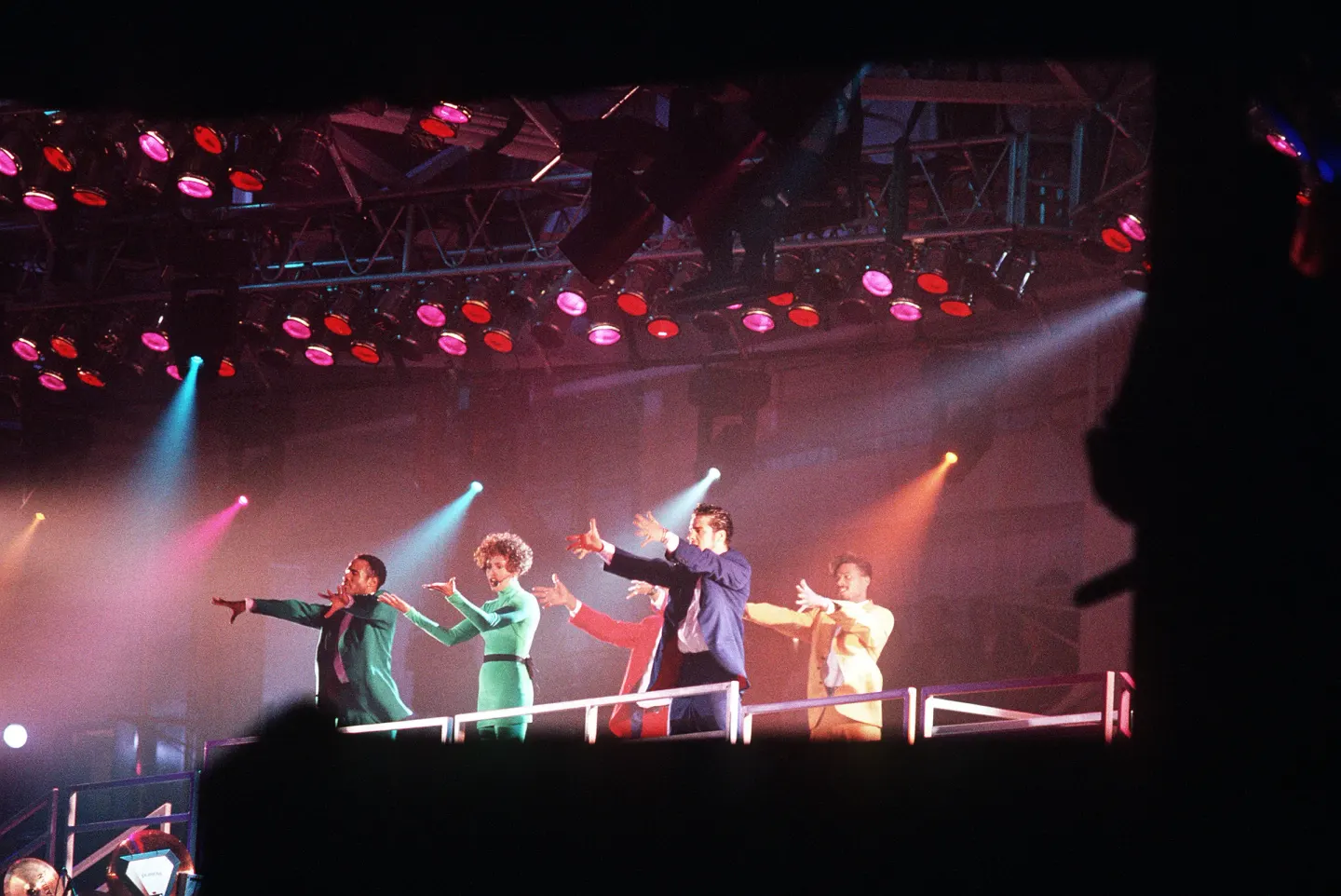
A closer look at the scenes and context surrounding Whitney Houston's music.
Whitney Houston is often remembered as a summit: the impossible note, the immaculate gown, the anthem rising above a stadium. But a summit is a poor place from which to understand a singer. Houston's greatness lived in the path between notes—the breath withheld, the consonant softened, the phrase delayed until a familiar lyric became a private discovery.
She possessed overwhelming vocal power, yet power alone does not explain why her records remain intimate. The central achievement of her career was translation. She carried the timing, testimony and improvisational intelligence of the Black church into pop arrangements engineered for the widest possible audience. In doing so, she changed the standard by which mainstream singing was judged.
That translation brought historic success and difficult questions. The industry presented Houston as a universal star while often muting the cultural specificity that made her voice possible. Her career is therefore not only a story about technique. It is about who gets called pop, what crossover asks an artist to surrender, and how one voice can exceed every frame built around it.
The church taught her that a melody is a conversation
Born in Newark in 1963, Houston grew up inside an extraordinary musical network. Her mother, Cissy Houston, was a formidable gospel and session singer; Dionne Warwick was her cousin; Aretha Franklin was a family friend. At New Hope Baptist Church, singing was not merely the accurate delivery of pitch. It was communication among soloist, congregation, text and spirit.
That environment trained the quality later mistaken for effortless instinct. Houston learned how to approach a note from below, bend a vowel without losing the word, and repeat a line with altered meaning. Gospel phrasing made melody elastic. It also taught restraint: testimony becomes less convincing when every sentence arrives at maximum intensity.
As a teenager, she sang backing vocals and appeared on recordings by artists including Chaka Khan. Session work placed her close to professional arrangement—the discipline of serving a song, finding a register that supports another voice and making precision sound spontaneous.
The debut makes virtuosity feel welcoming
Whitney Houston, released in 1985 after a long development process, introduced a singer whose scale was immediately apparent. Yet the album's craft lies in how carefully that scale is rationed. “You Give Good Love” opens with warmth rather than spectacle. Houston shapes each phrase as if testing whether trust can be granted.
On “Saving All My Love for You,” she inhabits a morally compromised romance without turning the character into either victim or villain. The vocal is conversational, even conspiratorial. Small slides and breaths reveal self-deception before the climactic notes expose the emotional cost.
The album's polished production was designed for adult contemporary, R&B and pop radio at once. That breadth helped make Houston a phenomenon, but it also established the argument that would follow her: whether crossover polish expanded Black artistry or concealed its sources. Her singing repeatedly answers by smuggling the church back into the center of the arrangement.
How Will I Know puts joy inside exact architecture
“How Will I Know” is bright enough to be mistaken for simple. Its synthesizers, electronic drums and color-block video belong unmistakably to mid-1980s pop, but Houston's rhythmic choices prevent the song from becoming mechanical. She places syllables slightly behind the beat, then snaps into the chorus with athletic clarity.
The lyric asks a vulnerable question; the performance turns uncertainty into motion. Houston does not erase doubt with confidence. She makes dancing the physical form of wondering. Her ad-libs near the end do not merely decorate the hook—they show the question growing too large for the written melody.
Greatest Love of All reveals her gift for escalation
Houston's version of “Greatest Love of All” begins almost formally. The opening lines are delivered with patient diction, allowing the message to stand before vocal display arrives. Each return adds weight: a fuller tone, a higher register, a longer release.
This architecture became one of her signatures. She could make a modulation feel not like a production device but like a conclusion the body had earned. Countless later singers copied the climax; fewer copied the discipline that gives the climax meaning.
Whitney turns a voice into an event
Her second album, Whitney, entered the American album chart at number one, a first for a female artist according to her official biography. Its opening stretch extends the debut's reach while making Houston more rhythmically assertive.
“I Wanna Dance with Somebody (Who Loves Me)” is frequently treated as uncomplicated celebration. The parenthetical phrase is the emotional key. She wants the dance, but she wants it to signify mutual recognition. The track's exuberance is edged by loneliness, and Houston keeps both feelings active.
Listen to how she alternates clean melody with rougher exclamations. The famous voice is not a marble object. It laughs, pushes, pleads and momentarily frays. Perfection becomes persuasive because she lets personality disturb it.
Seven consecutive number ones created a dangerous standard
From “Saving All My Love for You” through “Where Do Broken Hearts Go,” Houston achieved seven consecutive number-one singles on the Billboard Hot 100. The record confirmed extraordinary public connection, but success of that scale can narrow an artist's permitted future. Every release is expected to repeat certainty.
The commercial machine increasingly presented Houston as a standard of flawlessness: poised, elegant, technically invulnerable. That image opened doors for a Black woman at the absolute center of global pop. It also made ordinary complexity look like failure. An audience taught to expect transcendence can become impatient with the human labor underneath it.
Pop crossover carried the politics it claimed to escape
Some Black listeners and critics felt Houston's early material was calibrated too carefully for white radio. The criticism cannot be dismissed, because the recording industry has a long history of rewarding Black artists when their work is made legible to white markets. Nor should it be simplified into a claim that polished pop is culturally inauthentic.
Houston's 1989 Soul Train Awards appearance, where parts of the audience reportedly reacted coolly when her name was announced, has become emblematic of this tension. What mattered was not a single crowd response but the industry's habit of placing an artist in a false choice between Black belonging and global ambition.
Her later work would engage contemporary R&B more explicitly, but the Black musical intelligence was never absent. It lived in phrasing, call and response, melisma, tonal grain and the knowledge that a lyric can become testimony.
I'm Your Baby Tonight brings the rhythm forward
For I'm Your Baby Tonight, Houston worked with producers including L.A. Reid and Babyface, moving toward new jack swing and a harder R&B pulse. The title track lets her attack the beat with clipped authority, proving that her musicianship was not confined to ballad time.
“All the Man That I Need” begins in controlled solitude and rises toward church. Houston repeats the title until romantic dependency becomes something closer to spiritual declaration. The performance demonstrates her ability to alter genre from inside a phrase.
The album is sometimes described as a corrective to her pop image. More usefully, it shows that the categories had always been inadequate. Houston did not become an R&B singer in 1990. She made the production frame catch up with dimensions already present in her voice.
The national anthem becomes a study in communal time
At Super Bowl XXV in 1991, during the Persian Gulf War, Houston performed “The Star-Spangled Banner” over a pre-recorded orchestral and vocal track, singing live into the stadium atmosphere. The arrangement, by John Clayton, broadened the meter and gave the melody room to breathe.
Houston does not rush toward the high notes. She makes each clause feel collectively owned, then releases the final ascent with a brightness that cuts through ceremony. The performance became a major recording in its own right because it joined technical command to a complicated national moment.
Its enduring force should not prevent critical context. Patriotism during wartime is never politically neutral. Still, Houston's performance demonstrates how an inherited song can be remade through Black vocal language—less a museum piece than an act happening among bodies in real time.
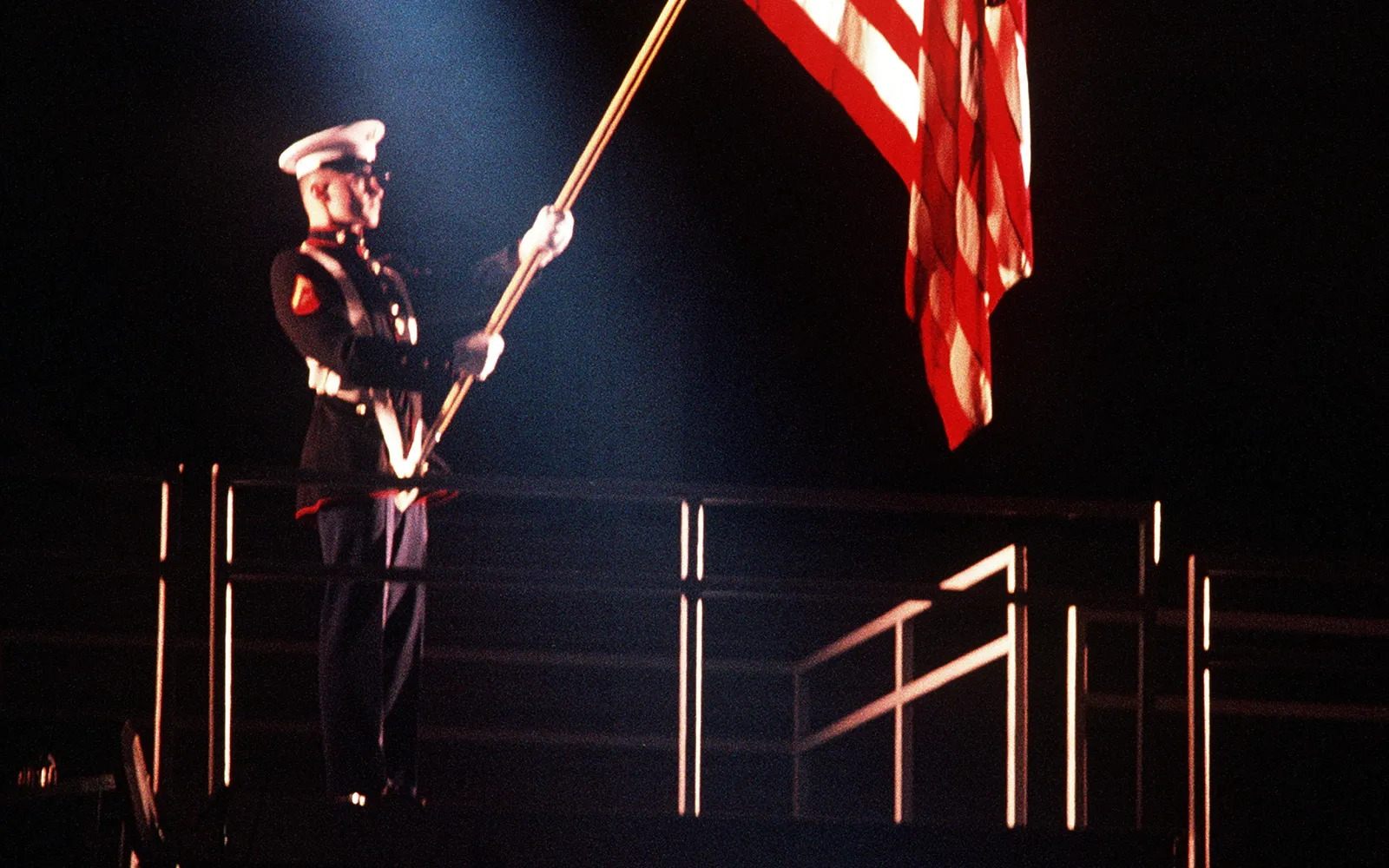
Whitney Houston performing during the 1991 Welcome Home Heroes concert in Norfolk, Virginia. Photograph by PH2 Mark Kettenhofen via DefenseImagery and Wikimedia Commons; public domain as a work of the United States federal government.
The Bodyguard turns interpretation into authorship
Houston's film debut in The Bodyguard made her image and voice part of one enormous global event. The soundtrack is often discussed through sales records, but its more interesting achievement is interpretive authority. Houston did not write “I Will Always Love You”; Dolly Parton did. Yet Houston rebuilt the song's dramatic scale so completely that her version became a distinct cultural object.
The opening is a cappella. No instrument protects the entrance, and every breath is exposed. Houston sings softly, almost privately, establishing departure before the arrangement arrives. When the drums finally enter after the key change, the impact depends on everything she has refused to spend.
The performance is famous for its climax, but the first minute contains the thesis of her art: power is the control of distance. She can sound beside the listener, then fill the horizon without losing the individual word.
I Have Nothing makes dependency physically legible
“I Have Nothing” offers the sort of grand ballad that can invite empty display. Houston prevents that by treating the lyric as an argument with escalating stakes. She begins with terms—accept me, do not change me—then allows the voice to reveal how little bargaining power the speaker actually has.
Her sustained notes remain connected to consonants and thought. The technical feat does not pause the drama; it is the drama. When she opens into the chorus, the size of the sound communicates the terror of having no emotional reserve.
I'm Every Woman makes celebration collective
Houston's cover of Chaka Khan's “I'm Every Woman” carries a circular history: she had sung backing vocals on Khan's “I'm Every Woman” era as a teenager, and now reintroduced the song within the biggest soundtrack of its time. She names Khan at the end, turning homage into audible credit.
The recording is not a solitary claim to universality. Background voices, dance rhythm and call-and-response structure make identity communal. Houston's star power expands because she shares the frame.
Film gave Black women's interior lives blockbuster space
After The Bodyguard, Houston helped bring Waiting to Exhale to the screen, acting within an ensemble centered on Black women's friendship, work and romantic disappointment. “Exhale (Shoop Shoop),” written and produced by Babyface, is a model of mature restraint. Its repeated “shoop” acknowledges the point at which language stops solving pain.
The Preacher's Wife returned her directly to gospel. The soundtrack allowed devotional repertoire and mainstream scale to meet without disguise. For an artist so often framed as having crossed away from the church, the project makes clear that the church remained home.
My Love Is Your Love lets the grain change
By 1998, pop and R&B production had shifted dramatically. My Love Is Your Love places Houston with collaborators including Wyclef Jean, Rodney Jerkins, Missy Elliott and Lauryn Hill. Rather than preserve her voice in an adult-contemporary case, the album lets it meet programmed rhythm, hip-hop cadence and a rougher emotional surface.
“Heartbreak Hotel” shares space with Faith Evans and Kelly Price, making betrayal a conversation among women rather than a solo showcase. “It's Not Right but It's Okay” turns judgment into dance-floor self-possession. Houston bites into the rhythm; the clipped phrasing is as important as any high note.
On the title track, her lower register carries weather and ease. The voice is no longer sold as untouched. It sounds lived in, and the record gains depth by allowing experience to alter beauty.
When You Believe rejects the imaginary contest
Houston's duet with Mariah Carey arrived after years of media narratives that treated major female singers as natural rivals. “When You Believe” does not erase the differences between them. Houston's grounded authority and Carey's agile brightness remain distinct, then converge.
The duet matters because vocal greatness is not a tournament. Their interaction shows technique as listening: leaving room, matching intensity and knowing when harmony communicates more than escalation.
Public struggle distorted the way audiences listened
Houston's marriage, substance use, health and television appearances became objects of relentless scrutiny. Any honest career account must acknowledge the damage without turning it into entertainment. Addiction is not a moral plot twist, and a person's decline does not exist to make earlier triumphs more cinematic.
The tabloid frame encouraged listeners to inspect every later performance for evidence of loss. That habit can prevent us from hearing adaptation. Voices change through age, use, illness and circumstance. Later Houston could not always reproduce the ease of her peak, but music is not valid only when the body behaves as an archive of its younger self.
The humane critical question is not whether she remained invulnerable. It is what expression remained available, what conditions constrained it and why the public demanded that a woman marketed as perfect perform her suffering on command.
I Look to You hears endurance instead of restoration
Houston's 2009 album I Look to You was presented as a comeback. That word can be cruel because it implies a return to an earlier body. The more moving moments do something else. The title song and “I Didn't Know My Own Strength” make survival audible without pretending the intervening years did not happen.
Her tone is darker and more limited, yet limitation creates new emphasis. She leans on text, rhythmic placement and earned gravity. The album is strongest when it does not ask the listener to compare decibels across decades.
Live performance shows the intelligence behind the instrument
Studio recordings can make Houston's precision seem engineered into existence. Live footage corrects that impression. She changes melodies, redirects background singers, plays with audience response and adjusts dynamics to the room. The famous instrument was guided by a fast arranging mind.
Her 1994 performances in South Africa, her gospel appearances and the 1991 Welcome Home Heroes concert reveal different relationships between form and freedom. A song was never a fixed obstacle course. It was a structure she could inhabit differently each night.
Melisma became a language—and then a cliché
Houston's influence is audible across pop, R&B, gospel and televised singing competitions. Generations learned from her runs, register transitions and climactic architecture. Inevitably, the surface features were easier to copy than the musical logic beneath them.
A run is not expressive because it contains many notes. In Houston's best singing, ornament clarifies the emotional pressure of a word. She maps harmony while changing tone and intensity. Imitation becomes empty only when agility is separated from narrative.
Her true lesson is therefore not “sing bigger.” It is to make every technical choice answer a dramatic question.
The recordings outlive the myth of effortlessness
Houston died in 2012 at forty-eight. Posthumous documentaries, live albums, remixes and a biographical film have continued to reorganize her legacy. The danger is that each new frame turns a complicated artist into either saint or cautionary tale.
The records resist both reductions. They contain calculation, collaboration, commercial strategy, cultural pressure, delight, fatigue and astonishing craft. They also preserve work by songwriters, producers, arrangers, background singers and musicians whose contributions made the apparent singularity possible.
Whitney Houston did not simply possess “The Voice.” She made thousands of decisions about how a voice could carry a word across social and musical distance. She taught mainstream pop to hear gospel technique as universal while never allowing that technique to become culturally empty.
Her most enduring performances begin before the enormous note and continue after it. They live in the breath that prepares the leap, the silence that gives it scale and the return to earth that makes transcendence human. Cover Story rating: 9.9/10.
Sources: Whitney Houston's official biography, catalogue and film pages; official Whitney Houston videos; official Spotify recordings; Rock & Roll Hall of Fame artist materials. Cover and inline photographs by PH2 Mark Kettenhofen via DefenseImagery and Wikimedia Commons, public domain in the United States as works of the federal government.